



Key Takeaways
- Start with the layout: a straight run is simplest, an L-shape adds prep space, and an island with bar seating keeps the cook social.
- Non-negotiables: a quality built-in grill, weatherproof storage, and a counter that laughs off sun and chlorine (porcelain, granite, or concrete).
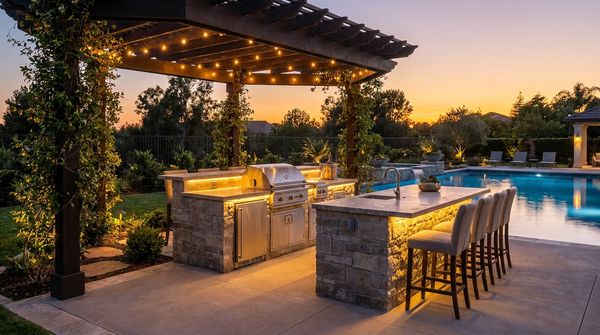
- Put the bar seating facing the pool — the cook stays in the party, not stuck facing a wall.
The pool draws everyone outside; the outdoor kitchen keeps them there. Nothing extends a backyard's usefulness like being able to cook, serve, and hang out without trekking indoors. Build it right and it becomes the heart of every summer weekend — build it wrong and it's an expensive grill surround that rusts by the second season. After years designing outdoor living spaces, here's how the best outdoor kitchen ideas actually come together, and exactly where we'd spend and save.
Nail the layout first
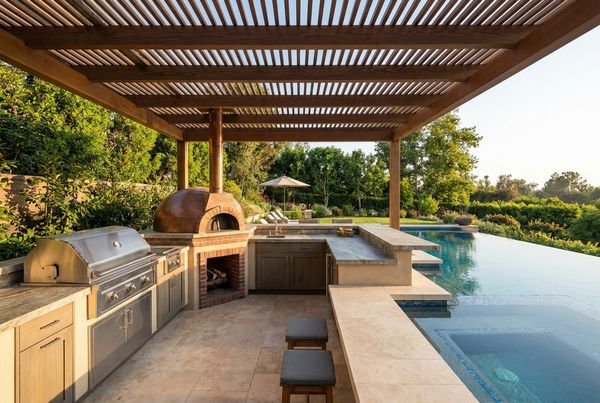
Before you fall in love with appliances, settle the shape. The layout dictates how the space flows, how many people can gather, and how much it costs — and it's nearly impossible to change once the masonry is set. There are four layouts worth knowing, and each suits a different backyard.
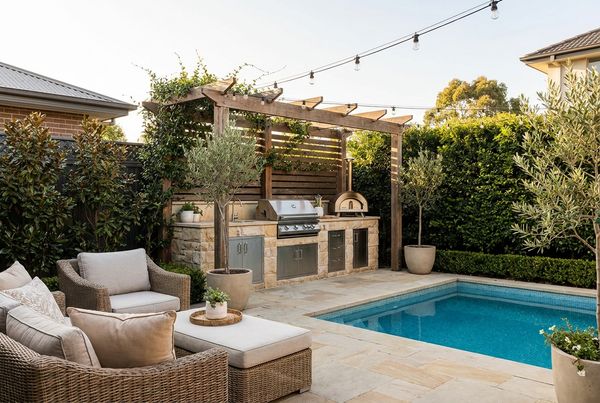
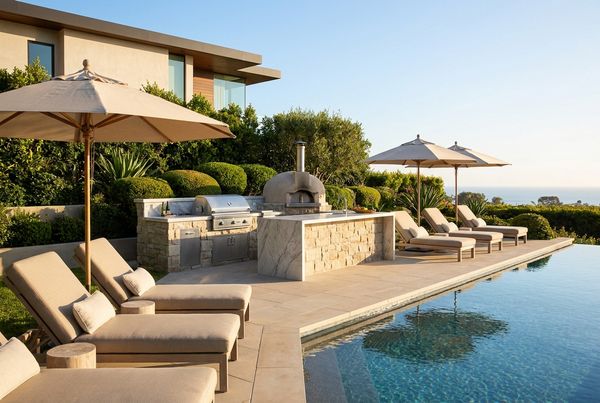
- Straight run: grill, counter, and storage in a single line against a wall or fence. It's the simplest and cheapest way to build, and for a compact patio it's often the smartest.
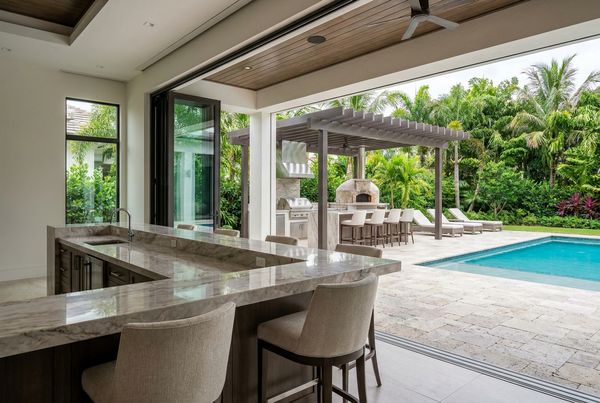
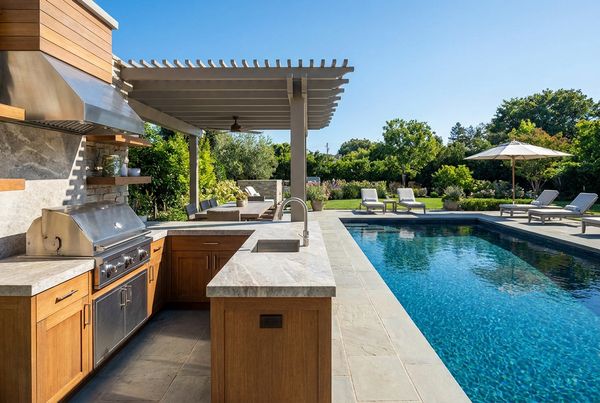
- L-shape: adds a second run of counter perpendicular to the first, which means real prep space and a defined cooking zone. This is our most-recommended layout for most backyards — it works hard without eating the whole patio.
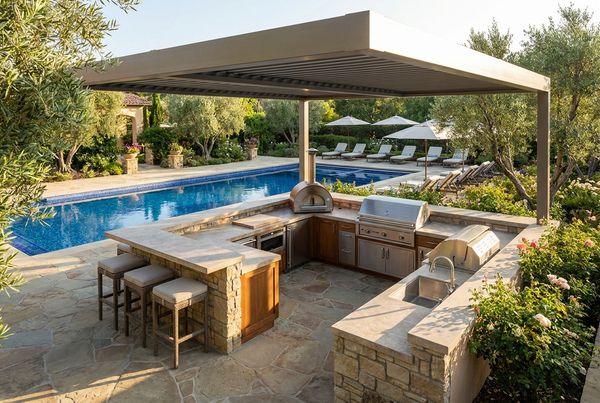
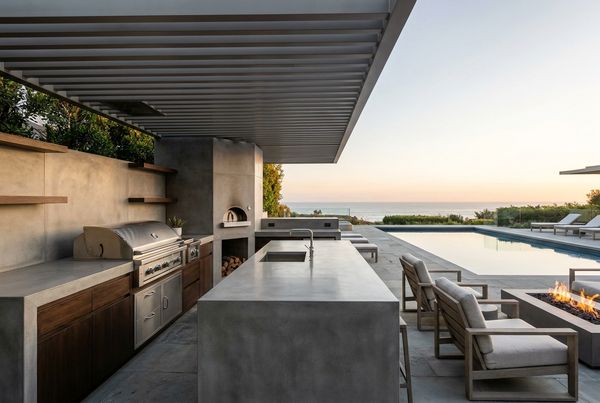
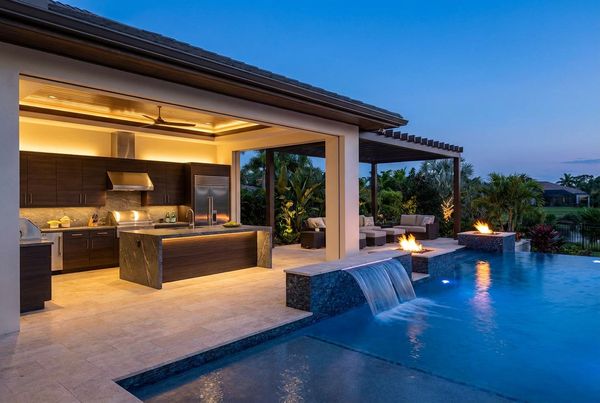
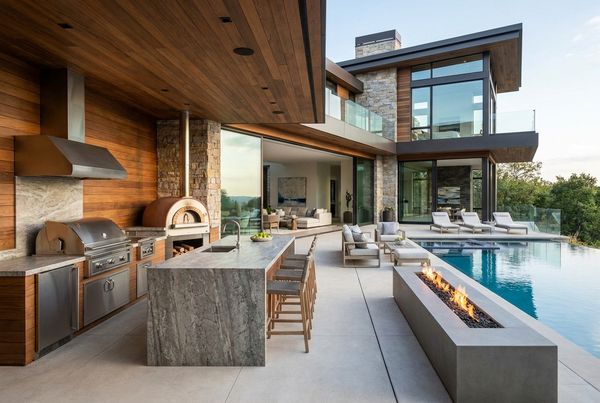
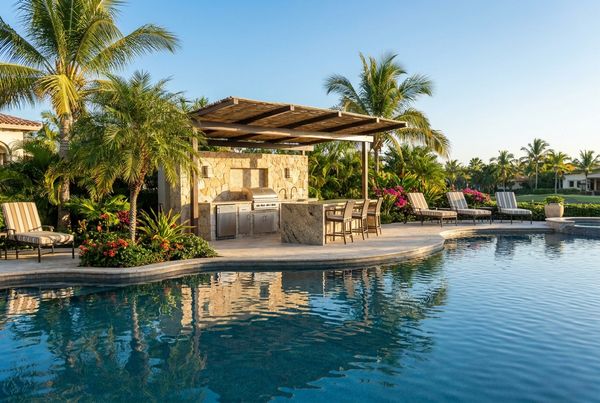
- Island with bar seating: the social choice. Guests sit at a raised bar facing the cook (and the pool) while food happens. Nothing keeps a party together better.
- U-shape / full kitchen: three runs of counter for serious entertainers with the space and budget — grill on one wall, prep and sink on another, storage and fridge on the third.
| Layout | Best for | Prep space | Relative cost |
|---|---|---|---|
| Straight run | Small patios, tight budgets | Limited | $ |
| L-shape | Most backyards | Good | $$ |
| Island with bar | Entertainers who want a social cook | Moderate | $$–$$$ |
| U-shape / full | Large yards, frequent hosting | Excellent | $$$$ |
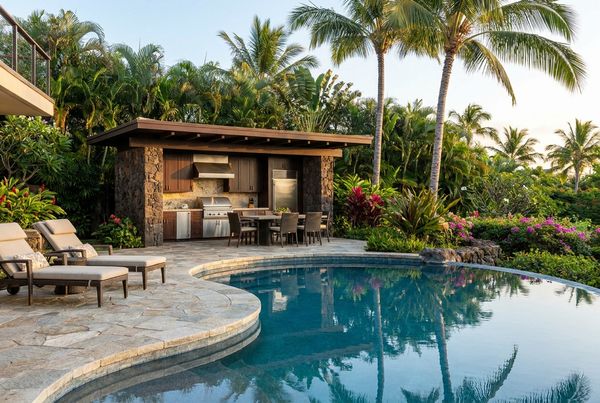
Whatever the shape, orient the cooking and bar seating toward the pool so the cook stays part of the action instead of facing a wall.
The appliances worth building in
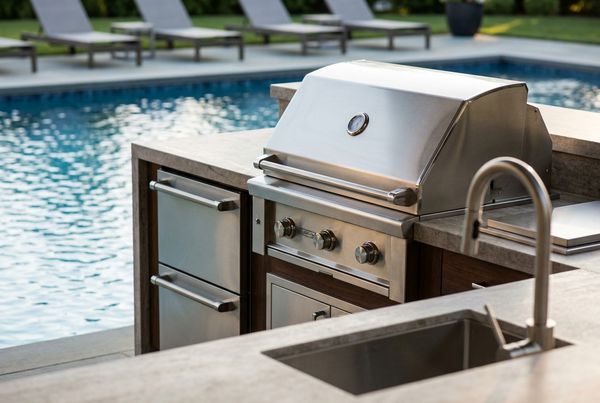
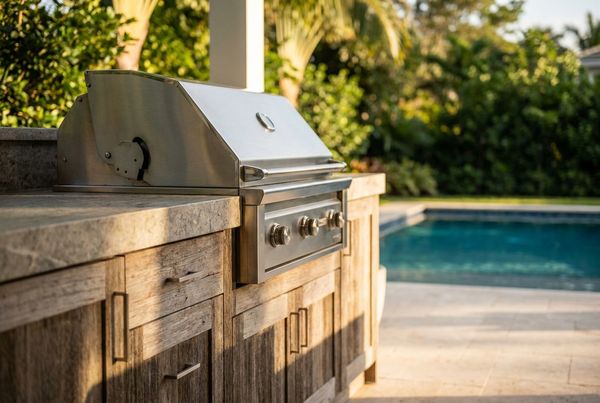
A quality built-in grill is the anchor of the whole kitchen, and it's the one place we'd never cut corners. A cheap grill warps, flares, and rusts; a good one cooks evenly for a decade. Buy 304 stainless, size the burners generously, and match the grill width to how many people you actually feed.
From there, the high-value add-ons are the ones that earn their footprint every cookout:
- Side burner — for sauces, sides, boiling corn, and anything you'd otherwise run inside for.
- Beverage or ice fridge — this saves endless trips to the house and is quietly the most-appreciated appliance we install.
- Sink — genuinely useful for prep and cleanup, but it means running water and drainage, so decide early.
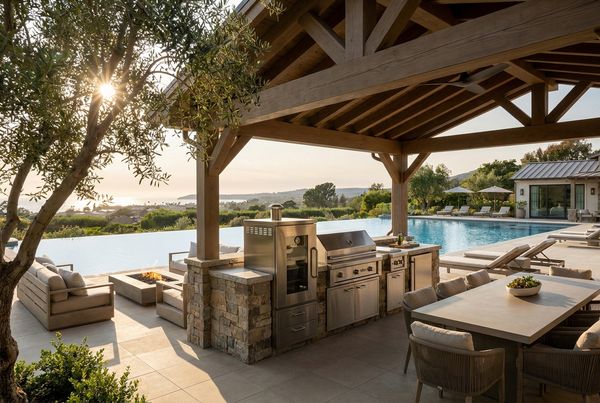
- Pizza oven — trending hard, genuinely fun, and a magnet for guests. Gas ovens are convenient; wood-fired ones deliver the theater.
- Smoker — for the low-and-slow crowd, a built-in or drop-in smoker is a real draw.
Everything else — warming drawers, kegerators, teppanyaki plates — is a nice-to-have. Get the grill and the fridge right first.
Countertops that survive sun and chlorine
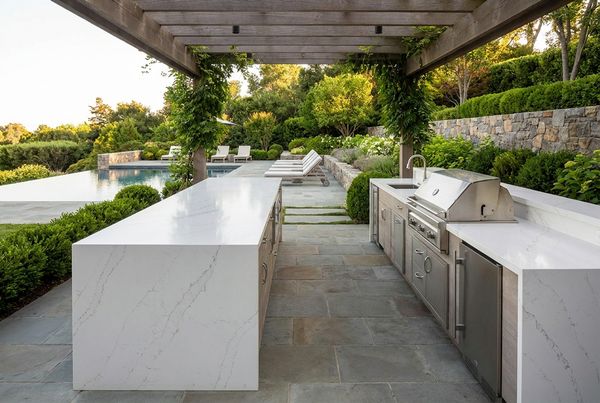
Sun, splashing, and pool chemicals are brutal on surfaces. Poolside, your counter takes UV all day, salt or chlorine spray, and the occasional dropped cast-iron pan. Three materials handle it well: porcelain, granite, and sealed concrete.
| Material | Look | UV / heat | Upkeep |
|---|---|---|---|
| Porcelain | Modern, uniform, large-format | Excellent — won't fade | Very low, no sealing |
| Granite | Natural, classic | Excellent | Seal periodically |
| Sealed concrete | Custom, industrial | Very good | Reseal every few years |
| Standard quartz | Indoor look | Poor — yellows in sun | Not recommended outdoors |
| Marble | Luxe but delicate | Stains and etches | Not recommended outdoors |
Porcelain is our modern favorite — it never fades, shrugs off heat and chemicals, comes in huge slabs for that seamless waterfall edge, and needs essentially no maintenance. Granite is the timeless choice: nearly bulletproof outdoors as long as it's sealed. Sealed concrete gives you a custom, cast-in-place look and integral drainboards, but plan to reseal it. Skip standard indoor quartz (it yellows in direct sun) and most marble (it stains and etches) — and if you love a quartz look, confirm the specific product is rated for outdoor UV.
Cabinetry and the bones underneath
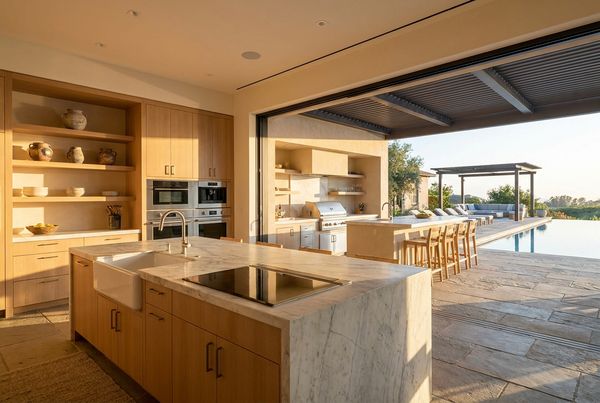
The part nobody photographs is the part that determines whether your kitchen lasts. Wood cabinetry belongs indoors; outside, it warps and rots. Build the carcass from marine-grade polymer, powder-coated aluminum, stainless steel, or masonry (block faced with stone, stucco, or porcelain tile). Any of these will outlive the appliances.
Then plan the storage like you mean it: sealed drawers for tools, a trash and recycling pull-out so bins aren't sitting in the sun, and a spot for propane if you're not on natural gas. And here's the detail that separates a kitchen that lasts from one that fails — run gas, water, and power during construction. Trenching a finished patio to add a line later is the single most expensive mistake we see. Stub in more than you think you need.
Covered vs. open: the shade decision
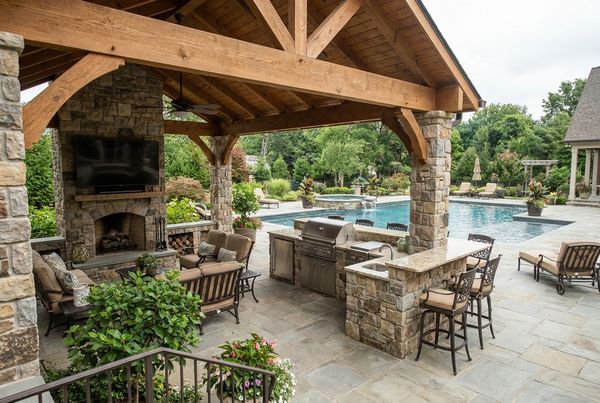
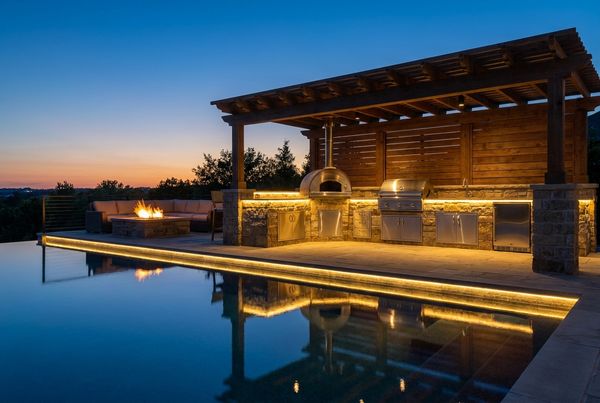
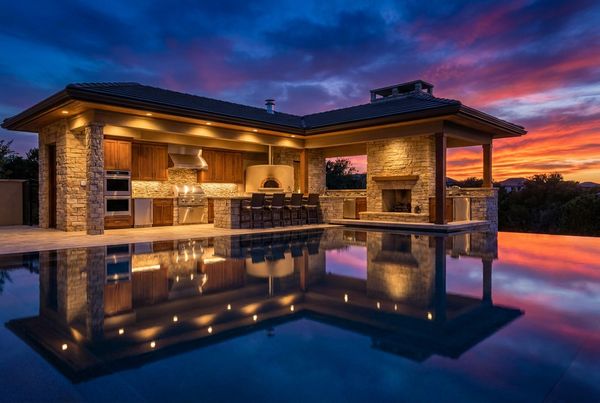
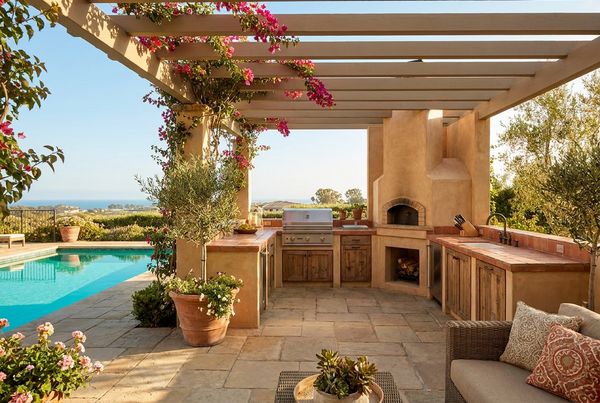
This is one of the biggest decisions you'll make, and it changes both the budget and the experience. A covered kitchen — under a roof, pavilion, or pergola — protects your appliances from UV and rain, keeps the cook out of the midday sun, and dramatically extends the hours the space actually gets used. It also lets you add a ceiling fan, lighting, and, if you insist, a TV.
An open kitchen costs less and feels more expansive and connected to the yard — but every surface weathers faster, so lean hard on stainless covers, UV-rated finishes, and appliance covers between uses. Our honest take: if the budget allows, cover it, or at minimum shade the appliances and the person doing the cooking. Even a simple pergola with a retractable canopy transforms how often the kitchen gets used. Pair it with layered pool lighting and the space works long after sunset.
Bar seating: orient it toward the water
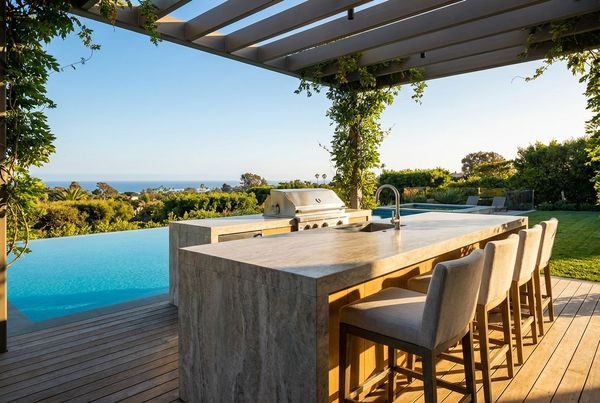
Bar seating is what turns a cooking station into a gathering place, and the orientation matters more than people expect. Put the stools on the pool side of the island so guests face the water and the cook faces them — now the person grilling is in the conversation instead of stuck staring at a fence.
A raised bar (a step up from the work counter) hides the grill mess from guests and gives a comfortable eating height. Allow roughly 24 inches of width per stool and 12 to 15 inches of knee overhang so people can actually sit. For a family of four planning to host, four to six stools is the sweet spot — enough to seat the crowd without turning the island into a runway. This social layout is the single most popular outdoor kitchen idea we get asked for, and for good reason.
What an outdoor kitchen really costs
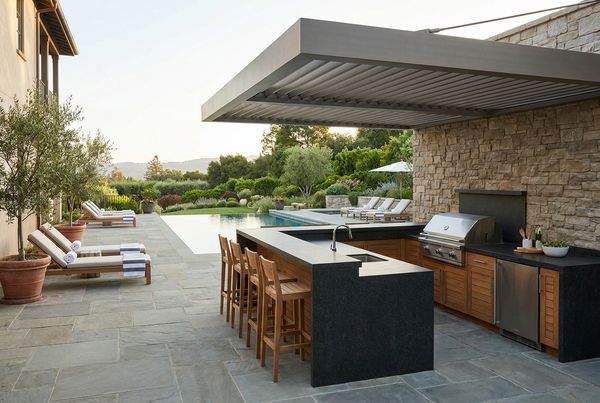
Outdoor kitchens span an enormous range, so ballpark it by scope. A simple grill island — a masonry base, a decent built-in grill, and durable counters — can land in the low-to-mid four figures. A mid-range L-shape with a side burner, a beverage fridge, and porcelain or granite counters typically runs into the low five figures. A large covered kitchen with premium appliances, a pizza oven, a sink, and stone counters can climb into the tens of thousands.
The biggest cost drivers, in order: cabinetry material (masonry and stainless cost more than polymer), appliance count and quality, and whether it's covered (a roof or pavilion is a real construction line item). Utilities — running gas, water, and power — add up too, which is exactly why you do them once, during the build. Fold this number into your overall pool design budget from day one rather than bolting it on afterward.
Splurge vs. skip
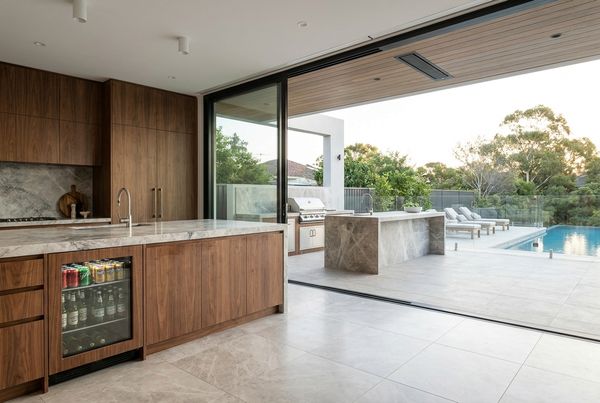
What we'd splurge (and skip)
Splurge: a great grill, durable counters (porcelain or granite), and a beverage fridge — these get used every single time. Add a cover if the budget stretches; it pays back in usable hours. Skip (at first): the outdoor TV, warming drawers, and specialty gadgets that sit unused and weather badly. Build the bones and cover them well; you can add the toys later. And run gas, water, and power during construction — trenching a finished patio is the expensive way to do it.
The pattern across every build we've done is the same: the daily-use items justify their price and the novelties gather dust. Spend on the grill, the surfaces, and the shade. Wait on everything you're not sure you'll use twice a summer.
Gas, water, and the utilities to run first
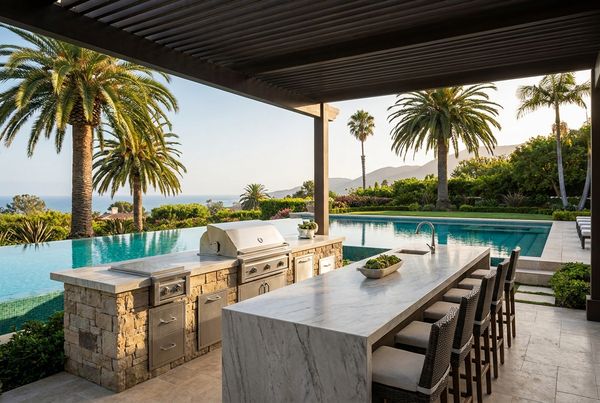
The single decision that saves the most money and heartache is settling the utilities before anyone lays a block. A built-in grill wants either a natural-gas line teed off the house or a hidden propane bay in the island. A fridge, ice maker, or lit under-counter zone needs a dedicated GFCI circuit — outdoor kitchens pull more power than people expect once the appliances stack up. And a sink needs both a supply line and a drain, which is the one people skip and regret.
Natural gas is my default when it's available: you never run out mid-cookout and there's no propane tank to hide or haul. Propane is fine — it just means designing a ventilated cabinet for the tank and accepting the swap routine. Either way, size the gas line for the total BTU load of the grill plus a side burner, not just the grill alone, or you'll starve the burners when everything's running.
Here's the rule I repeat on every job: run more than you think you need, once. Stub in a spare conduit and a capped water line even if the sink or pizza oven is a "phase two" idea. Trenching a finished patio to add a line later is the most expensive mistake I see, and it's entirely avoidable. If a pool is going in at the same time, coordinate the kitchen's trenching with the pool's plumbing so the yard gets opened up a single time — worth mentioning to your pool builder early.
Does an outdoor kitchen add value?
Outdoor kitchens are one of the outdoor-living features buyers actually notice, and a well-executed one reads as usable square footage rather than a decoration. It won't return dollar-for-dollar like a minor interior remodel, but in warm-climate markets — where the backyard is a genuine second living room for much of the year — a quality built-in kitchen is a real selling point that helps a listing stand out.
The caveat is that build quality shows. A masonry or stainless kitchen with durable counters looks like an asset a decade in; a cheap grill surround with rusted doors and a faded laminate counter reads as deferred maintenance and can actively hurt you. This is the argument for spending on the bones — the cabinetry carcass, the counters, and the utilities — over the gadgets. Fold the kitchen into your overall project budget and treat it as part of the backyard's finished value, not an afterthought you tack on the weekend before listing.
Pull the whole backyard together
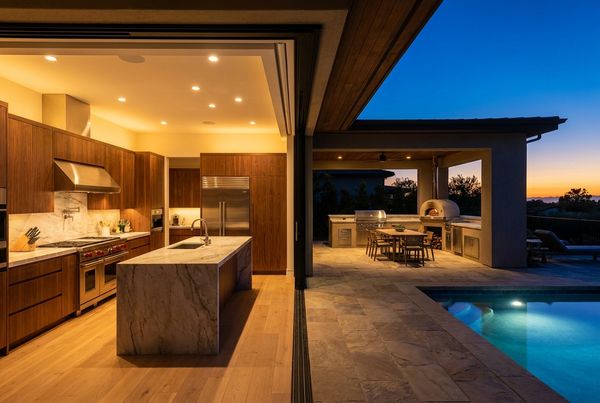
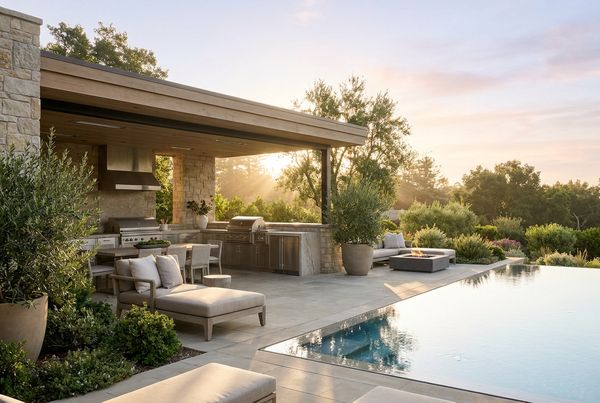
An outdoor kitchen doesn't live in isolation. The best backyards read as one designed space, which means coordinating the kitchen with everything around it. A pergola gives it shade and architecture, a fire feature adds a second gathering point for after dinner, and layered lighting keeps it all usable well past dark. Together, kitchen plus shade plus fire is the complete outdoor room.
When you're ready to price and build it, get real numbers from pros who do this every week — a good local builder will steer you on utilities, drainage, and appliance sizing, which matter as much as the finishes you see. Start with a pool builder near me and bring these ideas to the conversation.
Design Gallery
16 more ideas to save — tap any photo to view full screen.

Kelly E.
Pool Design Editor, PoolPad
Kelly has spent 10+ years around residential pools — planning projects, testing gear, and documenting backyard builds for PoolPad. Each design guide is checked against current construction methods and material pricing.
Frequently Asked Questions
What should every outdoor kitchen have?
What is the best countertop for an outdoor kitchen?
How much does an outdoor kitchen cost?
Should an outdoor kitchen be covered or open?
How far should an outdoor kitchen be from the pool?
Do I need a sink and plumbing in an outdoor kitchen?
Natural gas or propane for an outdoor kitchen grill?
Does an outdoor kitchen add value to a home?
How do I clean and maintain an outdoor kitchen?
Ready to build your dream backyard?
Compare local, vetted pool builders and get matched with pros who can bring these designs to life.
Find a Pool Builder Near You