



Key Takeaways
- Modern pool design is defined by clean geometry, disappearing edges, dark and glass-tile finishes, and features — fire, water, light — built into the architecture rather than added on top.
- The dominant 2026 shift is softened geometry: rectilinear pools with a single curved corner or a broad tanning ledge that keeps the crisp look but reads warmer and more usable.
- The style lives or dies on restraint and precision — flush coping, level edges, hidden equipment — so it rewards a builder who sweats the details.
Modern pool design isn't a shape you pick off a menu — it's a discipline. Strip away the boulders, the kidney curves, and the scalloped tile borders, and what's left is water held in the cleanest possible geometry, finished dark enough to mirror the sky, with fire and light and jets that look like they grew out of the architecture. After designing these pools for years, we've learned the look is deceptively hard: it hides nothing, so every edge, joint, and equipment run has to be right. Here's how the best contemporary pools are built in 2026 — and where the money actually earns its keep.
What actually makes a pool 'modern'
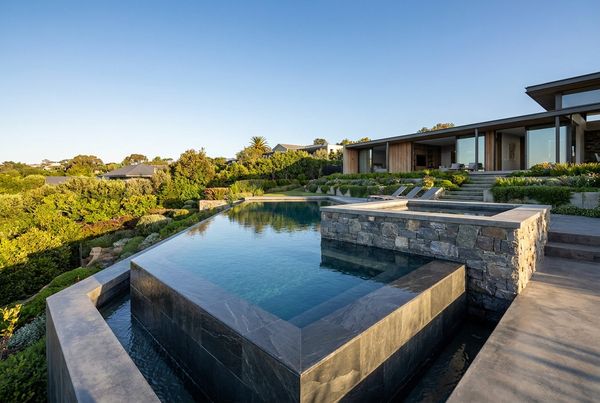
Ask ten homeowners and you'll get ten answers, but the honest definition is simpler than the Pinterest boards suggest. A modern pool is defined by restraint and integration. Restraint means clean geometry and a limited palette — one crisp shape, one or two materials, no ornament for ornament's sake. Integration means the features aren't bolted on; the spa, the water wall, the fire, the lighting all read as part of a single composition that matches the house.
That's the whole game. Everything below — the wet edges, the dark tile, the sheer descents — is just a tool in service of those two ideas. A modern pool can be a bare rectangle with a flush coping and nothing else, and if it's proportioned and executed cleanly, it will look more expensive than a lagoon crowded with rockwork. The style punishes clutter and rewards precision. If you take one thing from this guide, take that.
What we think
The most common way a "modern" pool goes wrong is over-decoration — a clean rectangle that then gets a rock waterfall, three colors of tile, and a curvy spa tacked on. Modern is subtractive. Decide on one hero move (a wet edge, a raised spa, a dark finish) and let everything else stay quiet. Restraint is the luxury.
Clean geometry and softened lines for 2026
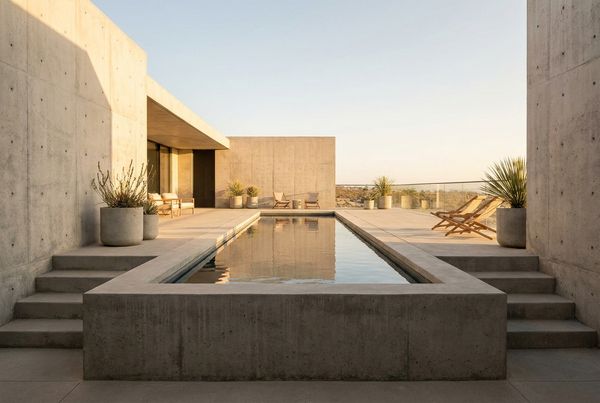
Straight lines are the backbone of the style because they echo contemporary architecture — the flat rooflines, the ribbon windows, the rectilinear massing. The rectangle is still the signature shape, followed by the L (which lets you tuck a shallow lounging zone off a lap run) and the long, narrow lap format. If you're weighing the options, our guide to pool shapes lays out how each one lives day to day.
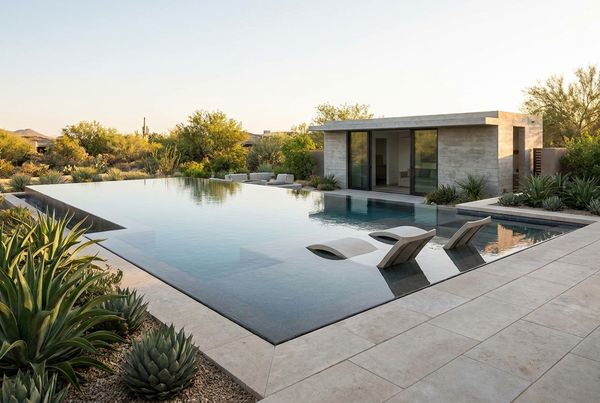
The real 2026 story is softened geometric. Pure hard-edged rectangles can feel austere, so designers are keeping the crisp overall footprint but relaxing one element — a single rounded corner, a gently curved bench, or, most popular of all, a broad tanning ledge (Baja shelf) across one end. It's a small move with a big payoff: the pool still photographs clean and modern, but it feels warmer and gets used more, because there's finally a spot to sit half-submerged with a drink. The other quiet trend is scale restraint — smaller, sharper pools and plunge pools that do more with less water.
Wet edges and perimeter overflow
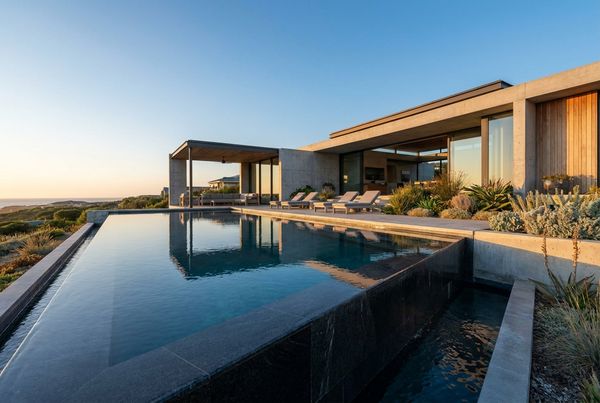
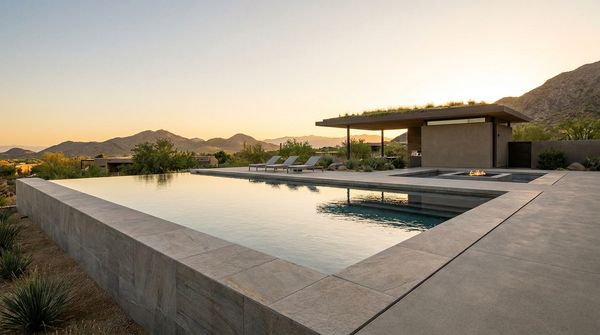
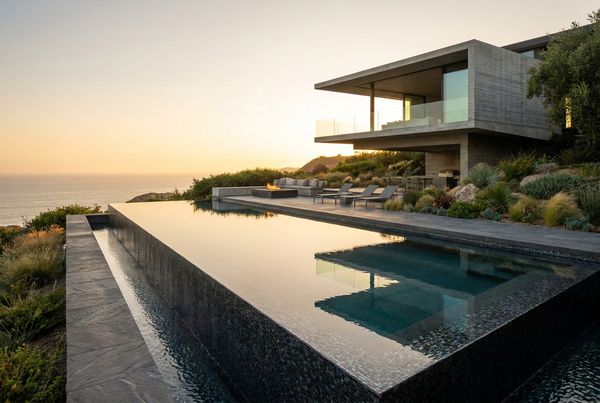
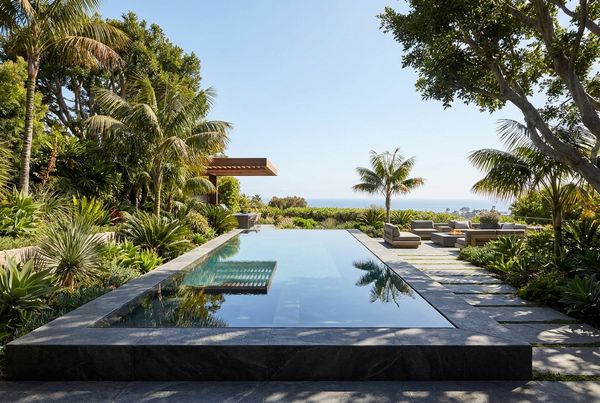
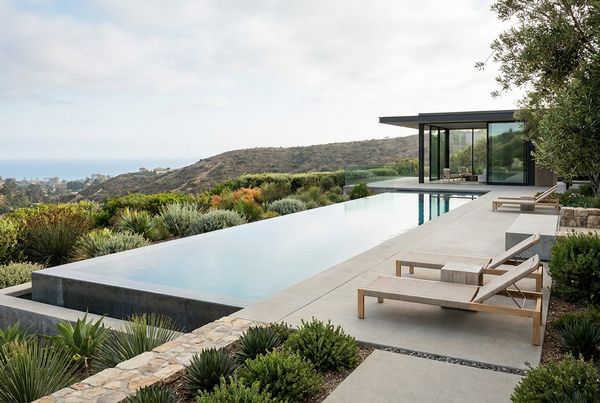
Nothing says "modern" like water that has no visible edge. There are two ways to get there, and they're often confused. A vanishing (infinity) edge disappears on one side toward a view or a drop — the drama move, covered in depth in our infinity pool ideas. A perimeter-overflow, or wet edge, is the more architectural cousin: the water vanishes on all sides into a narrow slot, sitting flush with the deck and dead flat, so the pool reads as a mirror set into the ground.
Perimeter overflow is the purest expression of modern design because it removes the edge entirely. There's no coping lip breaking the plane, no waterline tile, just an unbroken sheet reflecting the sky. It's also the most demanding and expensive build — every side is a working edge that has to be poured perfectly level and plumbed to a hidden surge tank. On a flat urban lot where an infinity edge would have nothing to disappear into, a perimeter overflow is the answer, because the effect is the reflection, not a distant view.
Dark bottoms and glass-tile finishes
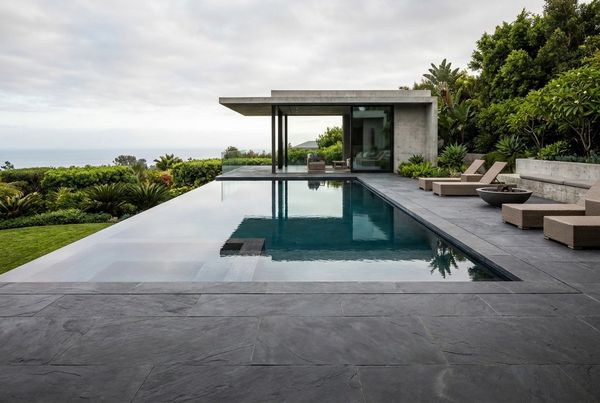
If geometry is the skeleton, the interior finish is the mood. A pale plaster reads bright and tropical; a dark finish — charcoal, graphite, midnight blue, or black-quartz pebble — does the opposite, turning the surface into a mirror that doubles the sky, the architecture, and the light. Stillness becomes the feature. That reflective quality is exactly what modern design is chasing, which is why the dark-bottom pool has become almost a default for the style.
Push it further with tile. A glass-tile pool adds a jewel-like shimmer and a depth of color plaster can't touch — iridescent blues, near-blacks, and gunmetal greys that shift with the light. Glass is the premium move (it's more material and more labor, detailed in our glass tile guide), but even a glass-tile waterline band on an otherwise plaster pool sharpens the whole thing. The trade-off with any dark surface is honest maintenance: they absorb solar heat (usually a bonus) but show mineral scale and a dropped water line sooner than pale plaster, so water chemistry has to stay tight.
| Finish | Look | Relative cost | Best for |
|---|---|---|---|
| Charcoal plaster | Soft dark, matte reflection | $ | Budget-conscious modern |
| Black-quartz pebble | Durable, deep, textured | $$ | Everyday modern workhorse |
| Dark glass tile | Jewel shimmer, mirror-flat | $$$$ | High-end statement pools |
| Iridescent glass band | Sparkle at the waterline | $$ | Sharpening a plaster pool |
Raised spas, sheer descents, and water
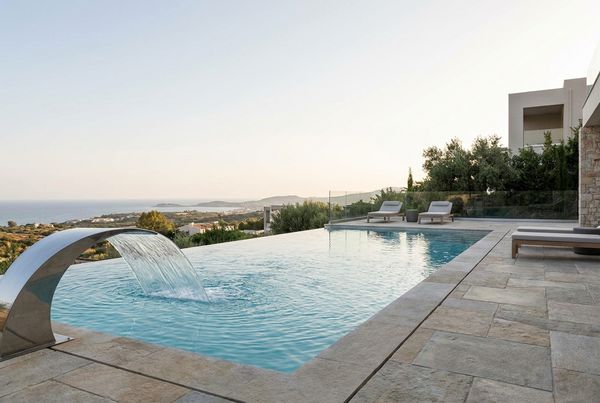
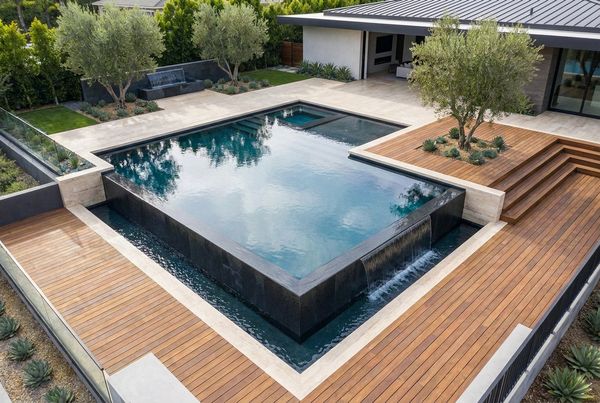
Modern pools do use water features — they just choose ones with clean lines. The workhorse is the raised spa: a square or rectangular hot tub lifted a step above the pool, clad in the same tile, spilling into the main body over a wide, flush weir. It anchors one end of the composition, adds a second body of warm water, and gives you that satisfying sheet of movement. See our spillover spa guide for how the overflow is detailed.
The other signature is the sheer descent — a wide, silent ribbon of water falling from a raised wall or bond beam into the pool. No splashing rocks, no gurgle, just a clean glass sheet. Paired with a floating fire feature or a run of scuppers, it's the modern alternative to the old rock waterfall. For the full menu of options that suit the style, our pool water features guide walks through scuppers, sheer descents, deck jets, and bubblers — the ones to reach for, and the ones to skip.
Minimalist decking and planting
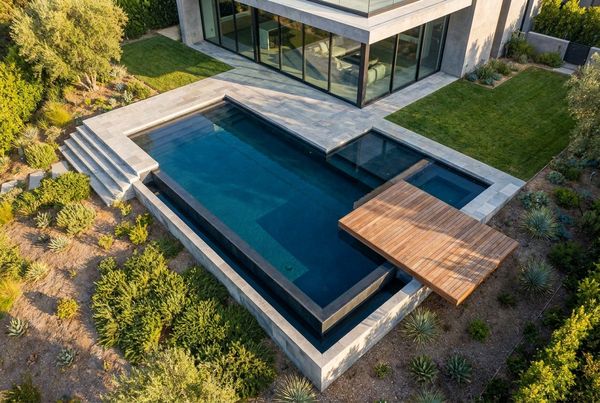
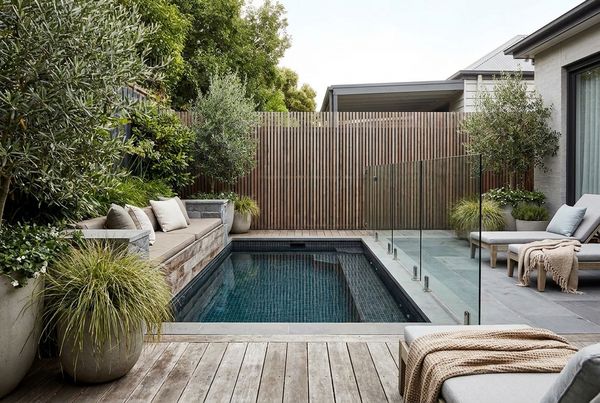
The deck is where a lot of modern pools quietly fail — too many materials, fussy borders, busy stone. The goal is one uninterrupted plane. Large-format porcelain pavers, poured concrete with wide clean control joints, and oversized sawn stone all deliver that flush, calm surface with minimal grout lines. Keep the coping flush with the deck (no bullnose lip) so the plane runs unbroken right to the water. Our pool deck and pool coping guides go deeper on the materials that hold up.
Planting follows the same logic: structural, not busy. Think architectural specimens with strong silhouettes — a row of clipped hedges, a single sculptural olive or agave, ornamental grasses that move in the wind — set in clean beds or planters rather than mixed cottage borders. Restraint in the landscape lets the water and architecture stay the focus. For the full treatment, our pool landscaping guide shows how to keep it modern without going sterile.
Integrated lighting, fire, and automation
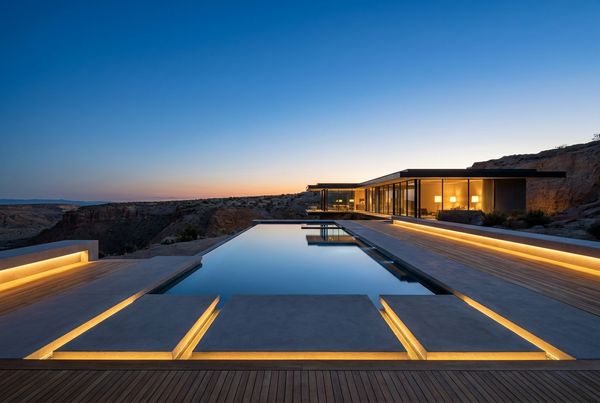
A modern pool is a day pool and a very different night pool, and the difference is lighting done as architecture. That means color-tunable LEDs in the pool and spa, but also light built into the structure — linear fixtures grazing a water wall, step lights washing the coping, and landscape uplights on those sculptural plants. The effect should feel composed, not floodlit. Our pool lighting and outdoor lighting guides cover the fixtures and the layering.
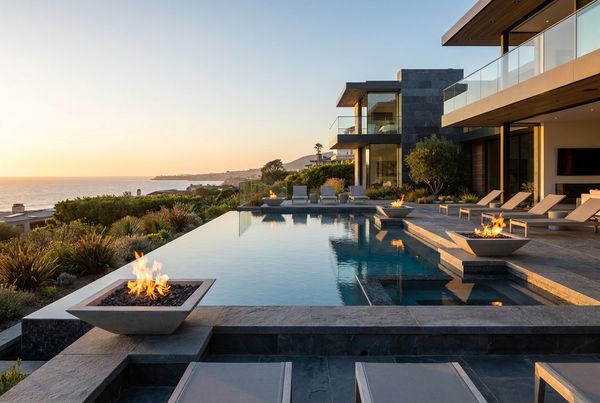
Fire is the other half of the after-dark story. Clean-lined fire bowls, a linear fire trough along a raised wall, or a companion fire pit add warmth and a flickering counterpoint to the still water — the fire-and-water pairing that defines high-end contemporary yards. Tying it all together is smart automation: a single app to run the pump, heater, lights, spa, fire, and water features, with schedules and scenes. In a design language built on integration, hidden, app-controlled equipment isn't a gadget — it's the point.
Where the money actually goes
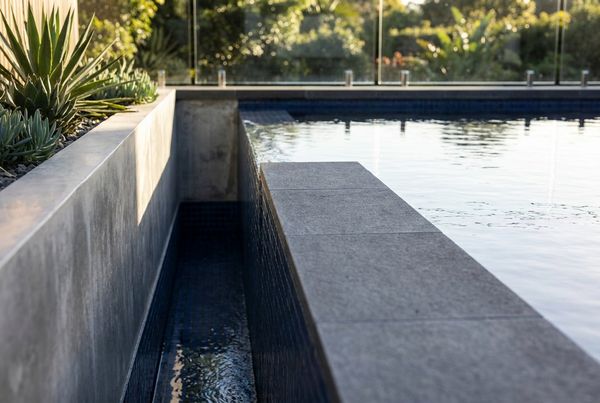
There's a persistent myth that modern pools cost more, and it's only half true. The shape itself is often the cheapest pool you can build — a clean rectangle uses less perimeter and less material than a curvy freeform. What drives the price is the features that define the high-end modern look: a perimeter-overflow edge with its hidden surge tank, glass tile, a raised spa with a flush weir, and full automation. You can build a genuinely handsome modern pool on a modest budget by keeping the geometry crisp and spending only where it shows. Our inground pool cost guide breaks down which features move the number most.
If the budget is tight, the smart move is to protect the two things you can't fake later — perfectly level, flush coping and a well-applied dark finish — and defer the rest. Skip the second water feature, delay the automation, downsize the footprint. A small, sharp pool often looks more resolved than an oversized one anyway; our small pool ideas and plunge pool ideas guides show how the modern language scales down without losing its edge. Running costs stay reasonable too — a compact modern pool holds less water, and you can trim energy use by finding the shortest effective pump schedule with our pump run-time calculator.
Living with a dark, mirror-flat finish
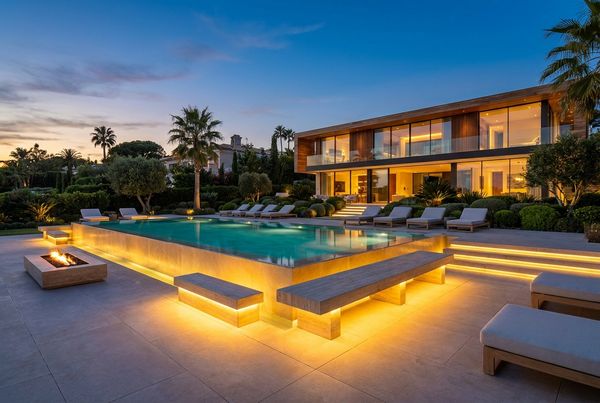
The dark, reflective surface that defines modern design comes with one honest trade-off: it's less forgiving than pale plaster. A charcoal or black interior shows mineral scale, a dropped water line, and any calcium haze sooner, precisely because the whole point is a flawless mirror. That's not a reason to avoid it — it's a reason to keep the water chemistry consistent so the finish always looks its best. Know your exact volume with our pool volume calculator, then dose precisely with our pool chemical calculator rather than eyeballing it.
The good news is that the mirror effect depends on stillness, and modern pools are built for it — a wet edge or a well-tuned sheer descent keeps the surface moving just enough to stay clean without breaking the calm. Balanced water and a steady turnover are all it really takes. If a dark pool ever goes cloudy or hazy after heavy use, our cloudy pool water guide runs through the usual culprits, and a reliable test kit is the cheapest insurance a reflective finish can have.
Indoor-outdoor flow and the modern lot
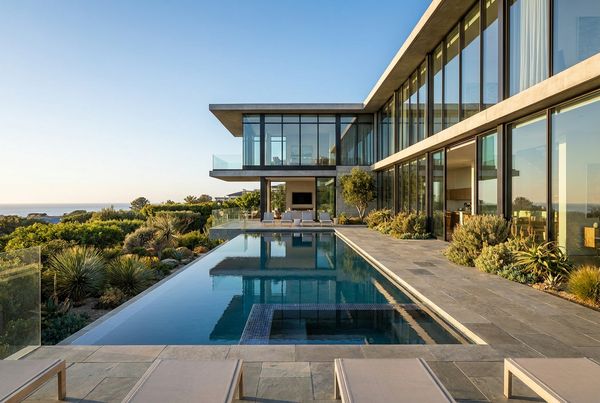
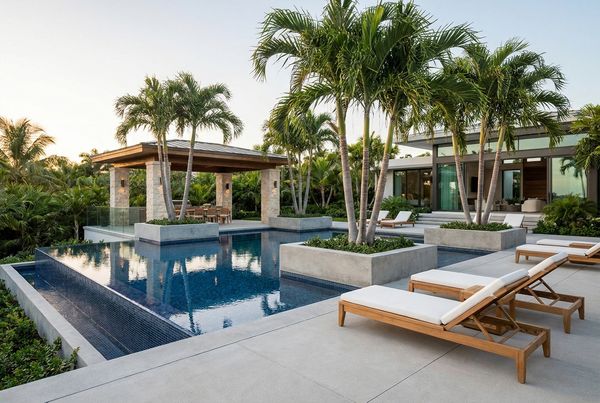
The best modern pools aren't designed in isolation from the house — they're designed with it. Contemporary homes lean on indoor-outdoor flow: sliding glass walls, a continuous floor material carried from the great room out onto the deck, a pool positioned so it reads as another room seen through the glass. When the interior stone runs flush out to matching pavers and the water sits just beyond, the whole rear elevation becomes one composition. That alignment — sightlines, materials, levels — is what separates a modern pool from a modern-ish one.
This is also where the style scales. A modern approach flatters a small lot as much as a sprawling one, because clean geometry and restraint don't need acreage; a small pool or a compact plunge often looks more resolved than an oversized pool crammed with features. And it climbs gracefully into the high end — the same principles, executed with wet edges, glass tile, and full automation, are exactly what our luxury pool designs guide is built on. Wherever your budget lands, start from the whole picture in our design hub, then let restraint and precision do the rest.
What we think
If you're building modern on a budget, spend on the two things you can't fake later: perfectly level, flush coping and a dark, well-applied finish. Skip the second water feature, delay the automation, downsize the footprint — but never cut the corners that keep the geometry crisp. A clean, dark rectangle done right will outclass a bigger pool with sloppy edges every single time.
Design Gallery
6 more ideas to save — tap any photo to view full screen.

Kelly E.
Pool Design Editor, PoolPad
Kelly has spent 10+ years around residential pools — planning projects, testing gear, and documenting backyard builds for PoolPad. Each design guide is checked against current construction methods and material pricing.
Frequently Asked Questions
What defines a modern pool design?
What is the most popular modern pool shape?
Are dark-bottom pools part of modern design?
What's the difference between a modern and a contemporary pool?
Do modern pools cost more than traditional ones?
What decking works best with a modern pool?
Are dark-bottom modern pools harder to maintain?
How can I build a modern pool on a budget?
What is a perimeter-overflow pool?
Ready to build your dream backyard?
Compare local, vetted pool builders and get matched with pros who can bring these designs to life.
Find a Pool Builder Near You