



Key Takeaways
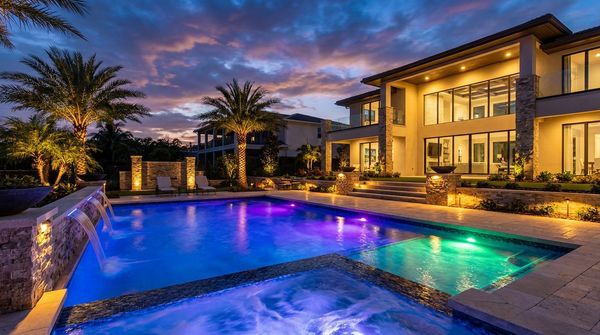
- Layer three types of light: in-pool LEDs, illuminated water features, and warm landscape/deck lighting.
- Color-changing LED pool lights are now standard — they're efficient, app-controllable, and set the whole mood.
- Warm, low-voltage landscape lighting does more for atmosphere than bright floodlights ever will.
A pool you love in the daytime can be *magical* at night — or completely dark and lifeless. The difference is a lighting plan. Great **pool lighting ideas** aren't about brightness; they're about layers, warmth, and letting the water and features glow. Get it right and your backyard doubles as an evening room you actually want to sit in.
The three layers of great pool lighting
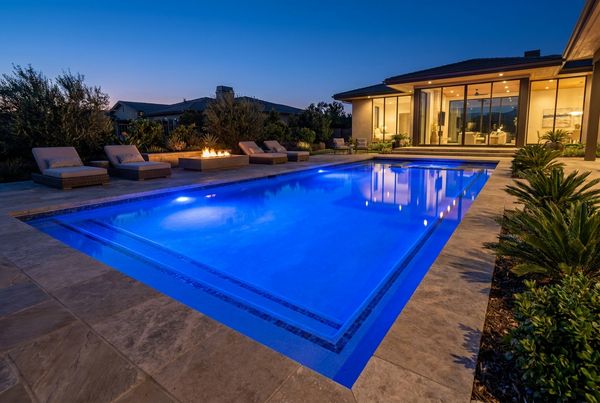
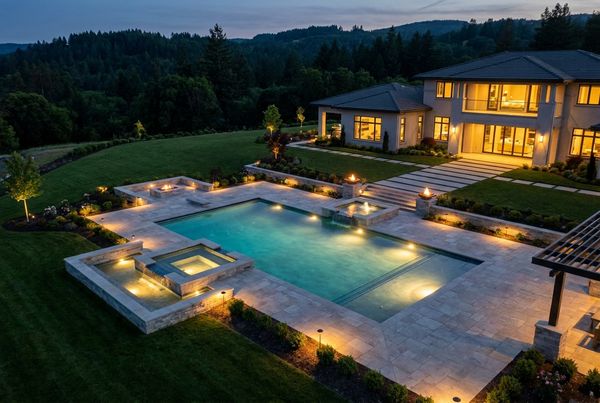
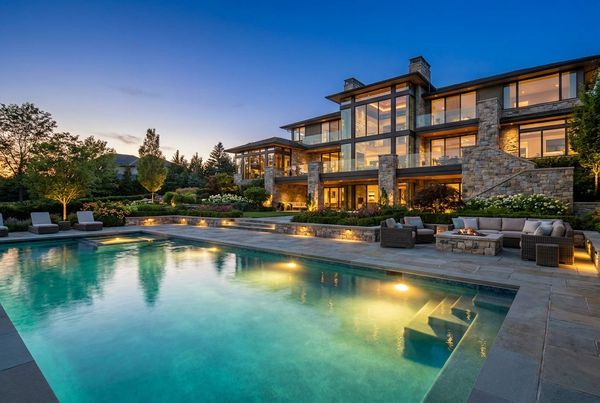
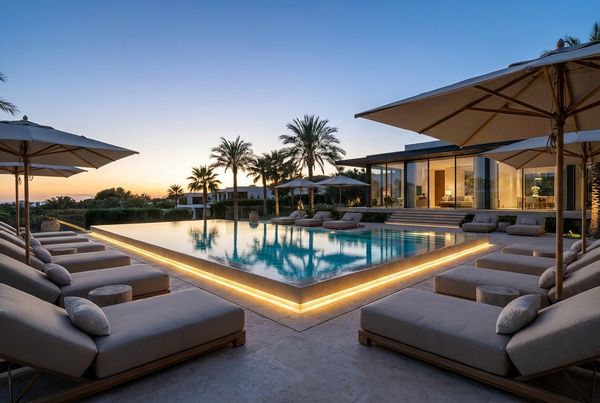
Every backyard that looks incredible after dark is doing the same three things, whether the owner knows it or not. It's lighting the water, lighting the features, and lighting the surroundings. Miss any one layer and the space feels off — a glowing pool floating in a black void, or a pretty deck with a dead hole in the middle of it.
Think of it the way a photographer thinks about a portrait: a key light, a fill, and a background. Your pool interior is the key light, your water features are the accent, and warm landscape lighting is the fill that ties everything together. The magic is in the balance, not the wattage. Below we walk each layer, then get into color, automation, safety, and the mistakes we see most.
A quick word on budget before we dive in, because it shapes every decision. A full three-layer plan on a mid-size backyard typically runs from a few thousand dollars for a single LED plus a modest landscape package, up to five figures once you add multiple in-pool fixtures, lit water features, a transformer or two, and an automation controller. The good news is that the layers are modular — you can build the pool light and a starter landscape kit now, then add feature and path lighting later as the conduit and transformers allow. Roughing in extra low-voltage runs during construction costs almost nothing and saves a fortune versus trenching a finished yard.
The 2026 baseline has shifted, too. Color-changing LEDs are no longer a splurge — they're the default fixture builders quote. Low-voltage landscape systems have gone almost entirely to app-controlled transformers, and the smart move now is to plan all three layers on one controller from day one rather than bolting on smarts after the fact. Design for the scenes you want first; pick the fixtures second.
Layer 1 — LED lights in the water
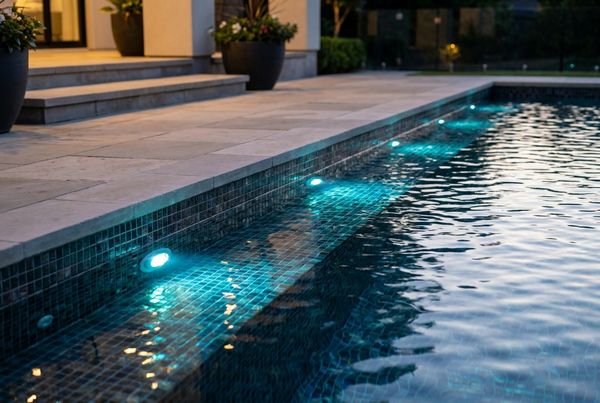
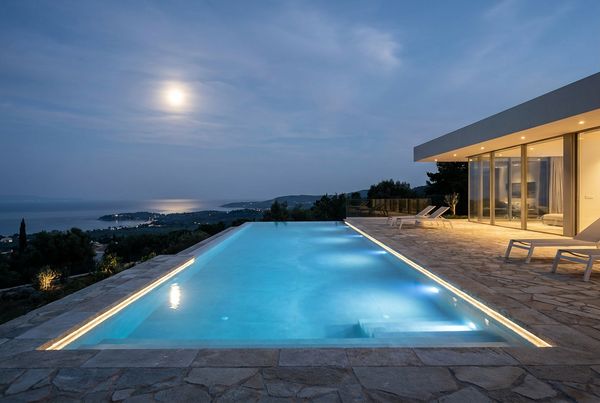
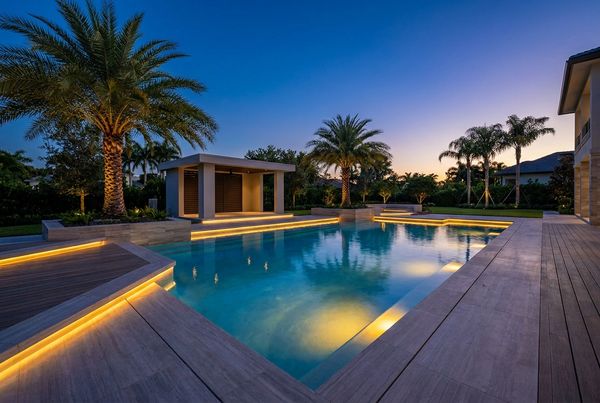
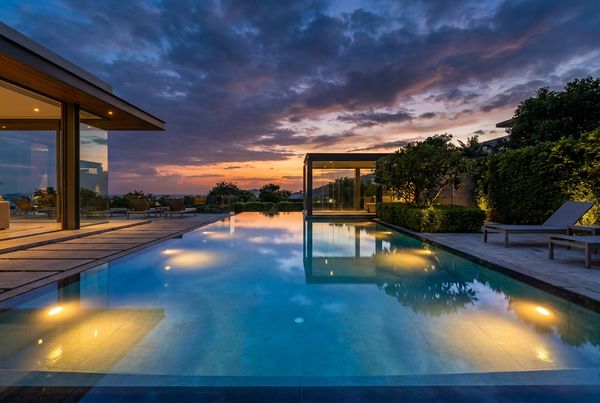
Submerged LED pool lights are the foundation, and they're where old pools show their age. If you still have an incandescent or halogen fixture, swapping to a modern color-changing LED is one of the highest-impact upgrades you can make. LEDs use a fraction of the energy, run cool, last for years, and can shift from a calm warm white to deep sapphire blue or a full color show at a tap.
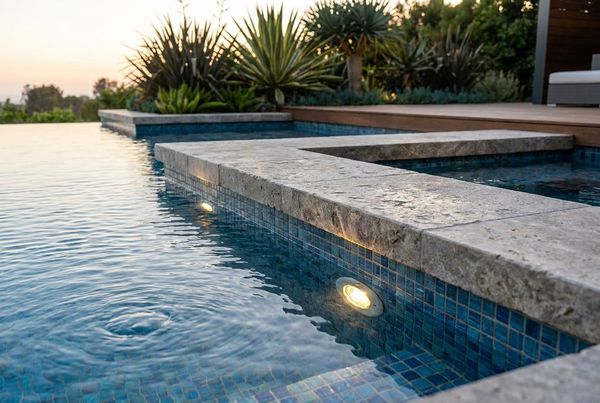
Placement and quantity matter more than most people realize. One well-positioned light transforms a small plunge pool; a larger pool needs several to avoid dark corners and get an even, glare-free glow. As a rule of thumb, plan one full-size LED for roughly every 12 to 15 feet of pool length, add a dedicated light for the spa, and give tanning ledges and deep sections their own fixtures so no zone falls into shadow. Position lights on the wall you look away from — typically the house side — so a swimmer gazing across the water sees glowing water, not a bright bulb firing back at them. Mounting depth matters as well: keep the fixture 12 to 18 inches below the waterline so the beam diffuses through the water instead of skipping off the surface.
On the fixture side, most residential niches take a standard large LED in the 25- to 45-watt range, while compact nicheless LEDs (great for retrofits and small pools) run lower and can flush-mount without a bulky housing. Look for a high lumen output paired with a wide beam angle, a fully sealed cool-running body, and app or automation compatibility so the light plays with the rest of your scenes. Interior lighting is also what makes dark plaster and dark-tile finishes look so cinematic after sunset — the darker the interior, the more that glow reads as saturated color rather than a washed-out bulb. If you're choosing a finish and a light together, lean dark; it's the single biggest multiplier on how good the water looks at night.
The 2026 trend worth noting: nicheless and low-profile LEDs are increasingly the retrofit of choice because they drop into existing pools with minimal fuss, and full RGBW fixtures (adding a dedicated white diode) now render a genuinely warm, clean white for everyday use instead of the slightly clinical white older RGB lights produced. That warm-white capability is what lets a single fixture serve both the calm "dinner" look and the vivid "party" look.
Layer 2 — light the water features
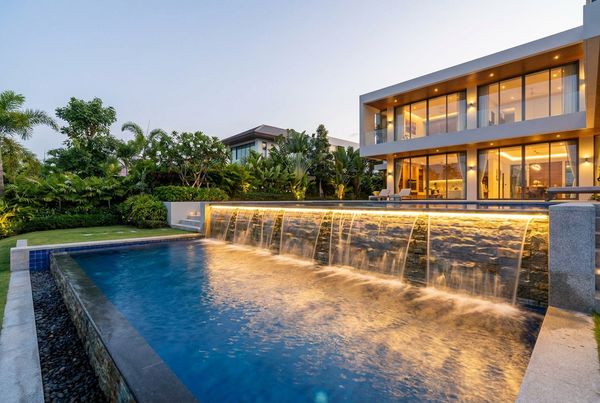
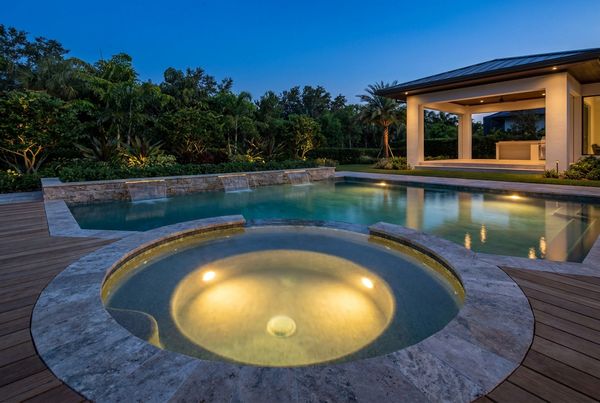
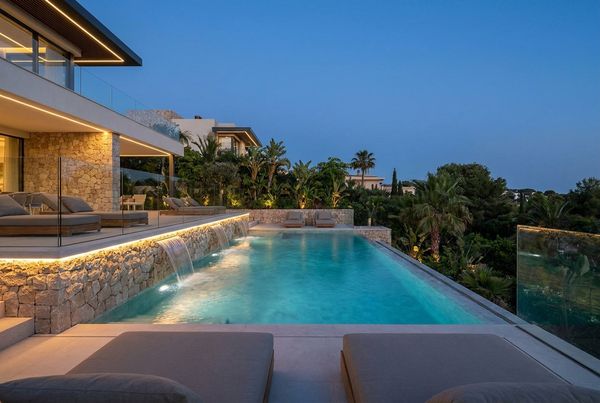
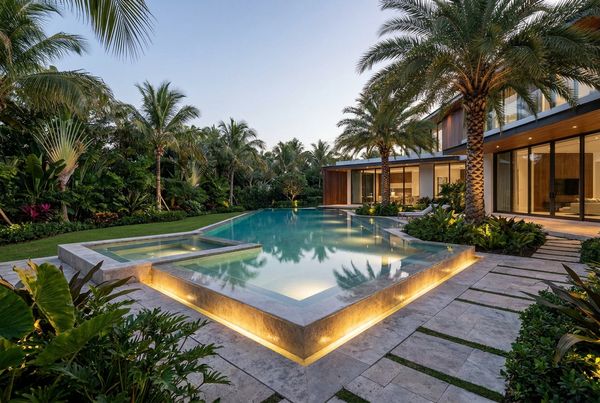
This is the layer most people skip, and it's the most impactful dollar-for-dollar. Moving water catches light beautifully — a lit sheer descent becomes a glowing curtain, illuminated laminar deck jets arc like ribbons of light, and a spa spillway turns into a shimmering edge instead of a dark seam.
The trick is to backlight or edge-light the feature so the water itself carries the glow, rather than pointing a light at it head-on. For a sheer descent or waterwall, a slim LED strip tucked behind or above the lip lets light travel down the falling water. For laminar jets, use fixtures with built-in LEDs at the nozzle so each arc glows along its whole length — a favorite party trick because the jets can color-match or contrast the pool. A spa spillway usually reads best when it borrows glow from an in-spa LED positioned near the weir rather than getting its own harsh spotlight.
Match the feature light's color logic to the pool. If the water is deep blue, keeping the features in the same cool family looks cohesive; if you're running a color show, let the features ride along on the same controller so everything shifts together. Wattage here is modest — feature lighting is about placement, not brightness. A few low-wattage, well-aimed fixtures beat one bright floodlight every time, because the goal is to make moving water luminous, not to blast it.
If you're planning any pool water features, budget for their lighting from the start — retrofitting is possible but far easier when the conduit is roughed in during the build, and it's a fraction of the cost. And don't overlook fire: pairing a lit water feature with a nearby fire feature gives you both cool and warm reflections dancing on the surface at once, which is exactly the layered, resort-grade look that's trending into 2026.
Layer 3 — landscape & deck lighting
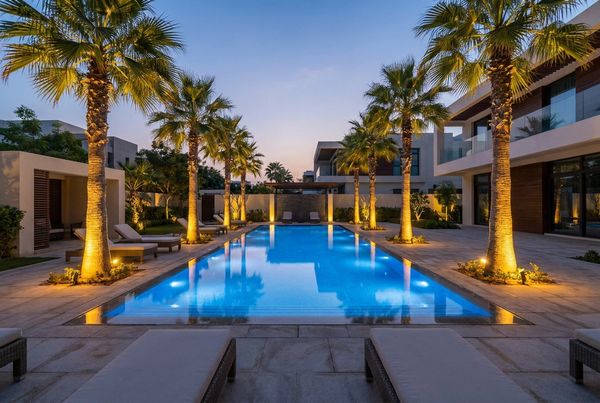
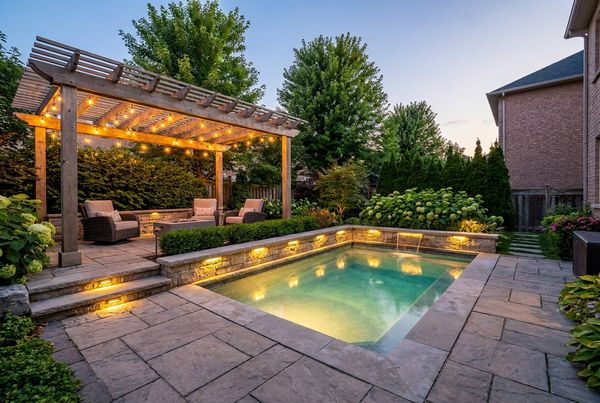
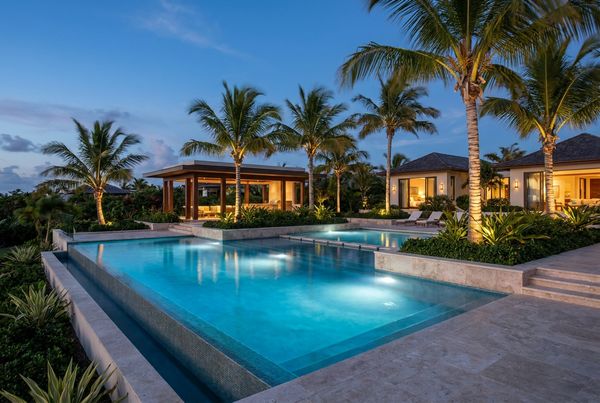
Soft, warm low-voltage landscape lighting is the secret to atmosphere, and it's exactly where budgets tend to run dry. Uplight a few palms or specimen trees to give the yard a canopy and depth. Graze a privacy wall or a stacked-stone accent to bring out texture. Add string lights over a patio or a pergola for instant, warm-and-fuzzy overhead glow.
Keep it warm — around 2700K — and keep it dim. You want pools of glow with shadow between them, not a floodlit parking lot. A little restraint here is what separates a resort-feeling backyard from a gas station. For plant and grade decisions that play well with uplighting, our pool landscaping ideas guide pairs nicely with this layer.
Technique matters as much as fixture choice. Uplighting (a narrow-beam bullet or well light at the base of a tree, angled up the trunk) creates drama and height. Grazing places a fixture close to a textured wall and rakes light across it to pop the stone or stucco. Downlighting — sometimes called moonlighting when the fixture hides high in a tree — casts soft dappled light onto a patio and feels the most natural of all. Path lights and hardscape lights handle the low, functional layer. Mixing two or three of these techniques, rather than lining everything with the same fixture, is what gives a yard depth.
On the technical side, most residential landscape lighting is 12-volt low-voltage, which is safer around water, cheaper to run, and easy to expand. Size the transformer with roughly 20 percent of headroom above your fixture load so you can add lights later, and keep runs balanced to avoid voltage drop dimming the far end of a long line. Bullet uplights typically run 3 to 7 watts in LED, path lights 2 to 4 watts — tiny loads that let a single transformer carry a whole yard. Spend on fixture quality and beam control over sheer output; a well-shielded 4-watt LED aimed correctly will always beat a cheap floodlight.
What we think
Homeowners consistently over-spend on the pool light and under-spend on landscape lighting — then wonder why the yard feels flat at night. Flip that. Put a good color-changing LED in the pool, absolutely light your water features, and then invest in a handful of warm, well-aimed landscape fixtures. Tie it all into automation so one tap sets the scene. It's the cheapest way to make a backyard feel expensive.
Color vs. warm white: choosing your palette
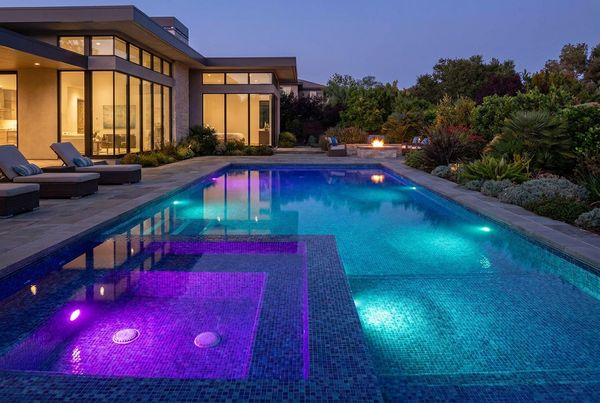
Here's the rule we come back to constantly: let the pool be the color and keep everything else warm. The water is your one place to play — deep blue for a resort feel, teal for a tropical vibe, or a full color-changing show for a party. Because the interior finish is dark, saturated color pops there in a way it never will on a plant or a wall.
Everything around the pool should stay in the warm-white family (2700K to 3000K). Warm light flatters skin, wood, and stone; cool light makes a backyard feel like an office. Resist the urge to run color into your landscape fixtures — a purple palm tree is a novelty that gets old by the second night. The contrast between a vivid pool and a warm, calm surround is exactly what makes the scene look intentional.
Color temperature is measured in Kelvin, and a quick mental map helps: 2700K is candle-and-lamp warm, 3000K is soft warm white, 4000K starts to feel cool and commercial, and 5000K-plus is daylight-harsh. For anything you sit near — decks, seating, dining, pergolas — stay at 2700K. Reserve slightly cooler tones only for the pool water itself, where a crisp blue or teal wants that cleaner light to sing against a dark interior. The table below is our default palette.
| Lighting layer | What it's for | Our tip |
|---|---|---|
| In-pool LED | Sets the mood and hero color of the water | Go color-changing; aim to avoid swimmer glare |
| Water-feature light | Turns movement into a focal point | Backlight the water, don't spotlight it |
| Tree / wall uplight | Adds depth, height, and a "ceiling" | Warm 2700K, dimmed, a few fixtures only |
| Path / step light | Safety and gentle wayfinding | Low, shielded, downward — never at eye level |
| String / overhead | Cozy warmth over seating | Warm white, on a dimmer, over patio or pergola |
| Where it is | Color temperature | Why |
|---|---|---|
| Deck, seating, dining | 2700K warm white | Flatters skin, wood, and stone; feels like a room |
| Trees, walls, plants | 2700K–3000K | Natural, inviting; avoids a sterile look |
| Pool water | Blue / teal / color | Pops against a dark interior; your one place to play |
| Steps & paths | 2700K warm white | Safe and calm; never draws the eye to the fixture |
Automation: one tap for the whole scene
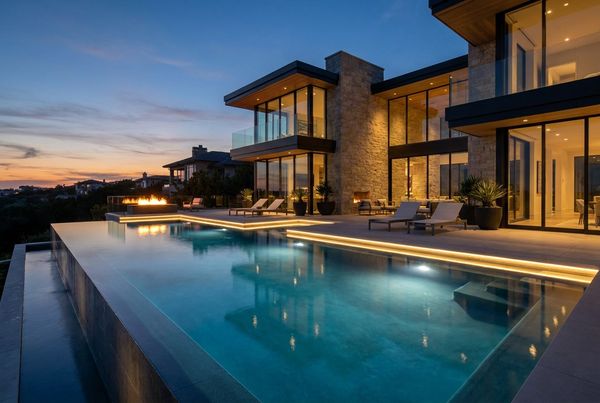
The layers only feel effortless if you can run them together. Modern pool automation systems — and app control on the LED lights themselves — let you build scenes: a "dinner" scene that dims the pool to warm white and brings up the landscape lights, a "party" scene that runs a color show, and an "off" that's genuinely off.
Tie the whole yard onto a schedule and astronomic timers so lights fade up at dusk without anyone touching a switch, then step down late at night. This is the difference between lighting you actually use and a beautiful system that stays dark because flipping six switches is a chore. If you're building new, spec the controller and the low-voltage transformers up front — it's dramatically cheaper than adding smarts later.
The three main pool platforms — Pentair, Hayward, and Jandy — all offer app control that manages the pump, heater, and lights together, and each supports color LED fixtures on the same brand. The catch is that in-pool LEDs generally speak color over a proprietary protocol, so it pays to keep the pool light and the automation controller in the same family. Landscape lighting usually runs on its own smart low-voltage transformer that can be voice- and app-controlled and, ideally, triggered by the same scenes. Where the brands don't natively talk to each other, a hub like a broader smart-home controller can bridge them into unified scenes.
A word on reliability: build a handful of named scenes — "dinner," "party," "swim," "off" — and put them on hardware buttons or a simple app tile, not buried three menus deep. The best automation is the kind a houseguest can run without a tutorial. And always keep a physical override; a lighting system that only works when the Wi-Fi does isn't a system you can trust on a Friday night. In 2026, app-driven, scene-based control is effectively standard on new builds, and retrofitting a smart transformer onto an existing landscape system is one of the easier upgrades to justify.
Safety, steps & path lighting
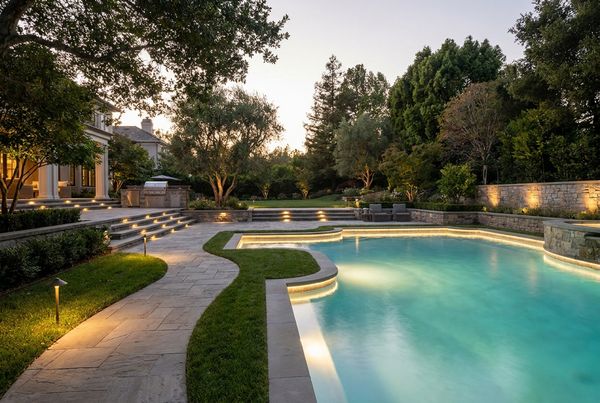
Ambiance can't come at the cost of a rolled ankle. Every change in grade — steps, a raised bond beam, the edge of a tanning ledge, the drop off a deck — deserves a discreet light. The best safety lighting is felt more than seen: low, shielded fixtures that cast light down onto the surface, not out into your eyes.
Recessed step lights, hardscape lights tucked under a cap, and a few well-placed path lights do the job without turning the yard into a runway. Keep the source hidden and the beam soft. Space path lights generously — every 6 to 8 feet is usually plenty — and stagger rather than lining them up like a runway. Put a light on every single step riser or, better, run a shielded strip under the tread nosing so the whole edge is legible. Around the pool coping, low hardscape lights under a bullnose wash the deck softly and mark the water's edge without glare.
The electrical rules are non-negotiable here. Anything near or in the water must be GFCI-protected, and all metal in and around the pool — rails, ladders, fixtures, rebar — must be properly bonded to prevent stray current. Low-voltage landscape and path lighting is inherently safer and easier to add, but the moment you're touching a niche light or running line-voltage near the pool, it's a licensed electrician's job. This is one area where DIY enthusiasm should stop at the fixtures you can safely plug into a low-voltage transformer.
Common pool lighting mistakes
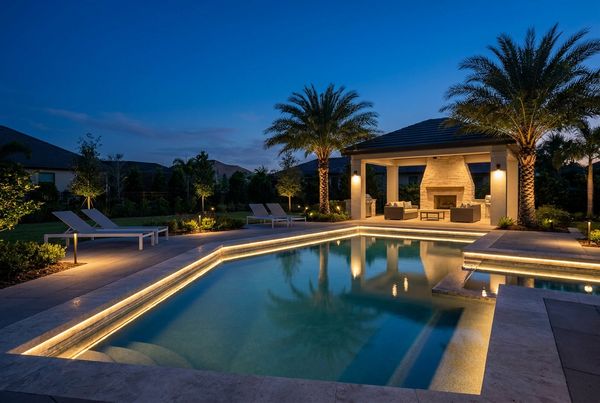
The failures are predictable, and every one is avoidable. Over-lighting is the big one — bright floodlights flatten the space, blow out the water's glow, and create harsh glare. Skipping the feature layer leaves the most photogenic elements in the dark. Cool-white everything makes a warm evening feel sterile.
We also see all color, no warm — a pool cycling rainbow colors with zero warm ambient light, which looks more nightclub than backyard. And glare into the pool, where an underwater light aims straight across at anyone in the water.
A few more that quietly ruin otherwise nice yards: mismatched color temperatures across the landscape, where a 2700K fixture sits next to a 4000K one and the whole scene looks accidental; exposed fixtures and visible bulbs that draw the eye instead of the object they're meant to light; too few in-pool lights, leaving dark quadrants in a large pool; and no dimmers or scenes, so every night is the same blast of full brightness with no way to soften it. The last one is easy to overlook at install and impossible to ignore once you live with it.
The cheapest fixes are almost always subtractive — remove a floodlight, dim a run, hide a source — rather than adding more fixtures. Fix these and you're most of the way to a professional result. If you'd rather hand the whole plan to someone, a good pool builder near you can integrate lighting into the design from day one, which is far cheaper than reworking it after the concrete is poured.
Retrofitting lighting into a pool you already own
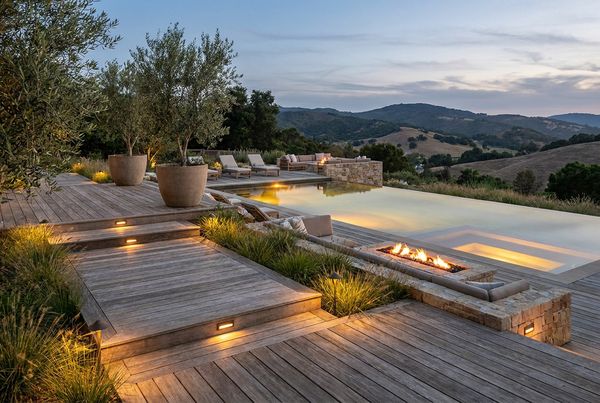
You don't need a new pool to get a great nighttime backyard — and this is the question I get asked most. The good news: the two most impactful layers, landscape lighting and water-feature lighting, are almost entirely retrofit-friendly. Low-voltage landscape systems run on a transformer plugged into a standard outlet, so uplights, path lights, and string lights can go in over a weekend with no trenching through concrete. That alone transforms a flat, dark yard.
The in-pool light is the one that takes more thought. If your pool has an old incandescent or halogen fixture, swapping it for a color-changing LED is one of the highest-return upgrades you can make, and many modern LEDs are built specifically to drop into an existing niche and pull through the old conduit — no draining, no cutting. Nicheless and low-profile LEDs exist for exactly this reason: they flush-mount with minimal fuss and are the retrofit of choice on pools that never had a good light to begin with. The work happens near water, though, so the actual swap is a licensed electrician's job, not a DIY afternoon.
Sequence it smart. Do the LED swap and a starter landscape kit first, since together they deliver most of the visible payoff, then layer in feature lighting and more landscape fixtures as budget allows. If you're renovating anyway — new plaster, new coping, a fresh pool remodel — that's the moment to rough in extra conduit and a bigger transformer while things are already open, because it's a fraction of the cost of coming back later. A pool going dark-finished in the same remodel is a bonus: the darker the interior, the more that LED glow reads as saturated color.
Beyond ambiance: security and everyday practicality
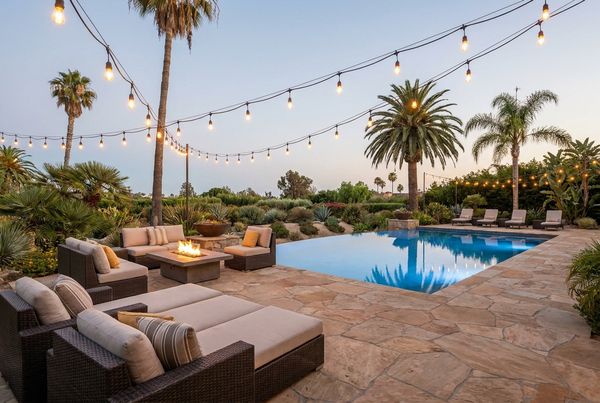
Lighting isn't only about the resort look — it earns its keep every ordinary night, too. A backyard that's genuinely usable after dark is one you can move through safely, find your way across, and feel secure in, and the good news is that the ambient plan and the practical plan mostly use the same fixtures. You just have to think about both when you place them.
For everyday wayfinding, make sure every change in grade and every route is legible without anyone reaching for a switch. Put the yard on astronomic timers so path and step lights fade up at dusk automatically, and consider a "swim" scene that brings the pool and deck to a safe, even brightness for after-dark swimming without the full color show. This is the difference between lighting you use and lighting that stays off because turning it on is a chore.
On security, a softly lit yard is both more welcoming and less inviting to anyone who shouldn't be there — dark corners are what you want to avoid. A few warm fixtures that wash the perimeter and the side yards do more than a single harsh floodlight, which just creates glare and hard shadows to hide in. If you want motion-activated security lighting, keep it separate from your ambient scenes and aim it away from the pool so it never fires a bright beam across swimmers' eyes. And keep everything on a physical override plus a schedule, so the yard is never fully dark just because the Wi-Fi dropped — the same reliability thinking that makes automation trustworthy makes it safe.
What we think
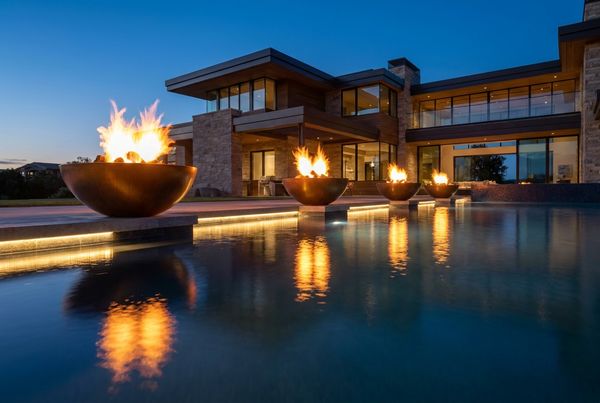
If we had to boil it down: light in layers, keep the surroundings warm, save color for the water, and automate it. A single great LED in a dark-finished pool, thoughtful lights on your water features, and a handful of warm 2700K landscape fixtures on a scene controller will out-perform a yard full of bright floodlights every single time.
The trend line is clear — color-changing LEDs are now the default, app-driven automation is standard, warm low-voltage landscape lighting is what separates the great yards from the good ones, and lit water and fire features are everywhere for good reason. Start with the pool, add the features, then spend real attention on the surround. For the bigger picture, browse the full pool design ideas hub and see how lighting ties every other element together after dark.
Design Gallery
18 more ideas to save — tap any photo to view full screen.
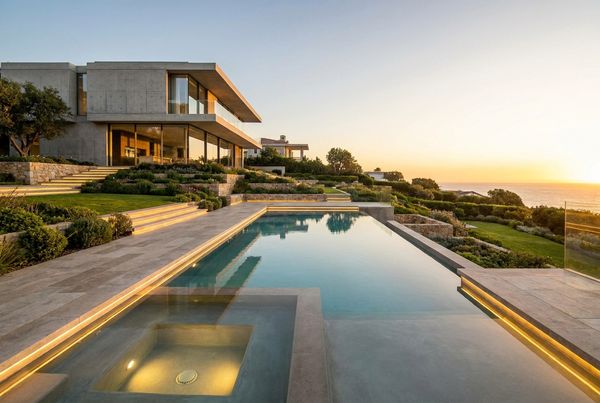
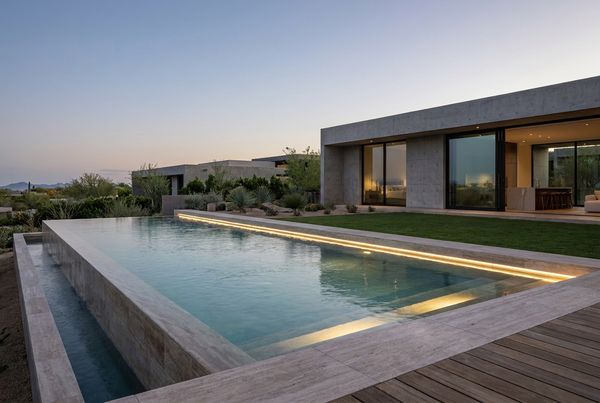
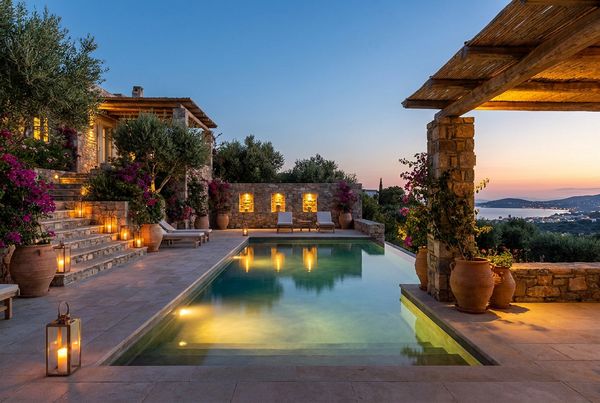
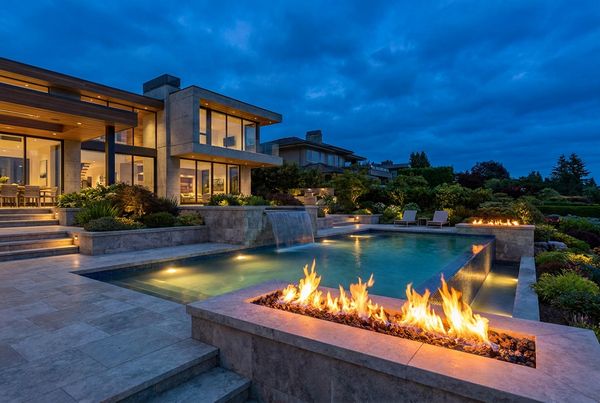
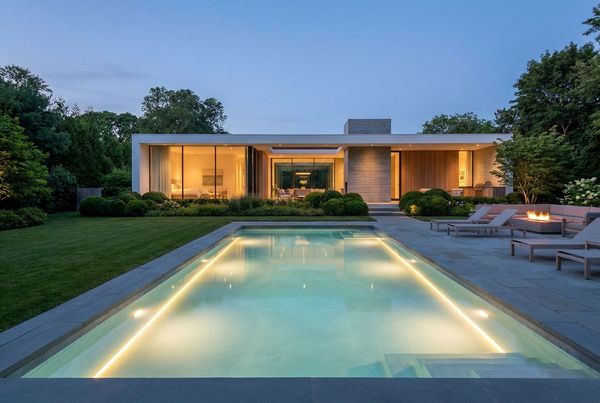

Kelly E.
Pool Design Editor, PoolPad
Kelly has spent 10+ years around residential pools — planning projects, testing gear, and documenting backyard builds for PoolPad. Each design guide is checked against current construction methods and material pricing.
Frequently Asked Questions
What are the best pool lights?
How do I light my pool area at night?
Are color-changing pool lights worth it?
How many lights does a pool need?
What color temperature is best for landscape lighting?
Can I add pool lighting to an existing pool?
How much does it cost to light a pool and backyard?
Do LED pool lights save money?
Does pool lighting need to be on a GFCI or bonded?
What color should I set my pool lights?
Ready to build your dream backyard?
Compare local, vetted pool builders and get matched with pros who can bring these designs to life.
Find a Pool Builder Near You