



Key Takeaways
- Pool slides range from freestanding fiberglass flumes you bolt to the deck to custom rock and grotto slides sculpted into the landscape — the type drives both the look and the cost.
- Safety comes down to depth and clearance: most residential slides need at least 3 to 4 feet of water at the runout, with a clear splash-down zone free of steps, walls, and swimmers.
- Expect roughly $1,500–$8,000 for a freestanding slide installed, and $10,000–$40,000+ for a custom rock slide built into the pool.
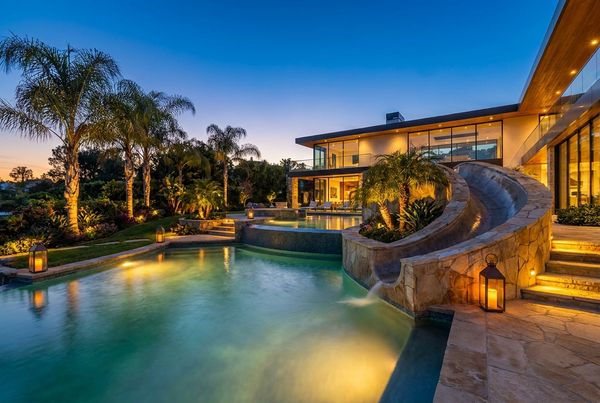
Nothing turns a pool into a backyard destination faster than a slide. It's the feature kids beg for, the one that keeps a birthday party going for hours, and — done right — a genuinely handsome piece of the design rather than a plastic afterthought bolted to the deck. This guide walks through every kind of pool slide, the depth and space you actually need to install one safely, what each type costs, and how the best 2026 builds weave a slide into rockwork, grottos, and lighting so it looks like it belongs.
Why add a pool slide?
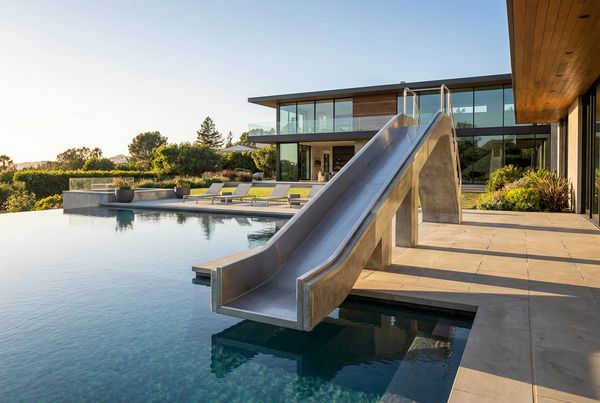
A pool slide does one thing better than almost any other feature: it makes a pool fun on sight. A tanning ledge is relaxing, a waterfall is beautiful, but a slide is the thing kids run toward the second they step into the yard, and it's the reason a pool stays busy long after the novelty of just swimming wears off. If you're building for a family — or you host the neighborhood — a slide earns its keep every summer.
It's also more versatile than people assume. A slide isn't only a kids' toy: a well-designed curved or tube slide is a genuine thrill for teenagers and adults, and a sculpted rock slide can be as much a piece of landscape architecture as it is a ride. The trick is matching the slide to who's using it and to the style of the pool, so it reads as an intentional part of the design. Whether you're planning a family pool from our kids' pool ideas guide or a showpiece from our luxury pool designs guide, a slide can fit — the type is what changes.
Pool slide types explained
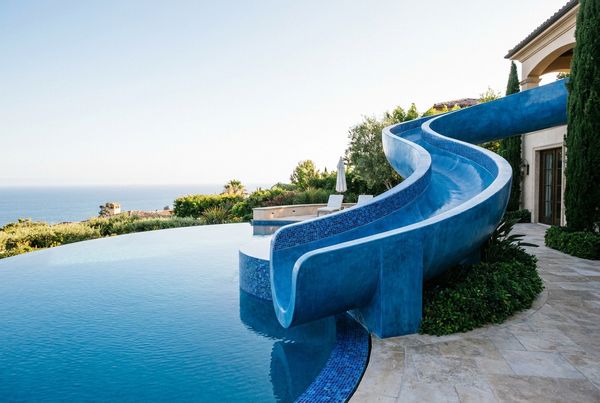
Pool slides split into a handful of clear categories, and knowing them up front makes every other decision easier:
- Straight slides. A short, direct chute — the simplest and usually cheapest option. Straight slides are compact and fast, but they project straight out from the pool, so they need room and a clear landing zone.
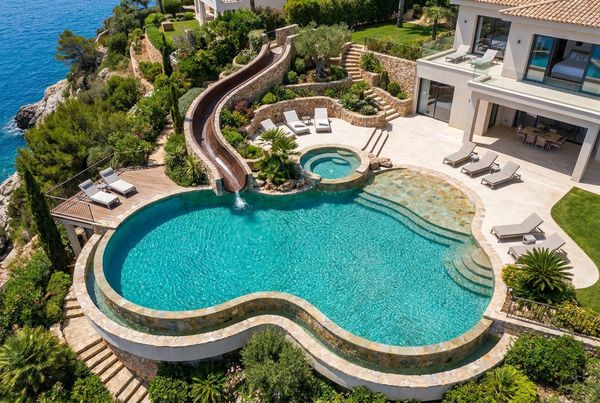
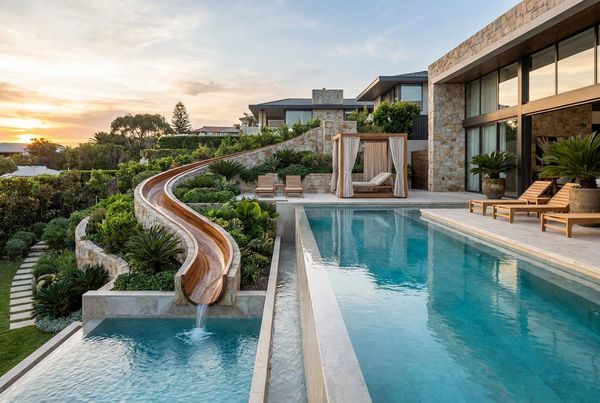
- Curved (flume) slides. The most popular residential type. One or more bends slow the ride, add fun, and let the slide curl back against the pool's edge instead of sticking out. Most freestanding fiberglass slides you'll see are curved.
- Tube / enclosed slides. A partially or fully enclosed flume that adds height, speed, and a real thrill — best for older kids and adults, and often the tallest freestanding option.
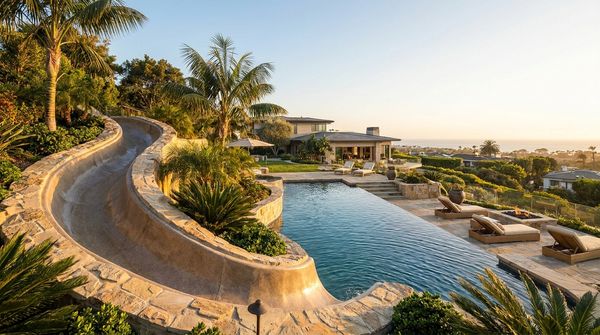
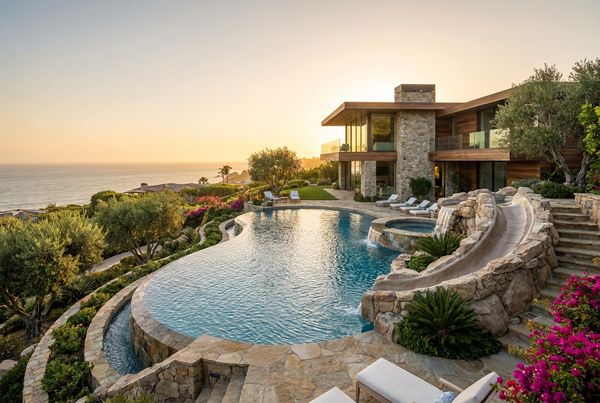
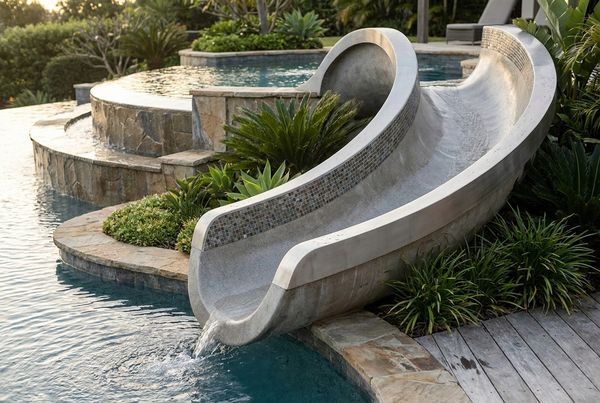
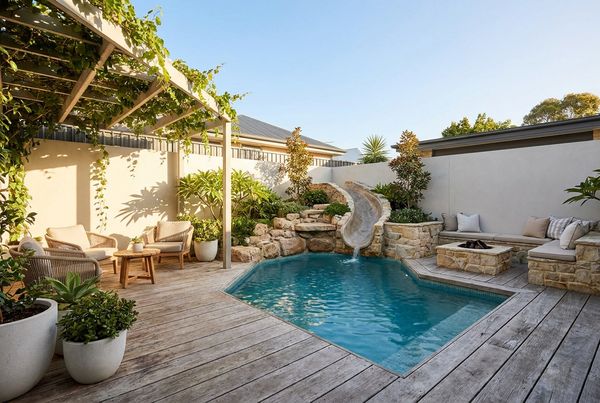
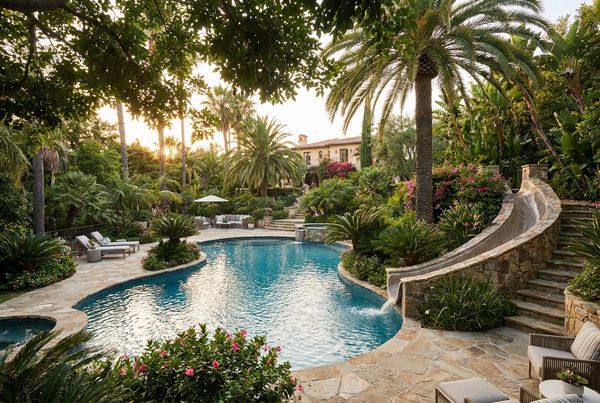
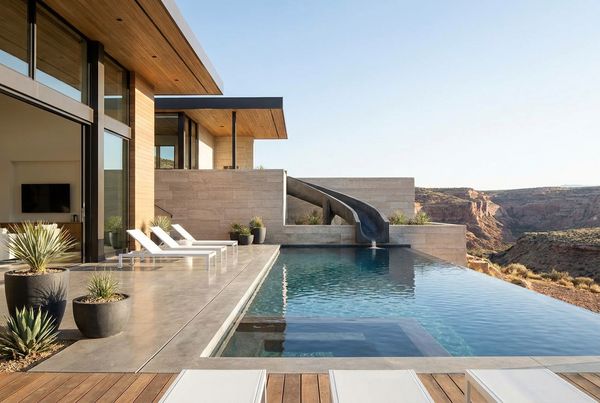
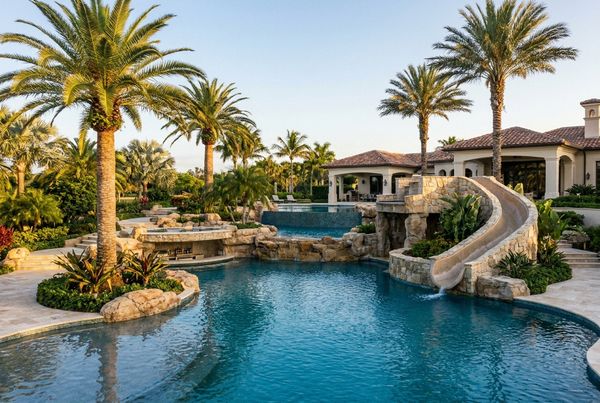
- Rock and waterfall slides. Custom slides sculpted into boulders and gunite so the flume disappears into the landscape, often with water spilling alongside. These are landscape features as much as rides.
- Grotto slides. A rock slide that launches you out of a cave — the resort move, and the most dramatic of the bunch. See our pool grotto ideas guide for how the cave and slide are built as one.
The first three are freestanding products you buy and install; the last two are built-in features constructed on-site. That split — freestanding versus built-in — is the single biggest fork in cost, look, and installation, and it's worth its own section below.
Safety & depth requirements
Safety on a pool slide comes down to two things: depth and clearance. Most residential slides require at least 3 to 4 feet of water at the runout, and taller or steeper slides need more — the manufacturer's spec sheet is the number that governs, not a guess. Installing a fast slide over a shallow end is the most common and most dangerous mistake, so confirm the depth at the exact splash-down point before anything is bolted down.
Just as important is a clear splash-down zone. The area where riders land should be free of steps, benches, walls, ladders, and other swimmers, so no one hits a hard surface or another person coming down. Beyond that, the fundamentals are simple: slip-resistant steps, a sturdy handrail, a flume sized for the rider, and a few house rules — one at a time, feet first, look before you go. A slide designed around real depth and a clear landing is remarkably safe; one squeezed into a pool that can't support it is not.
What we think
Design the slide and the pool together, not the slide as an afterthought. The single biggest regret we see is someone falling in love with a tall, fast slide and then discovering their pool is too shallow at the landing — so they end up with a small, gentle slide instead of the one they wanted. If a slide matters to you, tell your builder before the shell is dug so the depth, the deck clearance, and the plumbing are all designed around it. On the splurge question: skip the fancy freestanding slide, spend on a built-in rock slide only if you're already going custom and gunite — otherwise a good curved fiberglass slide delivers 90% of the fun for a fraction of the cost.
Built-in rock slides vs. freestanding
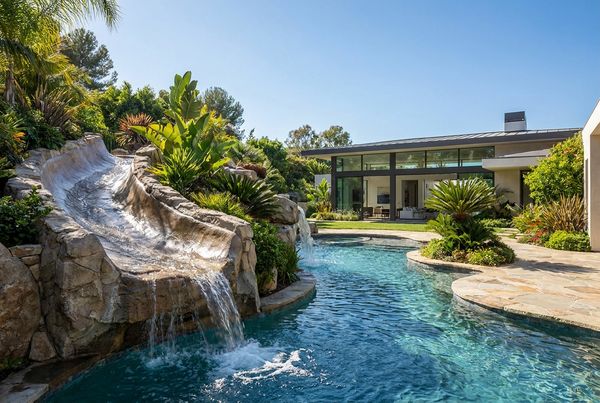
This is the fork that shapes everything. A freestanding slide is a manufactured fiberglass unit you buy, deliver, and bolt to the deck — quick to install, available in straight, curved, and tube styles, and by far the more affordable route. It's the right answer for most backyards, and it's the only realistic option for an existing pool, since it doesn't touch the shell. The trade-off is that it always looks like an added product, however nicely finished.
A built-in rock slide is a different animal: hand-sculpted from gunite and rock on-site so the flume winds through boulders and disappears into the landscape. It's the same craft as a grotto and, like a grotto, it's gunite-only — you can't build one onto a fiberglass or vinyl pool. It needs its own footing and plumbing tied into the pool structure, which is why it's far easier to design into a new build than to retrofit. The payoff is that it doesn't read as a slide sitting on the deck; it reads as part of the yard, especially when water spills alongside it. This is custom, poured-in-place work — exactly what our gunite pools guide covers.
Kids' slides vs. adult slides
Who rides the slide should drive which slide you buy. For young kids, a low, gentle slide with a short flume and a soft, slow ride over a shallow end is ideal — enough fun to thrill a five-year-old without the height or speed that demands deep water and constant nerves. These pair naturally with the shallow shelves and beach entries in our kids' pool ideas guide.
For older kids, teens, and adults, the calculus flips: a taller curved slide or an enclosed tube slide delivers the speed and drop that make the ride genuinely exciting, but it requires deeper water and a bigger clearance zone. The families who get this right often plan for both — a modest slide the little ones can use unsupervised-ish, plus enough depth that a faster slide works when the kids grow into it, or a diving board alongside for the older crowd. Thinking about who'll use the pool in five years, not just today, is what keeps a slide from being outgrown.
What a pool slide costs
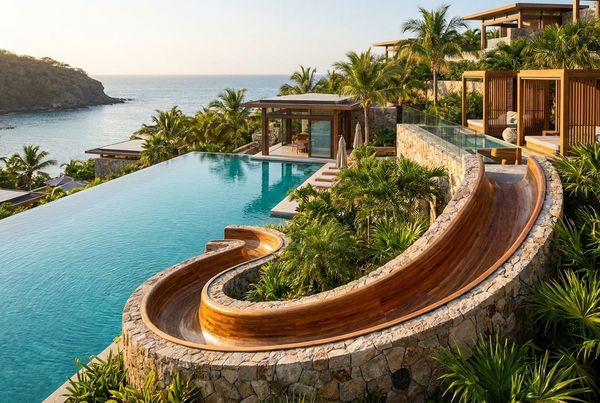
Cost tracks almost entirely with that freestanding-versus-built-in split. A freestanding fiberglass slide typically runs $1,500 to $8,000 installed, depending on size and whether it's a straight, curved, or tube model, plus a bit for the water line and deck anchoring. A built-in rock or grotto slide is a different category — usually $10,000 to $40,000 or more — because it's hand-built from gunite and rock on-site. Whichever you choose, budget it as an add-on to your inground pool cost, never a substitute for it.
| Slide type | What you get | Typical 2026 cost* |
|---|---|---|
| Straight freestanding | Short direct chute, compact footprint | $1.5k–$4k |
| Curved / tube freestanding | Winding or enclosed flume, more thrill | $3k–$8k |
| Built-in rock slide | Gunite-and-rock flume woven into the pool | $10k–$25k |
| Grotto / resort slide | Sculpted slide launching from a cave, water feature | $25k–$40k+ |
*Ballpark U.S. installed ranges; size, height, materials, and region move the number substantially. See the full picture in our inground pool cost and luxury pool designs guides.
The big cost swings on the built-in side are size and rockwork — the same factors that drive grotto pricing, since a rock slide is built the same way. On the freestanding side, height and flume length are the main levers, and a quality slide with a smooth gelcoat flume is worth the upcharge over a bargain unit that rides rough and fades in the sun. If budget is tight, a good curved fiberglass slide is the value pick every time.
Space, placement & pairing features
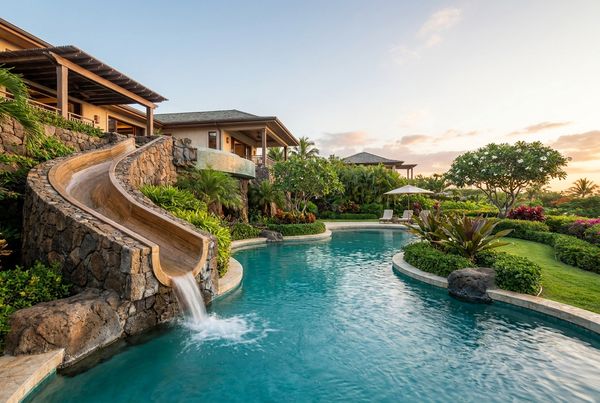
A slide needs more room than its footprint suggests. Beyond the deck space for the slide itself and its steps, you need the clear runout zone in the water and enough deck around the base for a rider to climb up safely. Curved and flume slides are friendlier here because they curl back toward the pool rather than projecting straight out, which is a big reason they've become the default. Placement matters visually too: a slide tucked against a corner or the deep end reads as part of the pool's shape, while one plopped in the middle of a run of deck looks like an add-on.
The best builds pair the slide with other features so it doesn't stand alone. A slide beside a diving board doubles a pool's play value; a slide woven into a waterfall or grotto turns the whole rock mass into one cohesive feature; and slides sit naturally alongside the tanning ledges, bubblers, and spillover spas that anchor a family pool. Bring your references to the designer early — a slide, a water feature, and a grotto conceived together look intentional, while the same pieces added one at a time look cluttered.
2026 resort-style slide trends
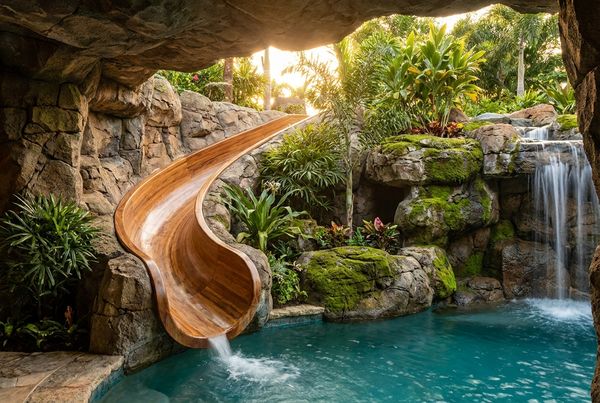
The clear direction for 2026 is resort-at-home — slides that stop looking like pool products and start looking like landscape. The most-requested builds weave the slide into rockwork and grottos, so it launches you out of a cave or down a boulder run with water spilling alongside, wrapped in dense tropical planting that makes the whole thing read as found rather than built. It's the same instinct driving softened, freeform pool shapes and lagoon-style designs across the board.
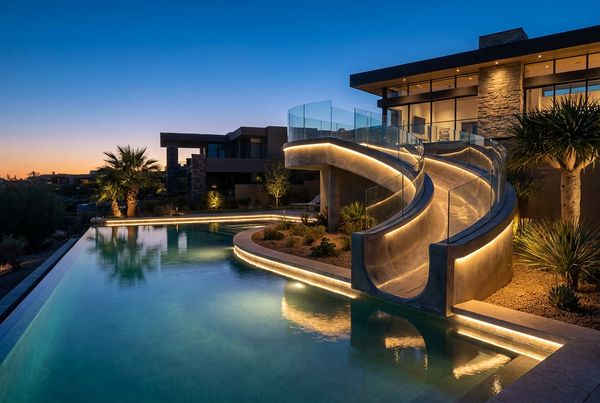
Two upgrades are showing up on nearly every high-end slide: bold LED lighting run along the flume and inside any grotto, so the slide glows as the yard's centerpiece after dark, and smart automation that turns the slide's water flow and lighting on from a phone alongside the rest of the pool's features. Pair those with the dark interior finishes and integrated water features that define the current look, and a slide becomes part of a cohesive, resort-style outdoor living space rather than a bolt-on. For the nighttime layer specifically, our pool lighting ideas guide covers how to light a slide and its surroundings well.
Is a pool slide worth it?
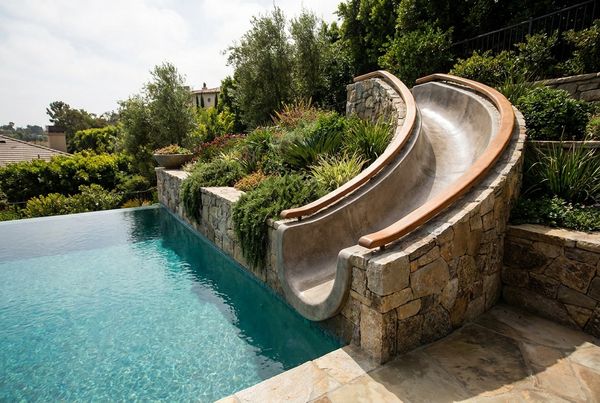
For a family pool, a slide is one of the highest-joy-per-dollar features you can add. A quality curved fiberglass slide costs a fraction of a grotto or an infinity edge and delivers more day-to-day fun than almost anything else in the yard — kids use it constantly, parties revolve around it, and it keeps a pool feeling exciting for years. If children or grandchildren are part of the picture, it's an easy yes.
The honest caveat is fit. A slide only works if your pool has the depth and clearance to support it, so it has to be planned early rather than wished for later — and a custom rock or grotto slide only makes sense if you're already committed to a gunite build with the budget for sculpted rockwork. Our advice: for most families, buy a good curved freestanding slide, place it so it curls against the pool's shape, and confirm the depth before anything is anchored. If you're going all-in on a resort look, build the slide into the rockwork from day one. Start with our gunite pools and pool grotto guides, then browse the full kids' pool ideas guide to shape the vision before you break ground.
Installing a slide: DIY or hire a pro
A freestanding fiberglass slide sits right at the edge of a capable DIY project — but the edge is where people get into trouble. The unit itself bolts to the deck and taps a water line, which sounds simple. The catch is that a slide anchored into the wrong surface, or over water that's too shallow, is a genuine injury risk, and getting the anchoring and the runout depth right is exactly the part beginners underestimate. If you're confident with the deck-mount hardware and you've verified the depth against the manufacturer's spec, a curved freestanding slide is a realistic weekend install. If any of that feels shaky, pay a pro — this is not the place to guess.
A built-in rock or grotto slide is never a DIY job. It's poured-in-place gunite and sculpted rock with its own footing and plumbing tied into the pool structure, the same craft as a pool grotto, and it belongs to the same crew building the shell. The practical rule: freestanding slides can be homeowner-installed with care, built-in slides are contractor-only. Either way, the water line feeding the flume should be plumbed cleanly off the system rather than left as a garden hose draped across the deck — if you're roughing in plumbing anyway, coordinate it with the rest of your pool water features so it all runs off one control.
Keeping a pool slide clean and lasting
A slide lives outdoors in sun, chlorine, and splash all season, and a little upkeep keeps it looking and riding like new. The flume collects the same grime as any deck surface — pollen, dust, sunscreen film, and the odd leaf — so a periodic wipe-down with mild soap and water keeps the ride smooth and the surface from getting slick with algae in shaded, damp spots. Check the deck anchors and any handrail bolts at the start of each season; a slide loosens over years of use and thermal expansion, and a wobble is your cue to re-torque.
The single biggest enemy of a fiberglass slide is the sun. UV slowly fades and chalks a cheaper gelcoat, which is exactly why the quality of that finish is worth paying for up front — a good flume holds its color and its smoothness for years, a bargain one goes rough and dull fast. In freezing climates, drain the slide's water line before winter and cover or store the unit if you can, the same way you'd protect other exposed equipment when you close the pool. And don't forget the water underneath it: a slide gets used hardest exactly when the pool is busiest, so keeping chemistry balanced through heavy-use stretches matters — our pool calculator makes it easy to dose correctly before a weekend of nonstop rides.
Design Gallery
6 more ideas to save — tap any photo to view full screen.

Kelly E.
Pool Design Editor, PoolPad
Kelly has spent 10+ years around residential pools — planning projects, testing gear, and documenting backyard builds for PoolPad. Each design guide is checked against current construction methods and material pricing.
Frequently Asked Questions
How much does a pool slide cost?
How much water depth do you need for a pool slide?
Can you add a slide to an existing pool?
Are pool slides safe for kids?
What's the difference between a straight and a curved pool slide?
Do pool slides need a water supply?
Can I install a pool slide myself?
How do you maintain a pool slide?
How long do pool slides last?
Ready to build your dream backyard?
Compare local, vetted pool builders and get matched with pros who can bring these designs to life.
Find a Pool Builder Near You