




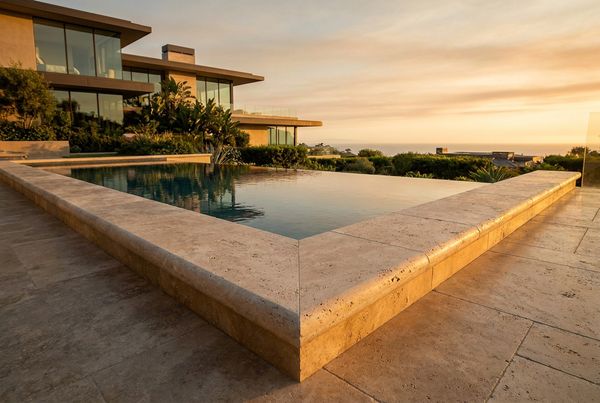
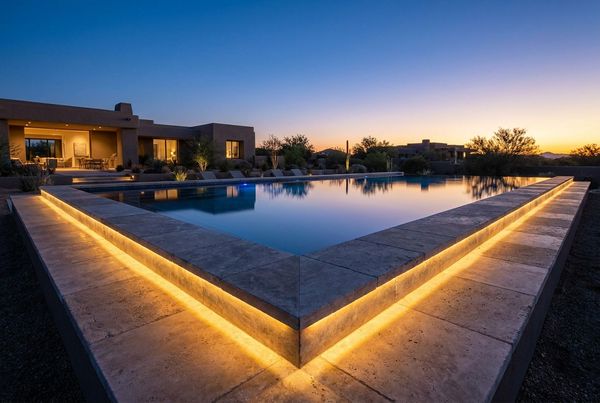
Key Takeaways
- Coping is the cap around the pool's edge — the highest-impact detail on the whole build and the first place a cut-rate job shows.
- Travertine and natural stone read most premium and stay cool underfoot; poured concrete is the value baseline and porcelain the sharp modern pick.
- Choose the edge profile for safety and style: rounded bullnose is soft on hands, square-edge reads modern, rolled is easiest on elbows.
Coping is the cap that runs around your pool's edge — the strip your hands grab, your elbows rest on, and your eye lands on every time you look at the water. It's a small percentage of the budget and the single highest-impact detail on the whole build. Get it right and an ordinary pool looks custom; get it wrong and it's the first tell of a cut-rate job. After decades framing pools, here's how the popular pool coping ideas really compare.
What coping is and why it matters
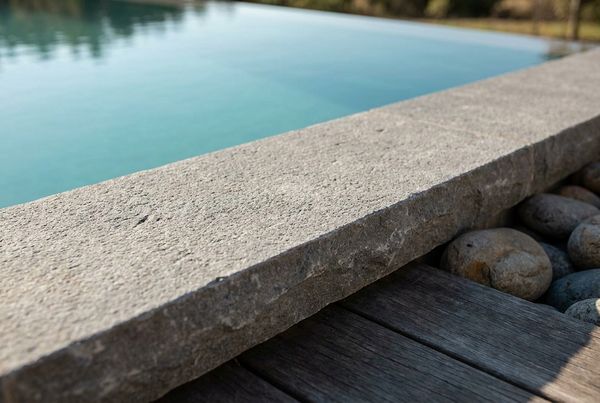
Coping is the capping material that sits on top of the pool shell, covering the joint where the concrete or fiberglass structure meets the surrounding deck. It does three jobs at once. Structurally, it protects the vulnerable top edge of the shell and helps direct splash-out and rain away from the pool rather than back into it. Functionally, it's the ledge swimmers grab to rest, pull up on, and cross barefoot. Visually, it's the frame around the water — the line that separates the blue of the pool from the tone of the deck.
Because it does all three, coping punches far above its size. It's typically only a foot or so wide, but it runs the entire perimeter and sits exactly where the eye and the hand land. That's why we tell every client the same thing: this is not the place to save money. A beautiful field of deck with sloppy, mismatched coping always looks cheap, while a modest concrete deck with a crisp, well-chosen coping always looks intentional.
Coping materials compared
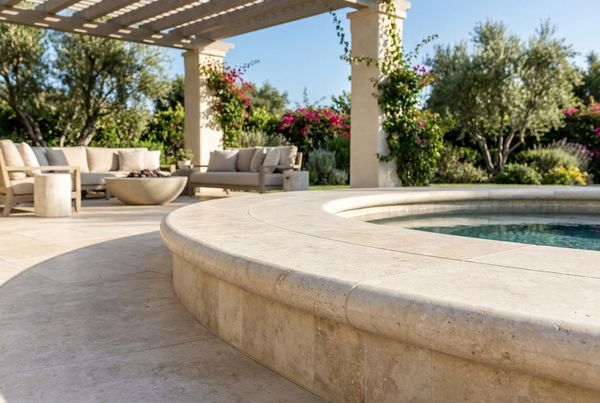
Every coping material is a trade-off between four things: how it looks, how hot it gets under bare feet, how well it grips wet skin, and what it costs installed per linear foot. Here's the honest breakdown of the five materials that cover almost every pool built today.
| Material | Look | Heat underfoot | Grip | Cost / linear ft* |
|---|---|---|---|---|
| Poured concrete (cantilever) | Clean, minimal | Warm | Good | $20–$35 |
| Brick | Traditional, warm | Warm | Good | $25–$40 |
| Travertine | Premium, natural | Cool | Very good | $30–$50 |
| Natural stone (limestone, granite, bluestone) | High-end, characterful | Cool–moderate | Very good | $40–$70 |
| Porcelain | Modern, uniform | Cool–moderate | Very good | $35–$65 |
*Approximate 2026 U.S. installed ranges per linear foot. Custom cuts, mitered edges, and raised walls push the final number up.
Travertine & natural stone: the premium picks
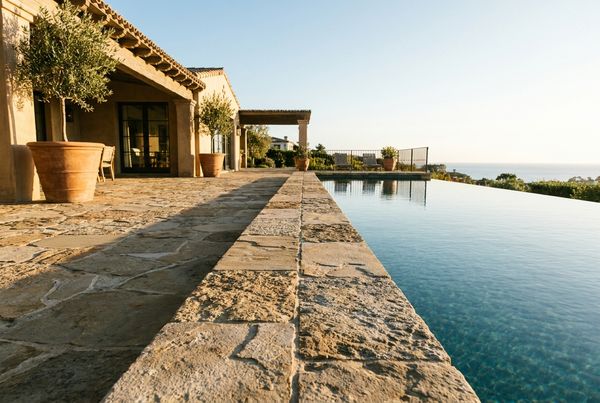
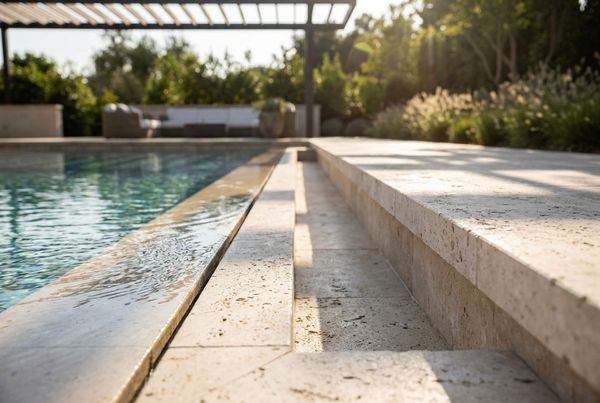
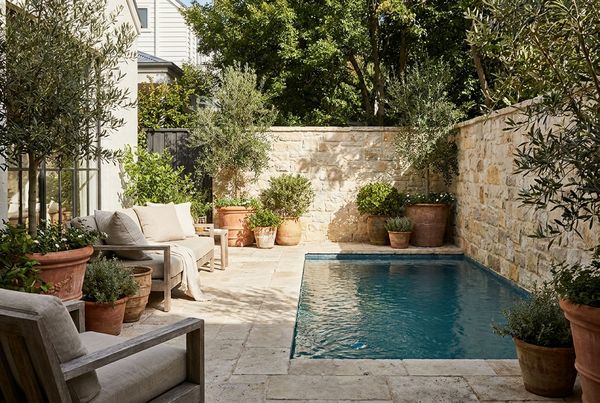
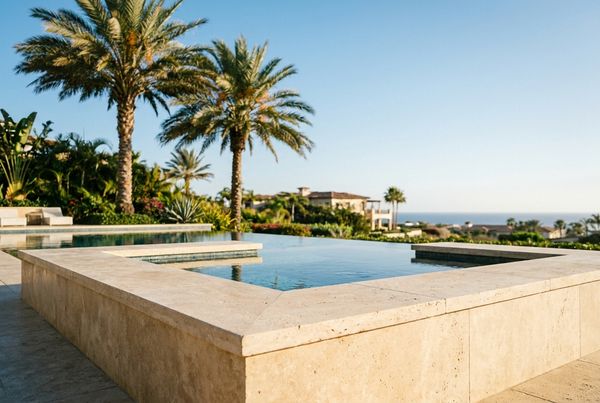
If we had to name the two materials that dominate premium coping, it's these. Travertine is a natural limestone with a light, naturally porous surface that stays cooler than almost anything else and grips wet feet without feeling harsh. A tumbled, filled-and-honed travertine cap reads instantly high-end and ages gracefully — the ivory and walnut tones only look better with a little patina. It's also widely available with matched deck pavers and pre-cut bullnose pieces, so the whole edge stays consistent.
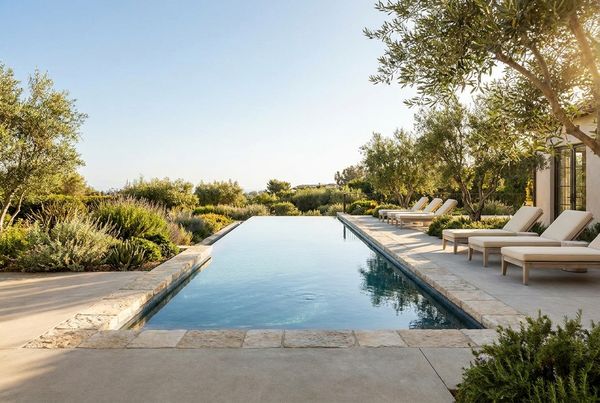
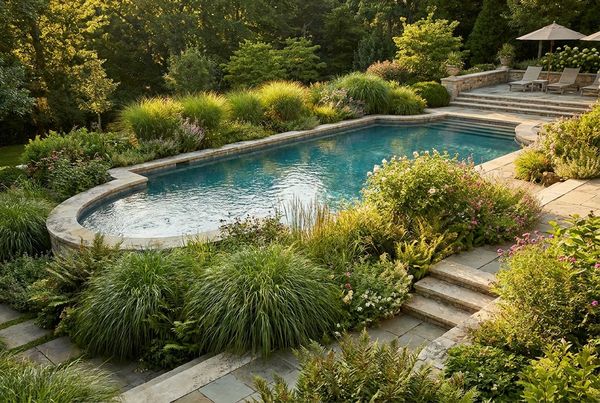
Natural stone — limestone, granite, bluestone, sandstone — is the step up in character and price. Each piece is a little different, which is exactly the appeal: a granite or bluestone cap has depth and variation no manufactured product can copy. The trade-offs are cost and consistency. Darker stones absorb more heat, so in Phoenix or Dallas a dark granite cap can be genuinely hot by afternoon. And because pieces vary, natural stone rewards a skilled installer who dry-lays and sorts before setting. For a high-end build, this is where we'd spend — a beautiful stone coping does more for the finished look than almost any other upgrade, and it pairs beautifully with a pebble interior finish and a coordinated deck.
Concrete, brick & porcelain: value and edge control
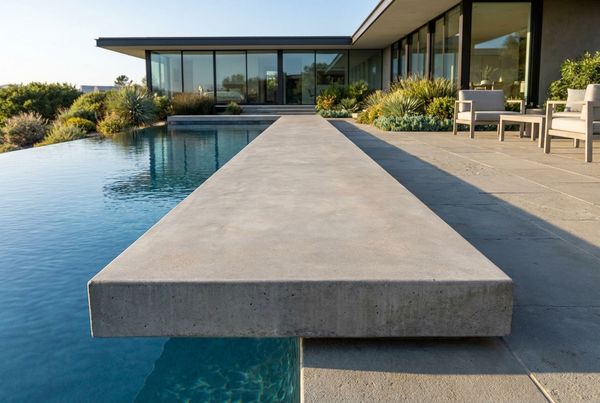
Not every great pool needs stone. Poured concrete, formed as a cantilever edge that flows straight from the deck over the shell, is the most affordable coping and cleaner than its reputation suggests. Done well, with a crisp form and a light color, cantilever concrete gives a minimal, monolithic edge that suits modern designs — and it costs a fraction of stone. The cautions are the usual concrete ones: keep the color light so it doesn't cook, and accept that concrete can eventually hairline-crack.
Brick is the traditional choice, and it's having a quiet comeback. A soldier course of brick around the edge reads warm and classic, fits colonial and traditional homes, and hides the shell joint neatly. It's mid-priced and forgiving to install.
Porcelain is the newest option and the one to reach for when you want a truly sharp, modern edge. Manufacturers now make porcelain coping and bullnose pieces with dead-uniform color, near-zero water absorption, and crisp square profiles that concrete and stone can't match. It resists stains, fading, and freeze-thaw, and it rarely needs sealing. The catch is installation: porcelain wants a precise base and careful cutting, so it's not the material to hand a bargain crew. Done right, it's the closest thing to a maintenance-free edge — a natural fit for the clean geometry in our modern pool designs.
What we think
If the budget allows, spend on the coping and let the deck be humble. A light concrete field with a travertine or natural-stone coping looks more expensive than a stone deck with cheap edges — the eye lands on the water's edge, so put your money there. For a modern build, a square-edge porcelain cap in a color that contrasts the deck is the single sharpest upgrade you can make. Whatever you choose, obsess over the mitered corners and the tightness of the joints — that's where quality shows.
Edge profiles: bullnose, square-edge & rolled
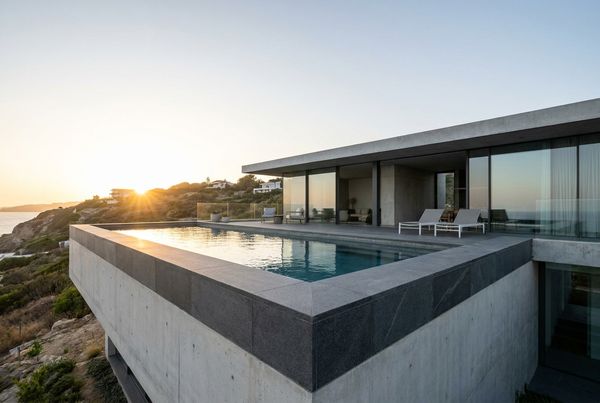
The profile — the shape of the coping's outer edge — matters as much as the material, because it's what your hands and elbows actually feel. There are three families worth knowing.
Bullnose is the rounded, classic profile: a smooth radius on the top outer edge that's soft on hands, easy on toes, and forgiving when a swimmer pulls up out of the water. It's the safest, most comfortable everyday choice and it never looks dated.
Square-edge (often a cantilever or porcelain cap) has a crisp, near-90-degree edge that reads sharp, architectural, and unmistakably modern. It's the defining detail of contemporary pools in 2026. The one caveat: a true sharp edge is a little less forgiving on elbows, so many builders soften it with a tiny eased corner that keeps the modern look while taking the bite off.
Rolled and safety-grip profiles sit between the two — a deeper curl on the underside gives fingers something to grab and is the kindest edge for kids and older swimmers. Match the profile to who's using the pool.
| Profile | Look | Comfort / safety | Best for |
|---|---|---|---|
| Bullnose (rounded) | Classic, timeless | Excellent | Family pools, traditional builds |
| Square-edge / cantilever | Modern, architectural | Good (ease the corner) | Contemporary and modern designs |
| Rolled / safety-grip | Soft, understated | Excellent | Kids, older swimmers, resort feel |
Matching your deck, tile & waterline
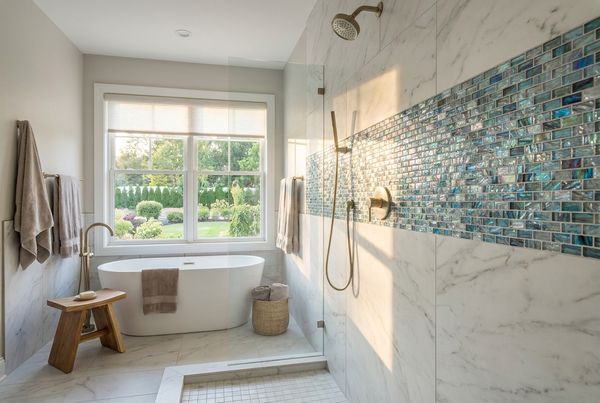
Coping never lives alone. It's the middle layer in a three-part stack: the deck behind it, the coping itself, and the waterline tile just below it. The best designs treat all three as one palette. A common, foolproof move is a warm travertine coping bridging a cooler grey deck and a blue-green glass waterline band — the coping becomes the transition that makes the two tones feel intentional rather than accidental.
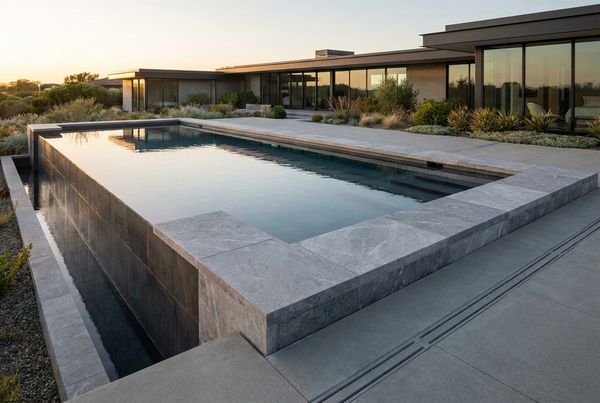
You have two strategies. Match the coping to the deck for a calm, monolithic look — a cantilever concrete deck-and-coping in one pour is the cleanest version of this. Or contrast the coping against the deck to define the water's edge, which is the stronger move in 2026. A dark stone cap against a light deck, or a light travertine cap against charcoal porcelain, draws a crisp line around the water and makes the pool read as the centerpiece it is.
Whatever you do, coordinate the coping with the waterline tile and any glass-tile band below it, and pull the whole scheme together with your deck material. Three unrelated choices look like a compromise; three coordinated ones look like a design.
Cost per linear foot & what drives it
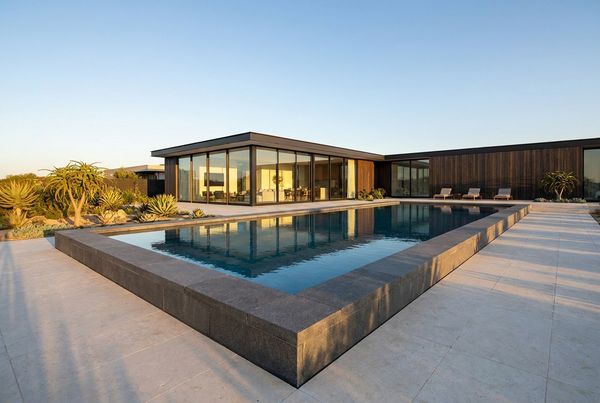
Coping is priced by the linear foot, and a typical residential pool has 70 to 120 linear feet of edge. In 2026, installed coping runs roughly $20–$70 per linear foot depending on material, with poured cantilever concrete at the low end, brick and travertine in the middle, and premium natural stone or custom porcelain at the top. On most builds that puts the coping line somewhere between $2,000 and $7,000 — a meaningful but not dominant slice of the total, which is worth planning alongside your overall inground pool cost from day one.
A few things drive that number up. Mitered corners and wrapped edges cost more than simple butt joints. Raised bond beams and walls need coping cut to cap them, which adds labor. Custom cuts around curves, steps, and features multiply cutting time. And material handling matters — heavy natural stone and precise porcelain both demand a skilled crew, and that labor is real. The honest takeaway: coping is one of the best places to spend a little more, because the upgrade lands exactly where everyone looks.
Sealing, caulking & keeping coping looking new

Coping is exposed to the harshest conditions in the yard — full sun, chlorinated splash, and freeze-thaw cycles in cold climates — so a little upkeep goes a long way. Porous materials like travertine, limestone, and concrete want a penetrating sealer every two to four years. Sealing doesn't change the look; it just keeps the surface from soaking up sunscreen, leaf tannins, and mineral spots, and it makes the whole cap easier to wipe down. Porcelain is the exception — it's dense enough that it almost never needs sealing, which is a real part of its appeal.
The detail that actually decides how long coping lasts, though, is the expansion joint. There's a deliberate gap between the coping and the deck, and it's filled with a flexible caulk — not grout — so the two can move independently as the ground shifts and temperatures swing. When that caulk dries out and cracks, water sneaks underneath the cap, and in a freeze it can pop coping loose. Refreshing the joint is cheap and quick, and it's the single best thing you can do to protect the edge; our pool caulking guide walks through when and how to redo it.
Everyday care is simple. Rinse off splashed-on chemicals, brush the shaded sections where a little algae can film up, and pull leaves out of the joint before they stain. If you do get staining, it's usually the same fix as the rest of the pool — check your water balance first, because scale and metal stains on coping often trace back to chemistry, not the stone itself.
Re-coping: upgrading the edge on an existing pool
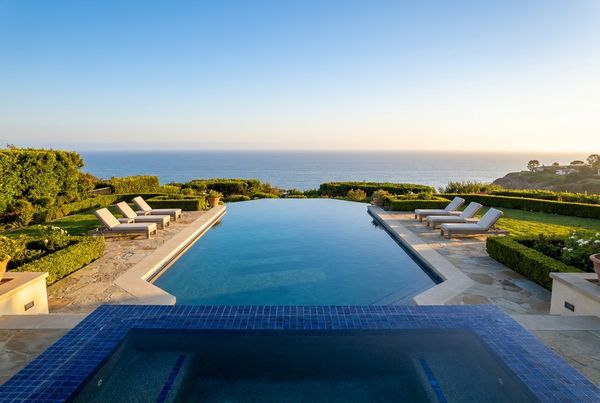
You don't have to build a new pool to get better coping. Re-coping — pulling off the old cap and setting a new one — is one of the most common standalone updates we see, and it delivers more visual change per dollar than almost anything else. A crew removes the existing coping, repairs the bond beam underneath, resets the new material, and re-caulks the expansion joint. On most pools it's a matter of days, and the shell, plaster, and plumbing are never touched.
It's often the opening move in a wider pool remodel. Tired grey cantilever concrete swapped for tumbled travertine or a crisp porcelain cap instantly modernizes a dated pool, and because you're already disturbing the edge, it's the natural moment to re-do the waterline tile in the same pass — the two share a work zone, so combining them saves labor. If the plaster is also aging, a re-coping, re-tile, and interior refinish together is the package that makes a twenty-year-old pool look brand new.
One honest caution: matching new coping to an existing deck is harder than starting fresh, because you're working around a deck you're keeping. Bring samples out to the yard and look at them wet and dry, in morning and afternoon light, before you commit — and price it as part of your overall pool budget so the edge upgrade lands where you'll notice it most.
Safety, comfort & the 2026 looks
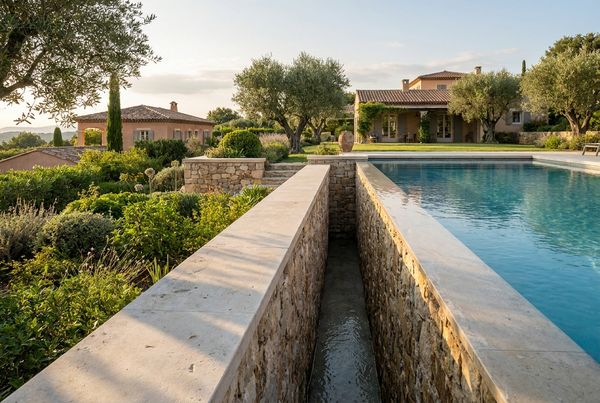
Start with safety, because coping is where wet feet meet the deck. Choose a textured, slip-resistant surface at the water's edge — tumbled travertine, brushed concrete, honed stone — and avoid polished or glassy finishes right where people climb out. A rounded or rolled profile at the grab point is both safer and more comfortable, and it's the detail older swimmers and kids feel first.
Then the fun part: the looks driving 2026. Contrasting dark coping against a light deck is everywhere right now — a charcoal stone or porcelain cap that draws a crisp frame around the water and makes blue pop. Sharp, modern square edges in porcelain and cantilever concrete continue to define contemporary builds, often paired with the softened-geometric shells and dark interior finishes trending alongside them. Coping is also doing more work than ever, capping raised walls, tanning ledges, and spillover spas — a continuous coping line that wraps from the pool up a raised retaining wall or around a spillover spa is what makes a multi-level design read as one composition instead of stacked boxes.
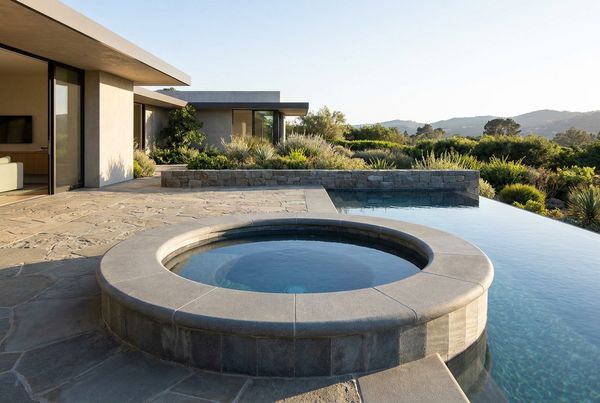
Finally, integrate the coping with the water in motion. A clean coping edge is the frame for laminar jets, sheer descents, and bubblers — plan it alongside your water features so the cap and the flow read as one detail. When you're ready to price it out, bring this comparison to a builder who does this every week; the difference between good coping and great coping is almost entirely in the hands setting it.
Design Gallery
7 more ideas to save — tap any photo to view full screen.

Kelly E.
Pool Design Editor, PoolPad
Kelly has spent 10+ years around residential pools — planning projects, testing gear, and documenting backyard builds for PoolPad. Each design guide is checked against current construction methods and material pricing.
Frequently Asked Questions
What is pool coping?
What is the best material for pool coping?
How much does pool coping cost per linear foot?
What is the difference between bullnose and square-edge coping?
Should pool coping match the deck?
Is pool coping slippery?
Does pool coping need to be sealed?
Can you replace just the coping without redoing the whole pool?
What causes pool coping to crack or come loose?
Should coping overhang the pool edge?
Ready to build your dream backyard?
Compare local, vetted pool builders and get matched with pros who can bring these designs to life.
Find a Pool Builder Near You