



Key Takeaways
- Sheer descents (sheetfall) and spillover spas give the most impact per dollar — clean, modern, and great sound.
- Bubblers on a tanning ledge and laminar/deck jets are affordable, kid-friendly, and stunning when lit.
- Natural rock waterfalls suit freeform/tropical designs but can look out of place on a sleek modern pool.
Water features are what your eyes and ears notice first. The right one turns a static rectangle of water into something alive — the hush of a sheet fall, arcs of light over the surface, the gentle churn of bubblers on a sun shelf. They also happen to be some of the best-value upgrades in a pool build, if you choose wisely. Below we walk every major type, what it costs, and who it's for.
Sheer descents (sheetfall)
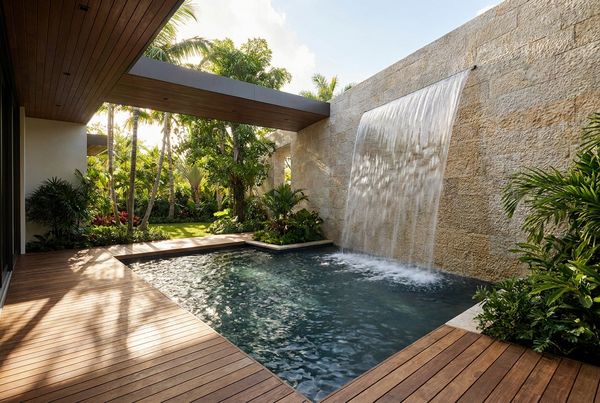
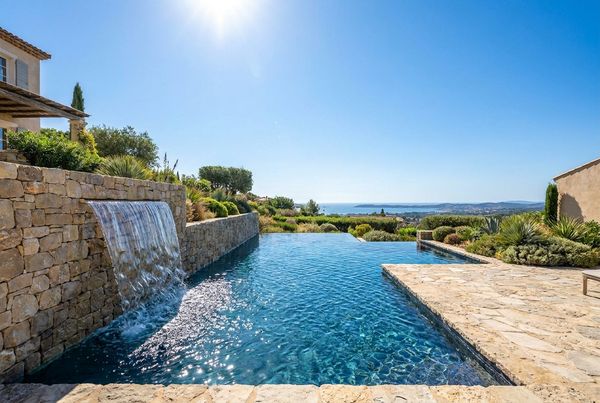
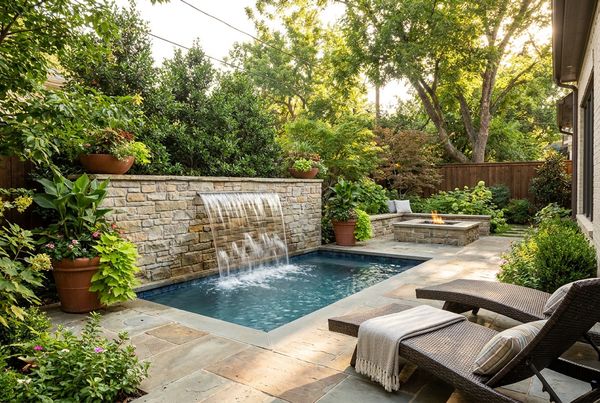
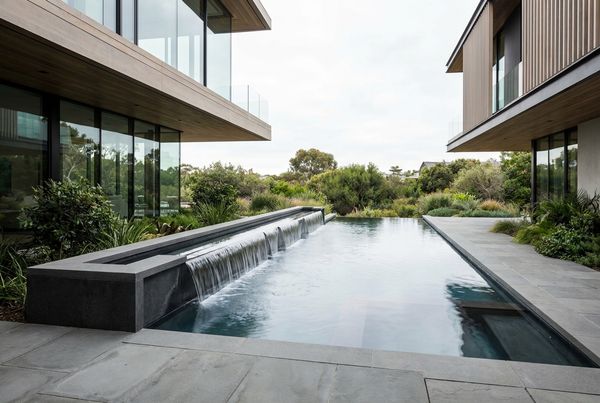
A sheer descent — sometimes called a sheetfall or waterfall wall — pours a wide, glass-smooth sheet of water from a raised bond beam or wall. It's the defining modern water feature for a reason: the line is architectural, the sound is a soft, even hush rather than a splash, and it flatters almost any style from mid-century to Mediterranean.
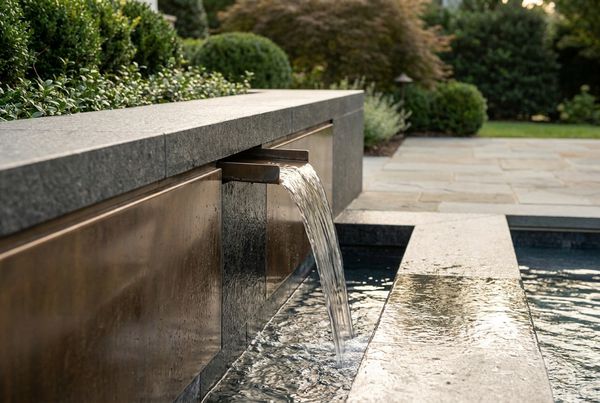
How it works is refreshingly simple: water is fed from the pool return line up to a slot-lipped spout set in the raised wall, and the flat lip shapes it into that seamless sheet as it drops. The wider and more level the lip, the cleaner the sheet — so the make-or-break is the mason's precision on the bond beam, not the hardware itself. Hire an experienced builder and the sheet holds unbroken across its full width; rush the wall and you get a ragged, dribbling edge that no amount of flow will fix.
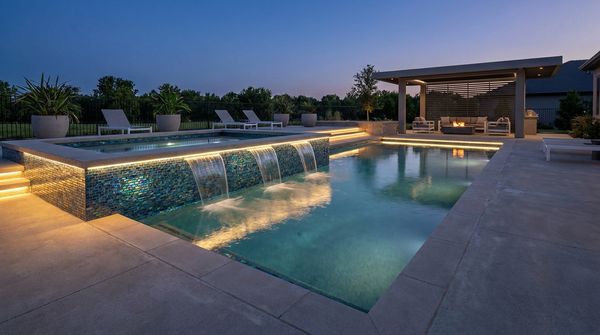
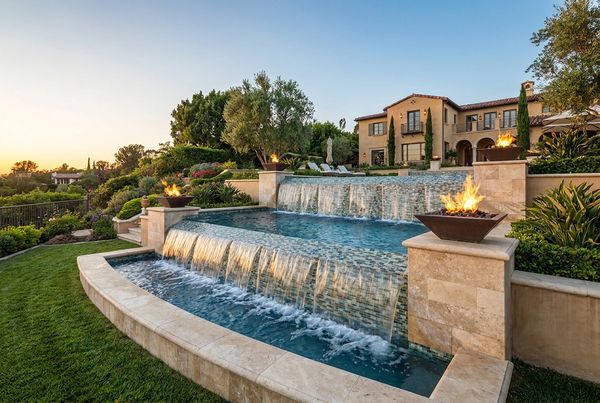
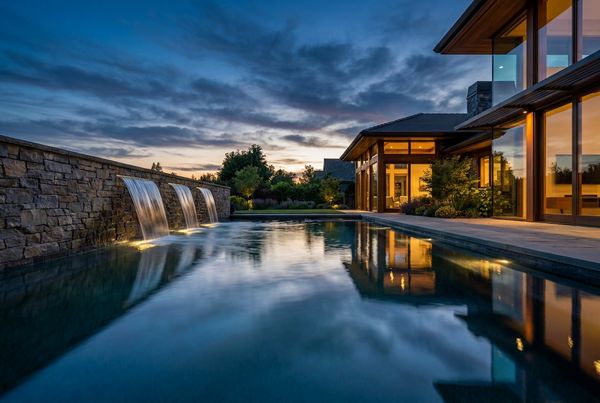
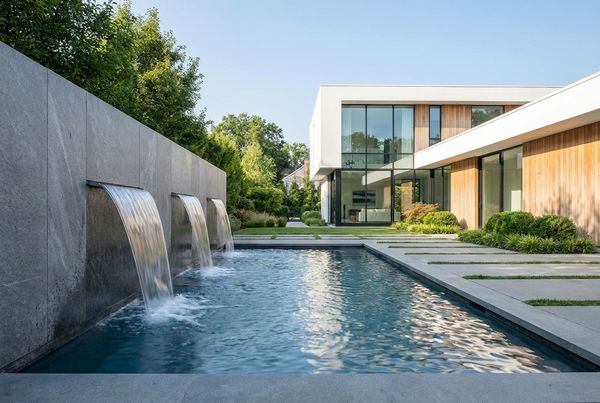
Cost and impact: low thousands installed, and the visual payoff is enormous per dollar. A single 24-inch spout reads as intentional; a run of three or four across a raised wall (see the multiple sheetfalls above) turns the whole back edge of the pool into a feature. Running costs are trivial since it typically shares the main pump, and putting it on its own valve lets you silence it for a still, mirror-like surface whenever you want.
Pros and cons: the upside is a soft, even hush that masks street and neighbor noise, plus a look that simply does not date. The main con is that the sheet needs enough flow to stay solid — starve it and it breaks into ribbons — so size the plumbing generously up front. It also needs a raised wall or spa to fall from, which not every layout has room for.
Who it's for: anyone building a clean, geometric, or contemporary pool who wants maximum impact without faux rock. Pair it with a raised wall clad in glass tile and it becomes the anchor of the yard. For 2026, the strongest look is a single wide, uninterrupted sheet lit from behind or below against a dark plaster interior — minimal, reflective, and unmistakably modern. This is our single most-recommended feature.
Spillover spas
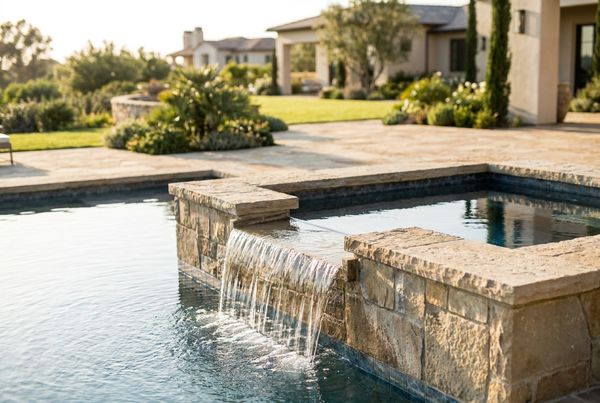
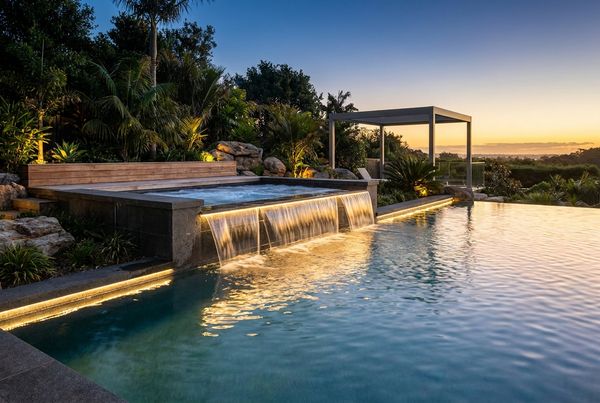
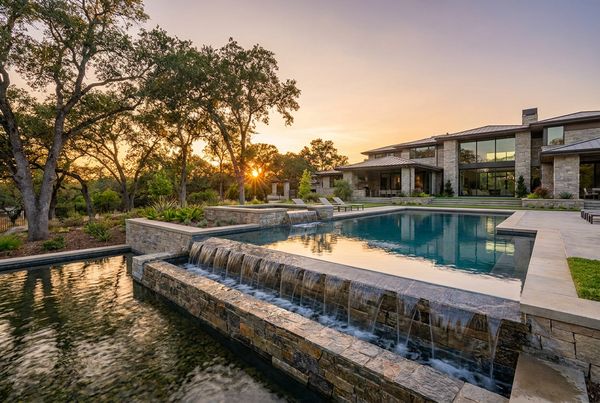
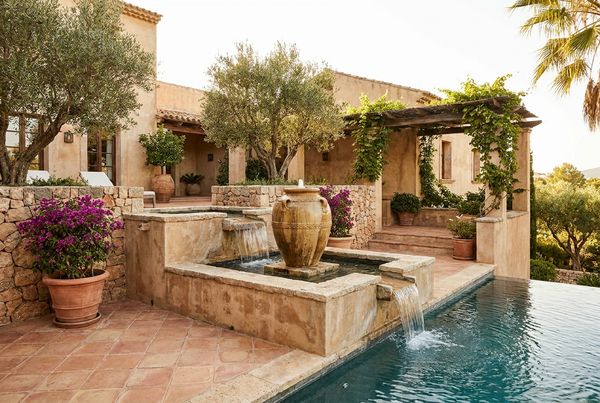
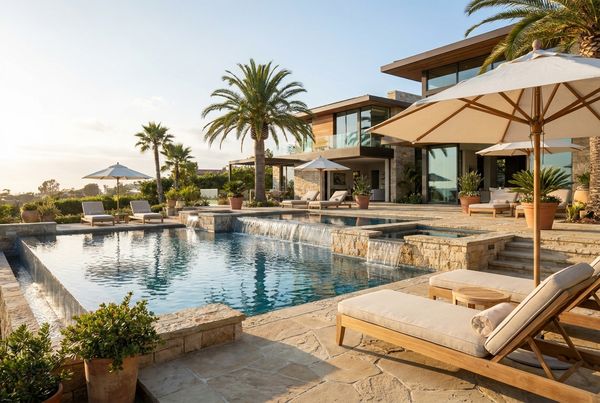
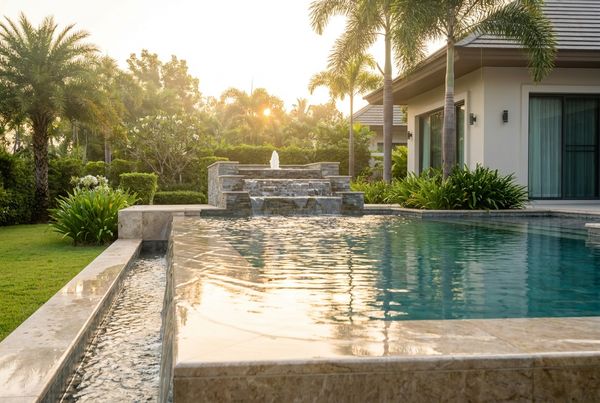
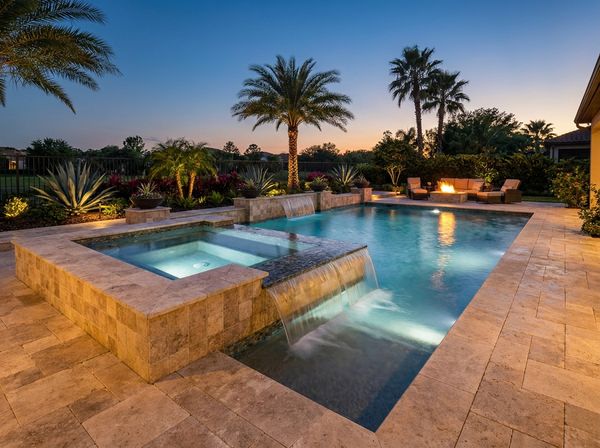
A spillover spa is a raised hot tub that spills into the pool over a smooth spillway — so you get a spa and a moving water feature from a single element. When the jets are off, the gentle overflow keeps the surface alive and the sound going; when they're on, you have a proper hot tub a few feet away.
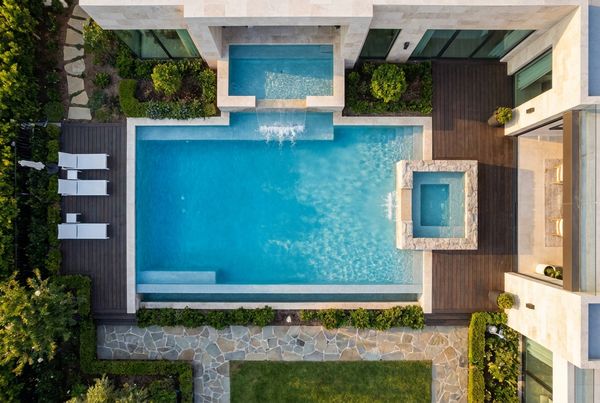
Mechanically, the spa sits a foot or so above the waterline, and its overflow weir (a smooth cut in the spa's edge) lets water sheet down into the pool. You choose the weir style: a narrow spout for a focused ribbon, or a wide spillway for a full sheet like a sheer descent. Most builders plumb the spa on a shared heater and dedicated spa jets, with automation so you can flip from "quiet spillover" to "full hot tub" from your phone.
Cost and impact: the spa itself is the big line item, but the spillover is nearly free once you're building a raised spa anyway. Dollar for dollar, it's the most efficient way to buy both relaxation and movement. Factor in the heater and cover as running costs — the spillway itself adds almost nothing to operate.
Pros and cons: you get two features for one footprint, and the raised mass gives the pool welcome vertical interest. The trade-offs are heating cost if you use the spa often, and the fact that a poorly placed spa can crowd a small yard. Keep the spillway wide and shallow for the cleanest sheet.
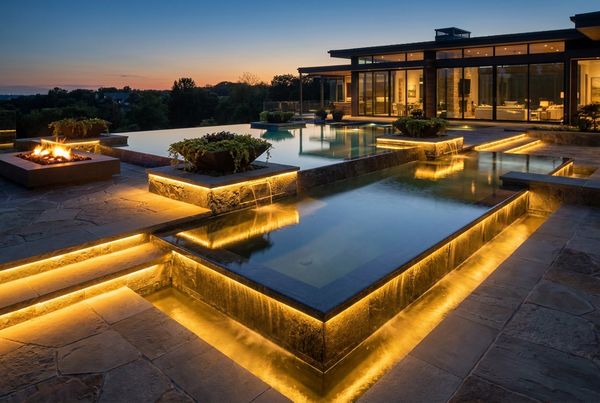
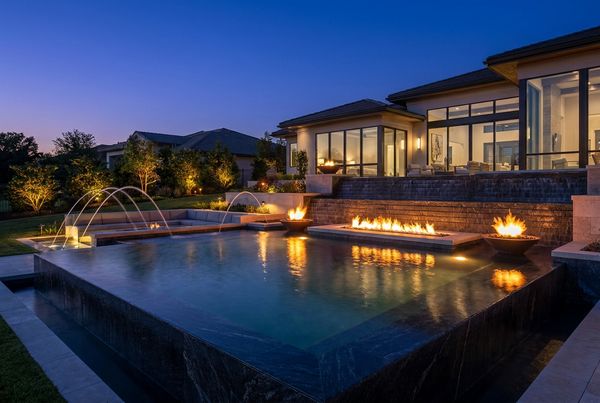
Who it's for: basically everyone building a spa. Raise it, spill it, and light the spillway. At dusk (image above), a spa spilling into a dark pool is one of the most photographed moments in any backyard. The 2026 move is a fully raised, tile-wrapped spa with a wide spillway and a matching sheer descent nearby, so the two sheets read as one deliberate design language.
Perimeter overflow & slot edges
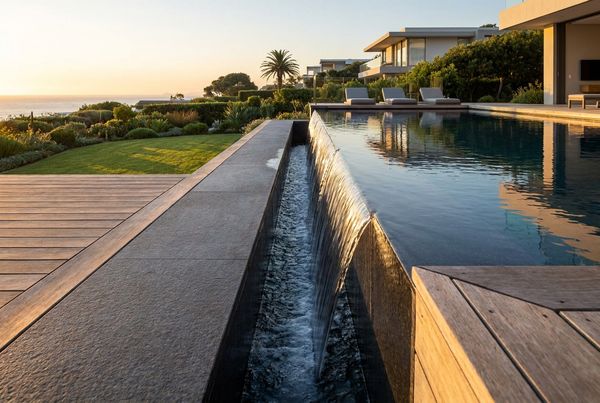
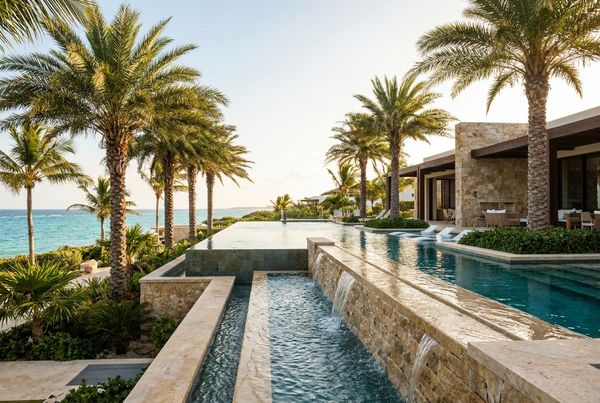
A perimeter overflow (or slot edge) sends water over the entire rim into a thin, hidden catch slot, so the pool sits perfectly full and mirror-flat — reflecting sky by day and lights by night. It's the close cousin of the infinity pool, but wrapping all four sides instead of one.
The engineering is what separates it from a garden-variety pool. Water sheets over a dead-level rim into a narrow slot, drains to a below-ground surge tank, and gets pumped back — a closed loop that must stay in perfect balance. That surge tank absorbs the displacement when swimmers get in (which would otherwise overflow the slot), and a dedicated pump keeps the rim wetted. Every element has to be built to a tighter tolerance than a normal pool, from the level of the coping to the calibration of the auto-fill.
Cost and impact: this is the premium end. It demands precise engineering, a surge tank, and flawless gunite work, so it's a serious investment — often adding a meaningful percentage to the whole build. The impact, though, is unmatched — a vanishing edge on every side is the most luxurious surface in the pool world.
Pros and cons: nothing else delivers that mirror-flat, edgeless plane, and it pairs perfectly with dark interiors and modern architecture. The cons are cost, complexity, and maintenance: the level tolerances mean you truly need a specialist builder, and the extra pump adds to running costs. It is unforgiving of settling or shortcuts.
Who it's for: high-end, architect-driven builds where a flawless reflective plane is the whole design idea. If dark reflective water is your vision, this is the ceiling — and reflective water is one of the defining 2026 trends, so a slot edge over a black interior is about as current as pool design gets.
Bubblers
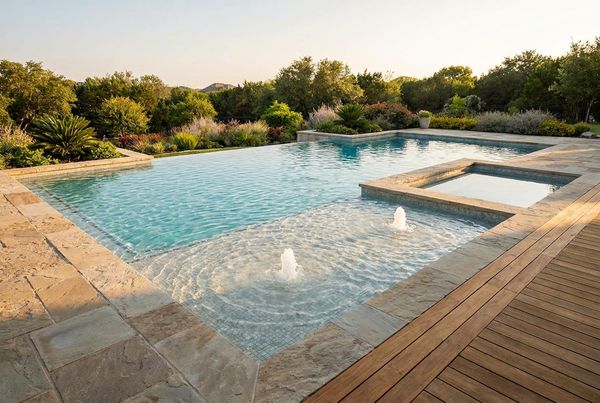
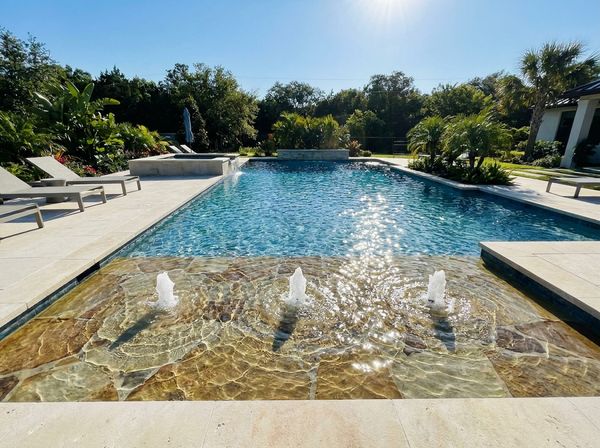
Bubblers are low fountains that gurgle up through a shallow tanning (Baja) ledge. They're the affordable crowd-pleaser: kids sit in the churn for hours, and after dark an LED underneath makes each one glow.
Each bubbler is a small nozzle plumbed under the shelf that pushes a low, foaming dome of water up through a few inches of depth. Because they sit in the shallowest part of the pool, they're gentle enough for toddlers to sit right in, and dropping an LED beneath each one turns them into glowing columns after dark. Builders usually run two or three symmetrically so the ledge reads as intentional rather than random.
Cost and impact: a few hundred to a couple thousand dollars for a pair or trio — pennies relative to the joy they deliver. Because they live on the sun shelf, they add movement and sparkle in the shallow zone where a pool is otherwise still, and they cost almost nothing to run off the main pump.
Pros and cons: cheap, kid-proof, and beautiful when lit — hard to fault. The only real caveats are that they demand a tanning ledge to live on, and the dome height is flow-dependent, so a shared pump running many features can leave them looking weak. Give them enough flow and they perform.
Who it's for: any pool with a tanning ledge, and especially families. If you're building a Baja shelf, adding bubblers is close to a no-brainer. In 2026, the popular pairing is bubblers plus lit laminar jets on the same pool — one feature for the kids in the day, both for the show at night.
Deck jets & laminar jets
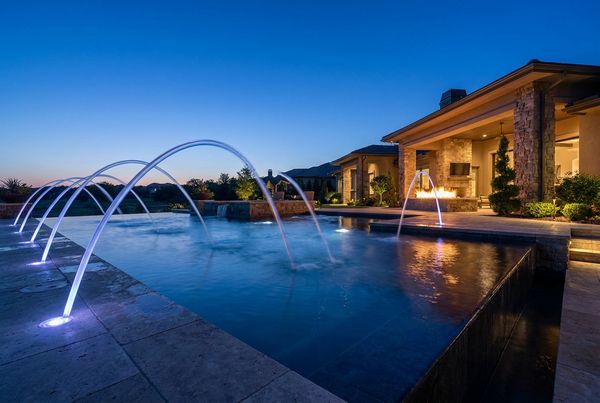
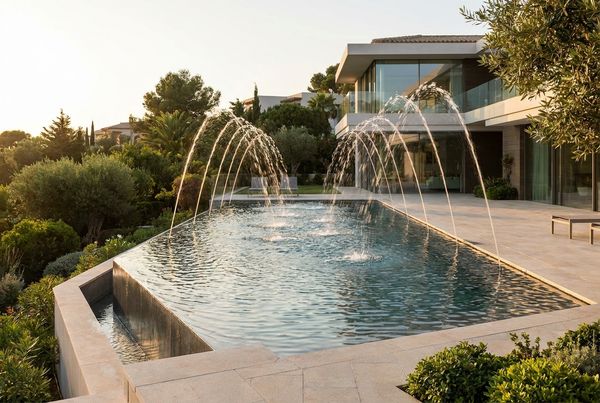
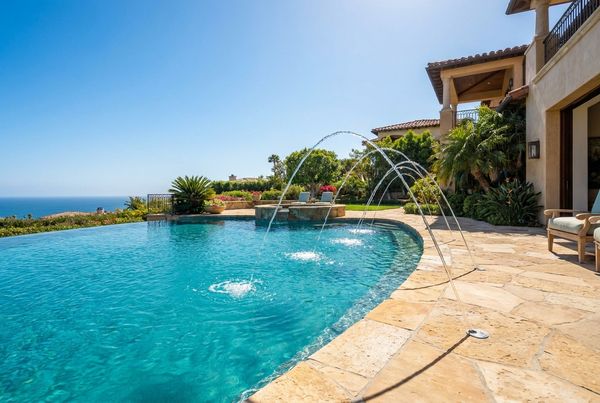
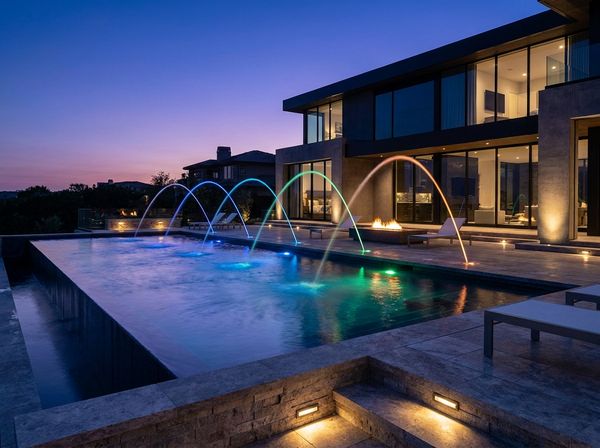
Deck jets shoot streams of water from the deck into the pool. Plain deck jets are cheap and cheerful; laminar jets are the upgrade — precision nozzles that throw a solid, rope-like arc of water so smooth it looks like glass, usually with an LED coloring the stream at night.
The magic of a laminar jet is laminar flow: the nozzle conditions the water so tightly that the stream holds together as a solid, glassy rope for several feet before it lands, with no spray or wobble. Deck jets are the simpler, splashier cousin — they arc water without that glass-clear finish, but at a fraction of the price. Both mount flush in the deck, and the good laminar units accept color-changing LEDs that light the entire arc from within.
Cost and impact: basic deck jets are a few hundred dollars; laminar jets run more per nozzle but deliver a genuine showpiece. By day they arc quietly (see the daylight version above); by night, lit, they're pure theater. Run them off a small dedicated pump and they'll cost only a few dollars a month when you use them.
Pros and cons: playful, symmetrical, and unbeatable at night — plus they're the easiest feature to add later. The downside is that laminar jets are fussier than they look: wind, debris in the nozzle, or low flow all break the clean arc, so they need occasional tending to stay picture-perfect.
Who it's for: anyone wanting a playful, symmetrical accent on a modern or transitional pool. Laminar jets are also the single easiest feature to retrofit, since they mount in the deck. Lit laminar jets are one of the standout 2026 trends — a crossing pair over a dark pool is the shot every builder wants in their portfolio.
What we'd add
Our default for a modern pool: a spillover spa plus a sheer descent — that covers sound, movement, and a hot tub in one coherent, timeless move. Add bubblers if you have a tanning ledge (cheap, and the best "wow" for kids), and consider a pair of lit laminar jets for night theater. Skip a giant faux-rock waterfall unless the whole design is genuinely natural or tropical — otherwise it dates the pool fast. And whatever you pick, run the plumbing during the build; retrofitting water features is expensive.
Scuppers & water walls
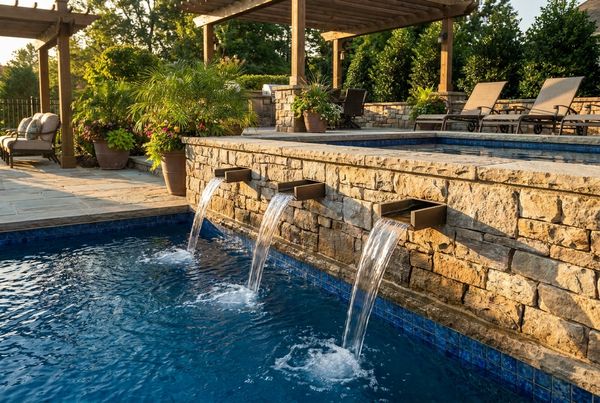
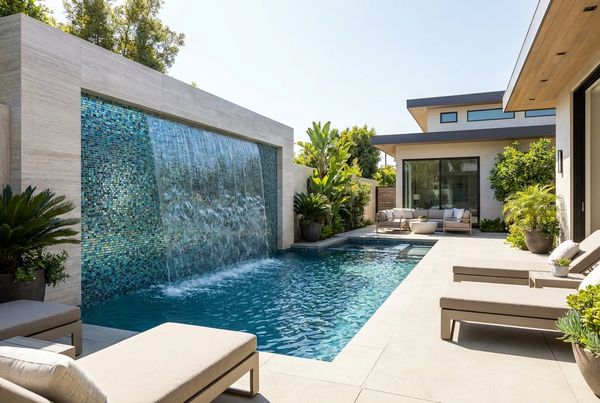
Scuppers are individual spouts set into a raised wall that pour into the pool — think of them as the punchier sibling of the sheer descent. Spaced evenly across a raised wall, they create rhythm and a livelier, splashier sound. A water wall takes it further: a full vertical face, often clad in glass tile or a rain curtain, that sheets or streams water down into the pool.
Each scupper is a spout — square, round, or a decorative bowl — plumbed through the raised wall so it pours a distinct stream rather than a continuous sheet. Line up three or five and you get a rhythmic, more animated look and a splashier sound than a sheer descent's hush. A water wall reverses the geometry: instead of pouring off a horizontal edge, water runs down a vertical face, either as a thin film over tile or, in a rain curtain, as dozens of individual droplet-streams from a slotted header above.
Cost and impact: scuppers are moderately priced and scale with count; a tiled water wall or rain curtain costs more because it's as much a masonry and finish project as a plumbing one. Budget for the tile or stone facing separately from the plumbing — the surface is often the bigger line item.
Pros and cons: scuppers bring pattern, rhythm, and a lively sound, and a tiled water wall doubles as a striking backdrop. The trade-off is that the extra splash can carry in wind and needs a wall to mount on; rain curtains especially want shelter, as a breeze scatters the droplets.
Who it's for: builds with a raised wall or spa that want texture and sound with a bit more visual pattern than a single sheet. A glass-tile water wall, in particular, doubles as a backdrop and a feature. For 2026, iridescent and dark-glass mosaic walls behind a thin water film are having a real moment — the tile shimmers through the moving water.
Rock waterfalls & grottos
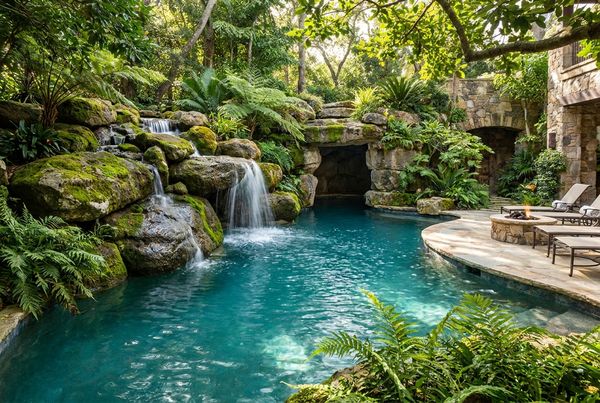
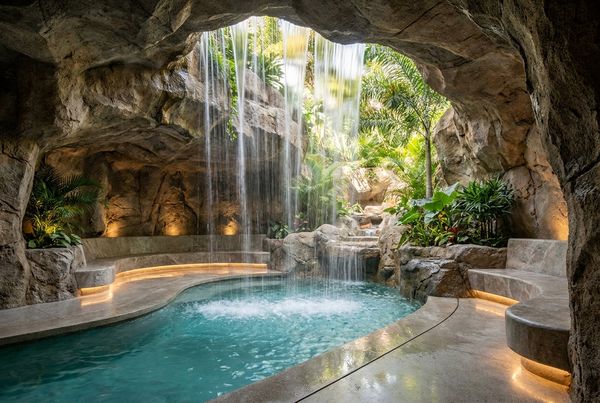
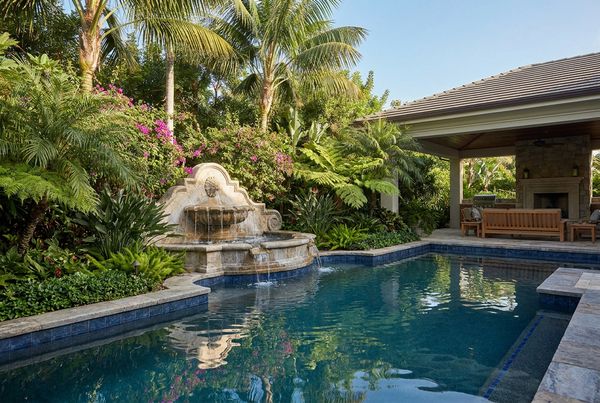
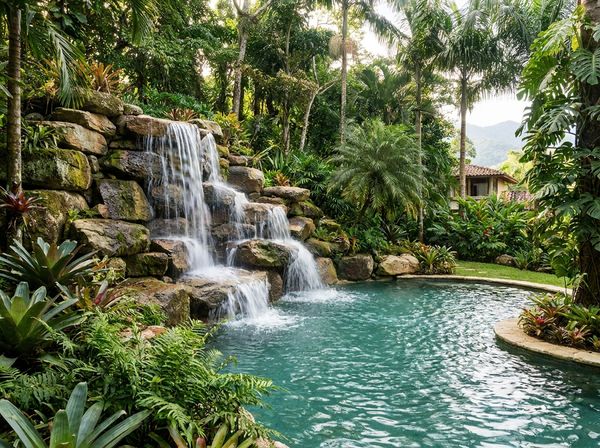
Rock waterfalls stack real or artificial boulders into a cascade, and a grotto hides a cave (sometimes with a bench or a swim-under) behind the falling water. Done well on a lagoon-style pool, they're spectacular — the closest thing to a private resort.
These are built one of two ways: real stacked boulders set with a crane and mortar, or artificial rock — steel-and-concrete forms hand-carved and colored to mimic stone. Real rock looks best and lasts longest but is heavy, costly, and hard to place; artificial rock is lighter and more flexible but can look fake if the artistry is weak. Water is pumped to the top of the cascade and tumbles down the face; a grotto simply builds a hollow behind or beside the falls, sometimes with a bench, a fiber-optic-lit ceiling, or a slide entry.
Cost and impact: the priciest and most variable feature here. A modest boulder cascade is a few thousand; a full grotto with a cave, seat, and slide can add many thousands and reshape the whole build. The dedicated waterfall pump also adds noticeably to running costs when it's on.
Pros and cons: at their best they're pure resort — the most immersive feature you can build, with a swim-under cave for kids. But they carry the highest cost, the most maintenance (algae and mineral staining on rock), and the biggest style risk. On the wrong pool they read as dated theme-park almost immediately.
Who it's for: genuinely natural, freeform, or tropical designs. Our honest take: on a sleek geometric pool, faux rock looks bolted-on and dates fast. Commit fully to the natural look, or skip it — half-measures read as theme-park. The 2026 direction, if you love the drama but not the boulders, is a rain curtain or a tiled water wall that gives you a falling sheet with a clean, modern face instead.
What we'd add
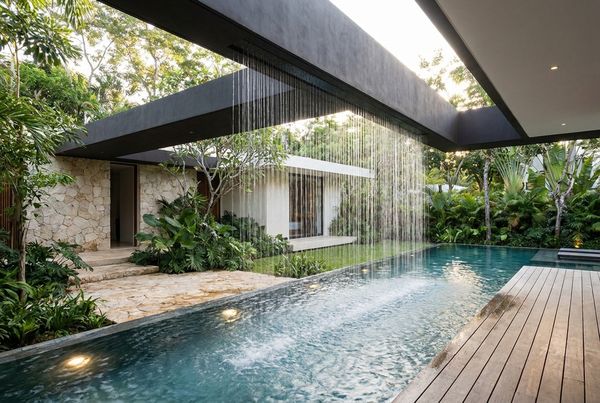
If we're spending on one thing, it's a sheer descent lit from within — the payoff at night, especially over dark reflective water, is the image people remember. Second is the spillover spa, because it earns its keep every cool evening. From there, bubblers and laminar jets are inexpensive ways to add movement and light. Coordinate every feature with your pool lighting plan from the start — a lit feature at night is worth ten times an unlit one by day. For a modern alternative to rock, a rain curtain gives you a dramatic falling sheet without the boulders.
The mistake we see most often is scattering too many different features on one pool: a rock waterfall on one end, scuppers on the wall, deck jets crossing the middle, and bubblers on the ledge all fighting for attention. Pick a coherent story instead. A modern pool wants clean sheets and lit jets; a lagoon pool wants rock and grotto; a family pool wants bubblers and a spillover spa. Restraint reads as luxury; a feature pile-up reads as a showroom. When in doubt, do fewer features, larger and better-lit.
Here's how we'd match features to the kind of pool you're building:
| If your pool is… | Lead with | Add | Skip |
|---|---|---|---|
| Modern / geometric | Sheer descent | Lit laminar jets, spillover spa | Rock waterfall |
| Family-focused | Bubblers | Spillover spa, deck jets | Grotto with slide (unless budget allows) |
| Natural / tropical | Rock waterfall | Grotto, boulder cascade | Slot edge |
| Luxury / architectural | Perimeter overflow | Sheer descent, dark reflective water | Faux rock |
Costs & planning during the build
Here's how the main features stack up on style and relative cost:
| Feature | Vibe | Relative cost |
|---|---|---|
| Bubblers | Playful, kid-friendly | $ |
| Deck jets | Playful, symmetrical | $ |
| Laminar jets | Modern, theatrical (lit) | $$ |
| Scuppers | Rhythmic, splashy | $$ |
| Sheer descent | Clean, architectural | $$ |
| Spillover spa | Warm, resort | $$ |
| Water wall / rain curtain | Bold, backdrop | $$$ |
| Rock waterfall & grotto | Natural, tropical | $$$ |
| Perimeter overflow | Ultra-modern, reflective | $$$$ |
The single most important cost rule: plumb for every feature during the build. Trenching, pumps, and returns cost a fraction when the deck is open and the gunite isn't cured. Retrofitting later means cutting concrete, adding pumps, and often doubling the price. Even if you can't afford a feature now, have your builder stub out the plumbing and cap it — that inexpensive foresight lets you add a sheer descent or laminar jets down the road for a fraction of a true retrofit.
Two more planning notes worth their weight. First, size your pump and hydraulics for the features, not just the pool: run several water features off an undersized pump and every one of them looks weak. A variable-speed pump is ideal, letting you dial flow up for the show and down for quiet efficiency. Second, put each feature on its own valve or automation so you can shut off the sound on a quiet night and run the full show when guests arrive — and wire the lighting into the same controller so features and LEDs come alive together at dusk. Get the plumbing, pump, and controls right during the build and every feature above becomes a switch you flip, not a project you dread.
Keeping water features running right
The prettiest sheer descent in the world looks sad if the flow starves it, and that's the failure mode I see most. Every moving-water feature is a hydraulics problem first and a design problem second. If your pump can't push enough water to the feature while still turning over the pool, you get ribbons instead of a sheet, weak bubblers, or a laminar arc that wobbles and splatters. Size the plumbing and pump for the features up front, and lean toward a variable-speed pump so you can dial flow up for the show and down for quiet, efficient filtration the rest of the day. If you're not sure how many hours a day to run the pump to keep both the pool and the features happy, our pool pump run time calculator gives you a real number to start from.
Upkeep varies wildly by feature. Sheets and jets are close to maintenance-free — there's no rough surface for scale or algae to grab, so a wipe of the lip now and then is about it. Rock waterfalls and grottos are the opposite: porous stone collects calcium scale and algae, especially where water sits and sun hits. Keep your water balanced (scale forms fastest when calcium and pH drift high), let a robotic or pool vacuum handle the debris that collects around a feature, and expect to scrub rock occasionally. Laminar jets have one quirk worth knowing: a leaf or bug in the nozzle breaks the glassy arc instantly, so they want a quick check before you turn on the night's show.
Matching features to your climate
Where you live should shape which features earn their keep. In a hot, dry climate, evaporation is the hidden cost — a big rock waterfall or a wide sheet exposes a lot of surface area to dry air and wind, so you'll top off the pool more often and your auto-fill works harder. That's not a reason to skip a feature, but it is a reason to favor a feature you can shut off with a valve on windy or blazing days rather than one that runs constantly. Wind, in particular, is the enemy of anything airborne: laminar jets and rain curtains scatter in a breeze, so in a gusty yard, lean toward sheets and spillways that stay attached to a surface.
Cold climates flip the priorities. Anything that has to be drained and winterized adds a chore, so keep the feature plumbing simple and make sure your builder can blow it out cleanly before a freeze. A spillover spa is the standout here, because you'll actually use it in shoulder season when the pool is too cool to swim — the warm water and the sound carry the yard for months the pool can't. And in any climate, tie the feature into your pool lighting plan: a feature you can only enjoy in daylight is worth a fraction of one lit to run after dark, which is exactly when most of us are home to enjoy it.
Want to see how these choices fit the bigger picture? Browse the full pool design ideas hub, weigh a fire pit to balance the water with heat, and when you're ready to build, find a pool builder near you who has done real sheer descents and spillover spas — not just rock piles.
Design Gallery
20 more ideas to save — tap any photo to view full screen.

Kelly E.
Pool Design Editor, PoolPad
Kelly has spent 10+ years around residential pools — planning projects, testing gear, and documenting backyard builds for PoolPad. Each design guide is checked against current construction methods and material pricing.
Frequently Asked Questions
What is the most popular pool water feature?
How much do pool water features cost?
What is the difference between a sheer descent and a laminar jet?
Do pool water features use a lot of electricity?
Are water features noisy?
Can I add a water feature to an existing pool?
Will a water feature keep my pool water cleaner?
Do water features add much to the pump run time I need?
Does a spillover spa count as a water feature?
Which water feature is easiest to keep clean?
Ready to build your dream backyard?
Compare local, vetted pool builders and get matched with pros who can bring these designs to life.
Find a Pool Builder Near You