



Key Takeaways
- On a sloped lot the retaining wall is structural, not decorative — get it engineered, drained, and reinforced before you think about looks.
- Break tall grade changes into tiered walls with planted terraces — safer, better-looking, and often cheaper than one massive wall.
- Design the wall to earn its keep — seat walls, spillways, planters and lighting turn dead retained soil into usable, beautiful space.
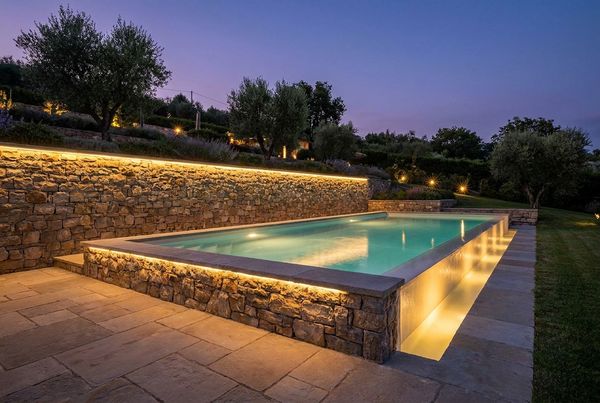
A slope is not a problem — it's a design opportunity most flat lots would kill for. The retaining wall is what unlocks it. Done right, it holds back the hill, creates the level pad your pool needs, and doubles as the single most dramatic feature in the yard: a stone backdrop for a waterfall, a raised terrace, a wall of warm light after dark. Done wrong, it's the thing that cracks, bulges, and slides two winters later. After decades building pools on hillsides, here's how we turn a difficult grade into the best seat in the backyard — and keep it standing.
Why sloped lots need retaining walls
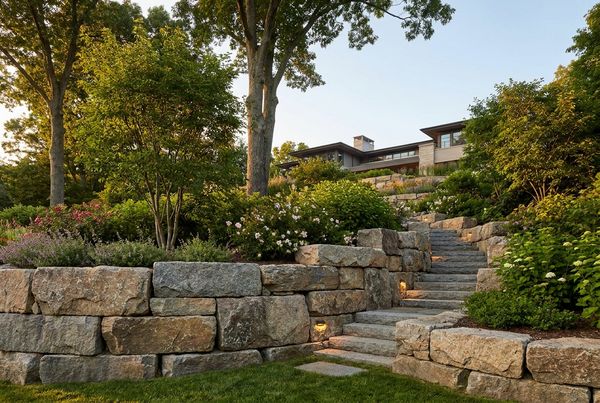
Every pool needs a flat, stable pad to sit on. On a sloped yard you only get there two ways: cut into the uphill side, or fill the downhill side — and both create a face of exposed soil that wants to slump back to its natural angle. A retaining wall is the structure that holds that soil in place permanently.
This is the part homeowners underestimate. On a hillside, the retaining wall isn't landscaping you add at the end; it's structural work that has to happen first, and it often costs as much as a meaningful chunk of the pool itself. A cut-and-fill approach usually means a wall on the uphill side (holding back the hill) and sometimes a second wall or engineered fill on the downhill side (holding up the extended pad). Getting the grading plan right is the whole game — which is why site work weighs so heavily in our inground pool cost breakdown. The good news: once you accept the wall as a given, it becomes the feature that flat-lot owners spend fortunes trying to fake.
Choosing a wall material
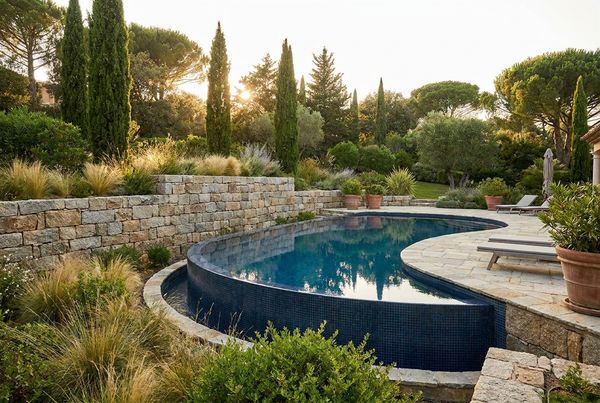
Material drives both the look and the cost, and the right answer depends on your architecture, your grade, and how much wall you're building. The four workhorses:
- Segmental block (SRW): interlocking concrete units engineered specifically for retaining. Cost-effective, fast to install, and available in dozens of textures. The default for most mid-height walls.
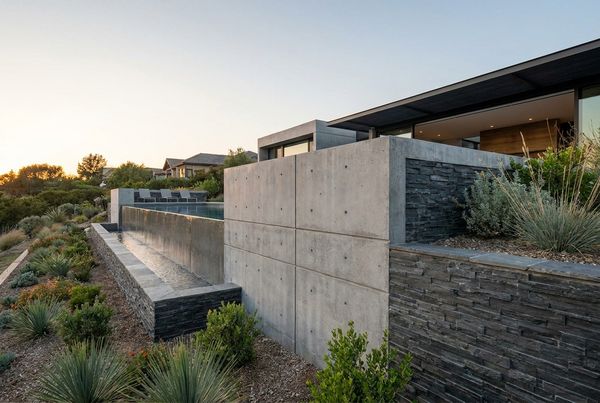
- Poured & board-formed concrete: the modern favorite — clean, monolithic, and strong. Board-forming presses wood-grain texture into the face for warmth. Ideal for tall walls and contemporary homes.
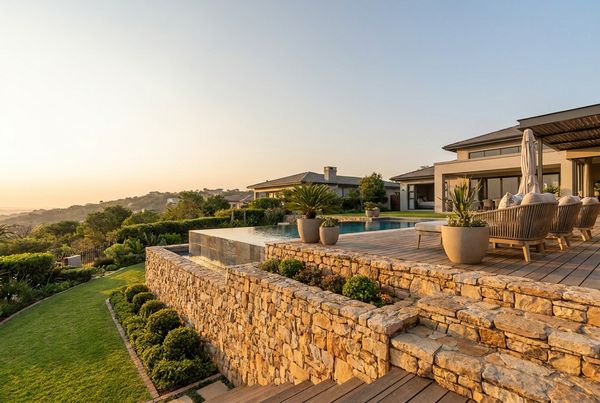
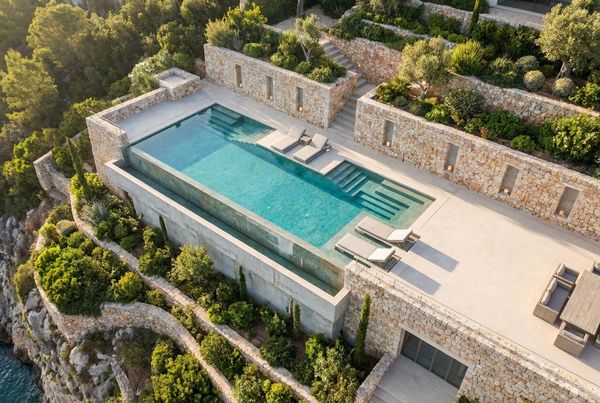
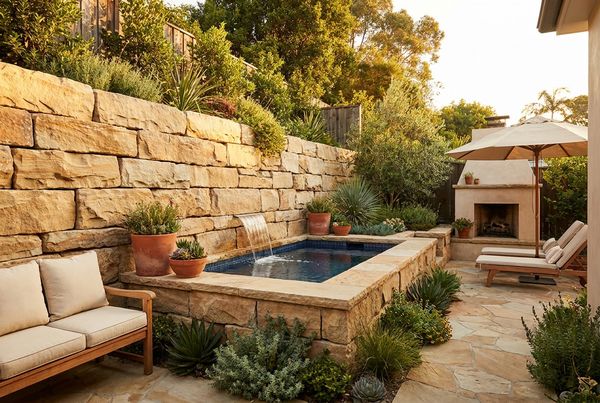
- Natural stone: dry-stacked or mortared stone veneer over a structural core. The most timeless, organic look and the most expensive per foot.
- Boulders: large stacked boulders create a rugged, naturalistic wall that ties beautifully into rock waterfalls and water features. Great for lower walls and softer grades.
A note that surprises people: the wall you see is often a facing over a structural core. A block or concrete wall does the retaining; the stone or tile you love gets applied to it. That's also how the wall coordinates with the rest of the yard — the same stone can wrap your pool deck and coping so the whole hardscape reads as one composition.
Tiered walls beat one tall wall
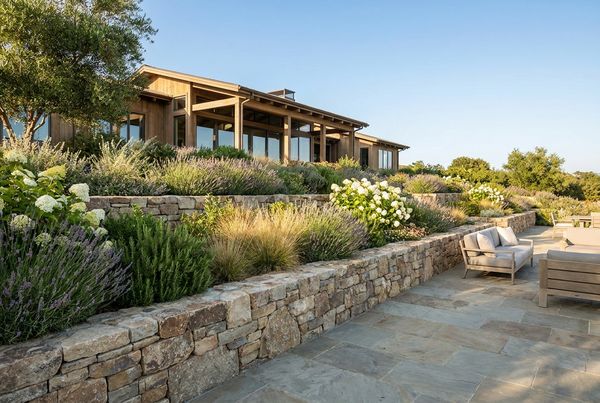
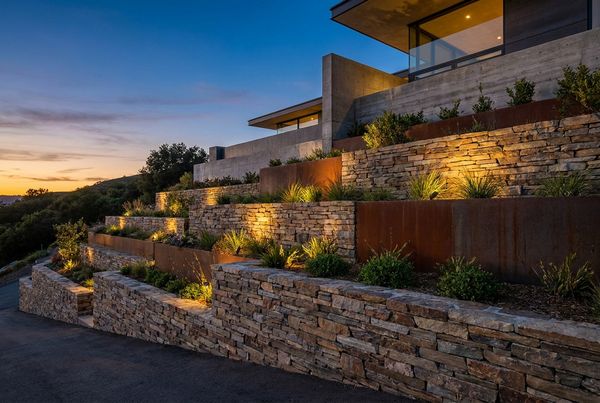
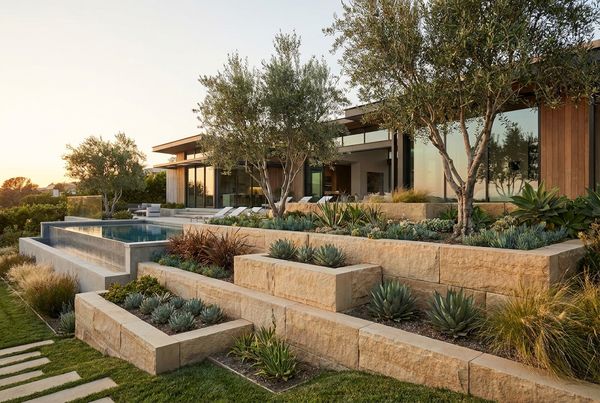
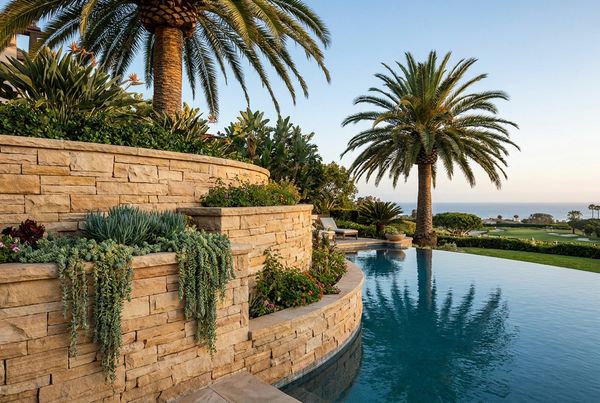
When the grade change is significant, resist the urge to hold it all with one towering wall. Stepping the slope into two or three shorter tiers is almost always the better move — and not just visually. Shorter walls are easier to engineer, carry less load each, and often come in cheaper than a single tall reinforced wall with its deep footing and tiebacks.
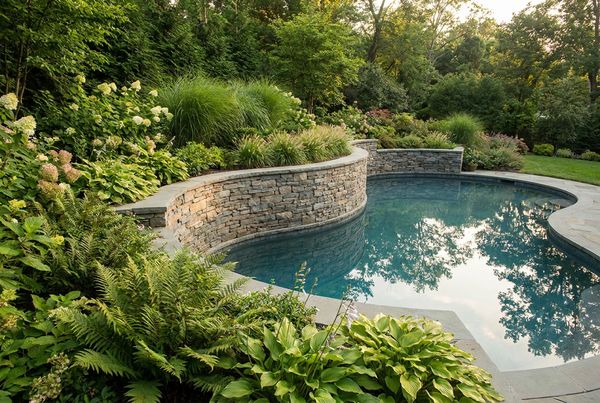
The terraces between tiers are where the magic happens. Each becomes a planting shelf, a path, or a landing — cascading greenery softens the hardscape and the whole hillside reads as a designed garden rather than a fortification. It's the same layering principle we lean on throughout our pool landscaping ideas: let the eye climb the grade in stages. Just make sure the tiers are spaced far enough apart (and drained independently) that the upper wall isn't dumping its load onto the lower one — that's a structural detail your engineer will size, not a guess.
What we think
Spend on the engineering and drainage, splurge on the facing, and never skip either. The wall that fails is always the one where someone saved money on the drain pipe or the footing. If the budget is tight, we'd build a plain, over-engineered structural wall now and phase in the beautiful stone veneer, seat cap, and lighting later — you can always dress a sound wall, but you can't cheaply fix one that's leaning. And if you're picking a pool type to sit behind it, a gunite pool gives you the most freedom to shape steps, benches and raised walls that tie into the hillside.
Seat walls that double as furniture
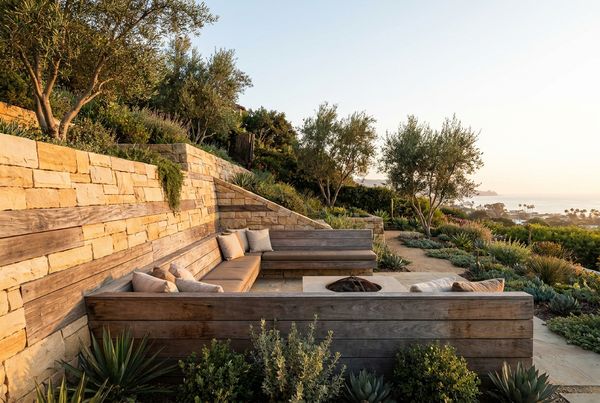
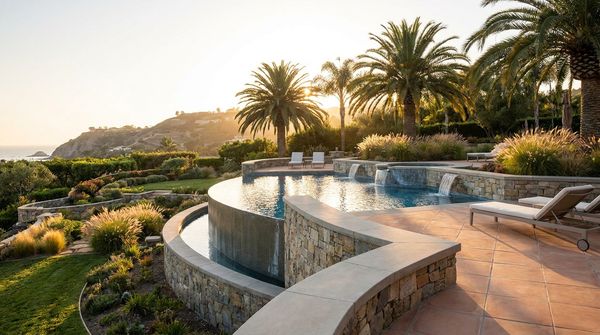
The easiest way to make a retaining wall earn its keep is to design it at seat height — roughly 18 inches — and cap it with a comfortable stone or concrete top. Suddenly the thing holding back your hillside is also poolside seating for a crowd, with zero furniture to store, drag out, or watch blow into the water.
Seat walls are perfect where a low retaining wall runs along the deck or wraps a lounging area. Add a few smart touches and they do even more:
- Wide caps (14–16 in.) so people can actually sit and set a drink down.
- Built-in fire bowls or a linear fire feature along the cap for warmth after dark.
- A gap left for a raised spa or planter so the wall changes rhythm instead of running flat.
Because the wall is already structural, adding seating is mostly a matter of getting the height and cap right — a lot of usable outdoor living for very little extra cost. It's one of the highest-value moves in the whole design.
Build the water feature into the wall
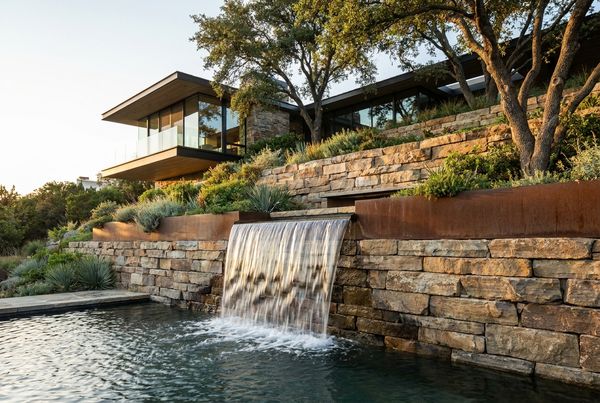
A retaining wall and a water feature are natural partners — the wall gives you the height and the hidden cavity that a great spillway needs. If you're building a wall anyway, running water down its face is one of the most cost-effective ways to add drama, because the hard structural part already exists.
The favorites we build into poolside walls:
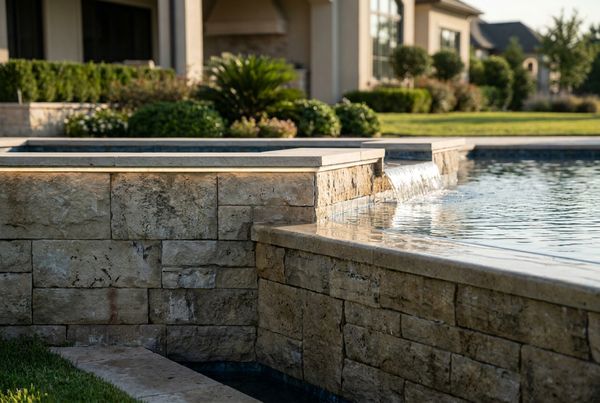
- Sheer-descent spillways — a clean, wide curtain of water off the wall cap for a modern look.
- Rock and grotto waterfalls — boulders and stone stacked into the wall for a natural cascade; pairs beautifully with a boulder retaining wall.
- Raised spillover spa — set a spa into the wall so it spills into the pool below. This is a signature hillside move; our spillover spa guide covers the plumbing and design.
The critical thing is to plan the plumbing before the wall goes up. Chasing pipe and electrical into a finished retaining wall is expensive and ugly; roughing it in during construction is nearly free by comparison. Browse our pool water features guide to pick a style, then hand it to your builder up front.
Planters, lighting and finishing touches
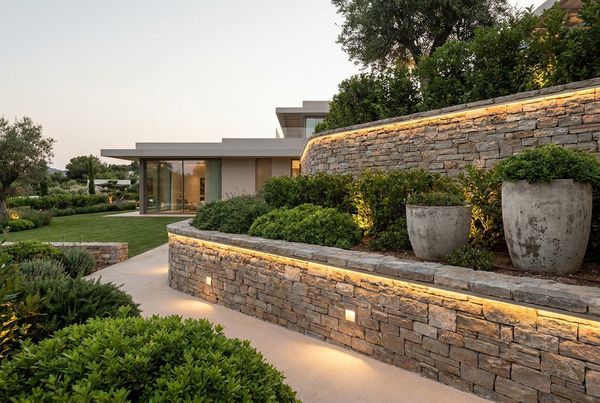
The difference between a wall that retains soil and a wall that anchors the whole backyard is in the finishing details — and they're mostly cheap to add while you're building.
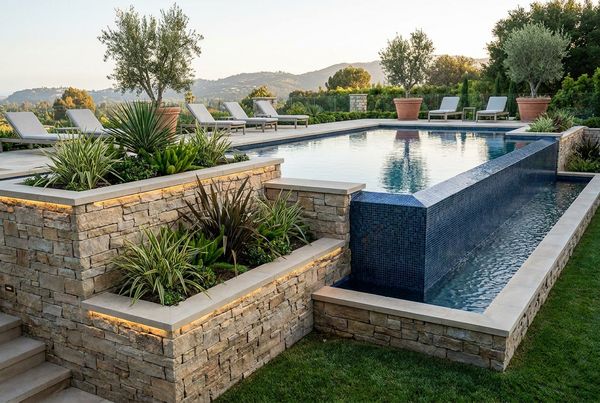
- Integrated planters: cast or build planting pockets into the wall so greenery spills over the face and breaks up the mass. Trailing plants soften even the heaviest stone.
- LED lighting: a strip tucked under the seat cap or a run of fixtures grazing the wall face turns it into a glowing feature at night. This is the single highest-impact upgrade after dark.
- Coordinated caps and veneer: matching the wall cap to your coping and deck ties the composition together and makes the wall feel intentional, not utilitarian.
Softened-geometric shapes, warm layered lighting, and resort-style outdoor living are dominating 2026 backyards, and a well-lit seat wall hits all three. Coordinate the wall's lighting with the rest of the yard rather than treating it as an afterthought — a little grazing light across textured stone does more for the evening mood than almost anything else you can buy.
Engineering and drainage basics
This is the section to read twice. A retaining wall next to a pool is holding back tons of soil and protecting a very expensive shell — it is not the place to save money or cut corners. A few non-negotiables from the field:
- Drainage is everything. The number-one cause of wall failure is water building up behind it (hydrostatic pressure). A proper wall has free-draining gravel backfill, a perforated drain pipe at the base, and weep holes or a piped outlet. No drain, no wall — it's that simple.
- Get it engineered. Most jurisdictions require an engineer's design and a permit for walls over 3–4 feet, and taller or surcharged walls (with a pool, deck, or driveway pushing on them) need reinforcement, geogrid, or tiebacks.
- Footing and base. A compacted, level base and a properly sized footing keep the wall from settling or tipping. Frost depth matters in cold climates.
- Keep water off the pool. Route site drainage around and away from both the wall and the pool shell so a storm doesn't undermine either.
The table below shows how the common wall types stack up. Use it to start the conversation — your engineer and local code have the final say.
| Wall type | Best for | Relative cost | Typical height* |
|---|---|---|---|
| Segmental block (SRW) | Most mid-height walls, value builds | $$ | Up to ~6–8 ft engineered |
| Poured / board-formed concrete | Modern looks, tall & surcharged walls | $$$ | Tall, with reinforcement |
| Natural stone (veneer on core) | Timeless, high-end aesthetics | $$$$ | Varies with structural core |
| Boulder | Naturalistic, lower walls, waterfalls | $$–$$$ | Best under ~4–5 ft |
*Heights are general guidance only. Any wall over 3–4 feet — and any wall retaining a pool — should be designed by a licensed engineer to local code.
What a pool retaining wall costs
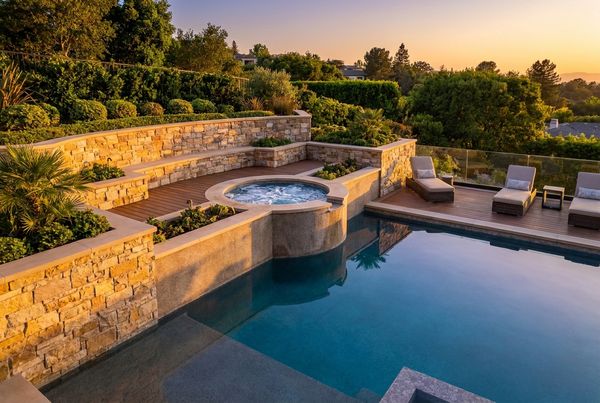
Pool retaining wall cost swings widely with height, material, drainage, and site access, but here are realistic 2026 US ballparks to plan around. Most walls price by the square face foot — the visible area of the wall.
- Segmental block: roughly $30–$55 per square face foot installed.
- Poured / board-formed concrete: roughly $45–$80+ per square face foot.
- Natural stone (structural + veneer): roughly $60–$90+ per square face foot.
- Boulder walls: roughly $30–$60 per square face foot depending on stone and access.
For a typical poolside wall that lands somewhere between about $5,000 and $30,000+, with tall engineered walls, difficult access, and premium finishes pushing higher. Drainage, engineering, and permits add to the base number but are the last place to economize. Remember too that on a hillside the wall is often the enabler of the whole project — it's what makes an unbuildable lot buildable, so weigh it against the value of the pool it unlocks, not in isolation.
Turning a slope into the best seat in the yard
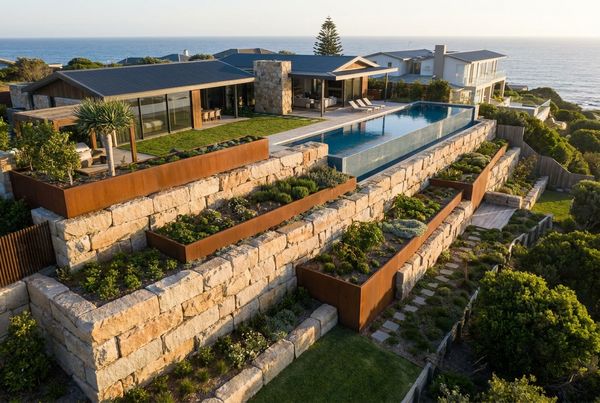
Here's the reframe worth holding onto: the flat backyard everyone thinks they want is often less interesting than the slope you're worried about. A grade gives you levels, backdrops, and elevation — the raw material of a resort. The retaining wall is simply the tool that turns that raw grade into a stacked composition of water, stone, planting, and light.
Get the structure and drainage right first, then let the wall do more than one job: hold the hill, seat your guests, drop a waterfall, glow after dark, and frame the water so every view has depth. That's why hillside pools, done well, so often out-photograph their flat-lot neighbors — the wall gives the whole yard a vertical story. When you're ready to see how the wall ties into the bigger picture, browse the rest of our pool design ideas and start matching a material and a feature to your slope.
Climate, frost and regional differences
Where you build changes how you build, and nowhere is that truer than a retaining wall holding back soil next to a pool. In cold climates the enemy is the freeze-thaw cycle: water that seeps into the backfill freezes, expands, and pushes on the wall over and over until something gives. That's why footings in frost country have to sit below the frost line, why free-draining gravel backfill matters even more, and why porous natural stone needs the right freeze-rated selection so it doesn't spall. Skimp on any of it and you'll see the damage by the second or third winter.
Hot, dry regions bring their own issues — expansive clay soils that swell when wet and shrink when dry, moving a wall around like the seasons breathe. Wetter climates load the wall with more hydrostatic pressure and demand serious drainage. The through-line is that a wall retaining a pool is never a generic product; it's engineered to your soil, your water table, and your winters. This is one more reason site work looms so large in our inground pool cost breakdown, and why a local engineer who knows regional soils is worth every dollar. A gunite pool shell paired with a properly engineered wall handles ground movement far better than rigid alternatives when the site is difficult.
Common retaining wall mistakes to avoid
After decades on hillsides, the failures I see almost always trace back to the same short list of shortcuts. The number one killer is no drainage — someone stacks a beautiful wall with no gravel, no perforated pipe, and no weep holes, and water pressure does the rest within a few seasons. The second is skipping the engineer on a wall over three or four feet, or on any wall with a pool, deck, or driveway surcharging it; that's not a permit technicality, it's the difference between a wall that stands and one that leans.
The rest are quieter but just as costly. Building one tall wall instead of tiers when the grade would be safer and cheaper stepped. Roughing in nothing for the waterfall, spa, or lighting you'll want later, then chasing pipe and wire into finished stone at triple the price. And treating the wall as decoration you dress up at the end rather than structure you get right first. My rule holds: build a sound, over-engineered, well-drained wall now, and phase in the veneer, seat cap, and lighting when the budget allows. You can always dress a solid wall — you cannot cheaply save a failing one. If a spillway or raised spa is anywhere in your plans, decide it before the wall goes up and browse our pool water features and spillover spa guides so the plumbing gets roughed in while it's nearly free.
Design Gallery
6 more ideas to save — tap any photo to view full screen.

Kelly E.
Pool Design Editor, PoolPad
Kelly has spent 10+ years around residential pools — planning projects, testing gear, and documenting backyard builds for PoolPad. Each design guide is checked against current construction methods and material pricing.
Frequently Asked Questions
Do I need a retaining wall for a pool on a sloped yard?
What is the best material for a pool retaining wall?
How much does a pool retaining wall cost?
Can I put a waterfall or spa in a retaining wall?
How tall can a pool retaining wall be?
What keeps a pool retaining wall from failing?
Do I need a permit for a pool retaining wall?
How do freezing winters affect a pool retaining wall?
Can I build a pool retaining wall myself?
What's the best pool type to pair with a hillside retaining wall?
Ready to build your dream backyard?
Compare local, vetted pool builders and get matched with pros who can bring these designs to life.
Find a Pool Builder Near You