



Key Takeaways
- Design safety first: a four-sided isolation fence with a self-closing, self-latching gate is the single most effective drowning-prevention layer — nothing on this page replaces adult supervision.
- Build the fun around a shallow zone — a beach entry or tanning ledge with bubblers is where kids under six actually spend the day.
- Plan for the kids you'll have in ten years: a slide and a real swimming depth keep the pool relevant long after the toddler years end.
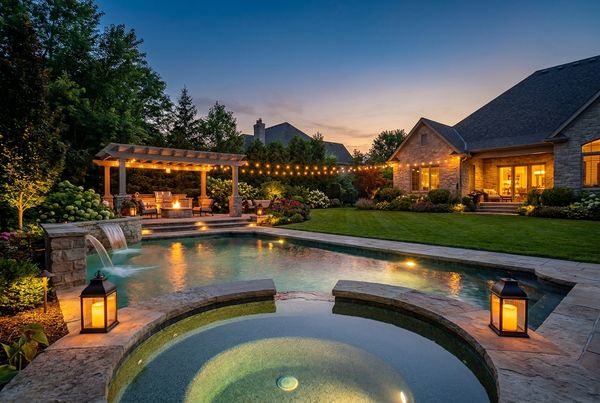
A pool built for a family isn't just a pool with a few toys thrown in — it's a design that layers real safety underneath genuine, all-ages fun. Get the order right and you build a backyard your kids wade into as toddlers, cannonball into as ten-year-olds, and still love as teenagers. Get it wrong and you build either a hazard or a pool nobody grows into. Here's how we approach a family pool: safety first, always, then the shallow zones, slides and features that make it the best place your kids will ever spend a summer.
Safety comes first, always
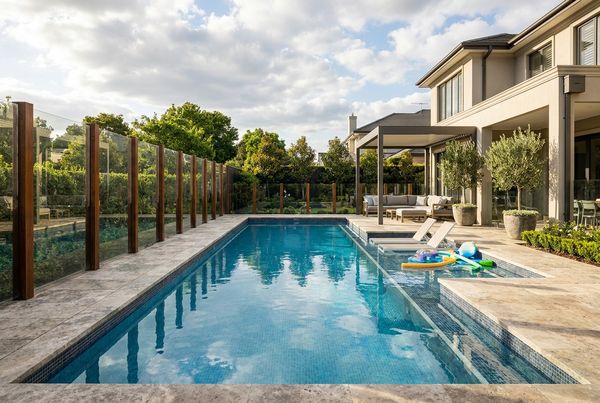
Before a single bubbler or slide, we start every family pool with one principle: layered safety, and no feature ever replaces a watching adult. Drowning is fast and silent, and it's the leading cause of accidental death for children ages one to four in the U.S. That's not a reason to skip a pool — it's the reason to design one properly. The professional consensus is to stack independent "layers of protection" so that if one fails, another still stands between a child and the water.
The core layers are simple and non-negotiable: a four-sided isolation fence separating the pool from the house, a self-closing, self-latching gate, alarms on gates and doors, and ideally a pool surface alarm or safety cover. On top of that hardware sits the layer that matters most — active, undistracted adult supervision, with a designated "water watcher" whenever kids are swimming. We cover the physical features in depth further down; everything else here assumes these layers are in place. Build the fun on top of the safety, never the other way around.
What we think
If we could give a family only one dollar's worth of advice, it would go here: splurge on the safety layers, never skip them to afford a fountain. A four-sided isolation fence, a self-latching gate, and a couple of alarms cost a fraction of the pool and are the difference between a fun summer and a tragedy. The design move we push hardest is a beach entry or wide shallow ledge — it removes the sudden drop-off that makes toddlers most vulnerable, and it happens to be the most fun part of the pool anyway. Safe and delightful aren't a trade-off here; the same shallow zone does both.
Beach entries & shallow play zones
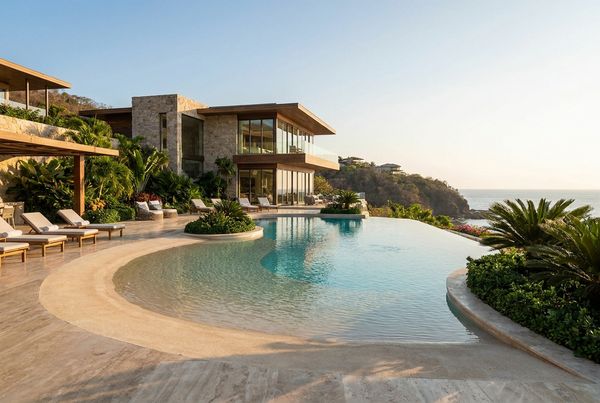
For kids under six, the single best design decision is a gradual, zero-depth entry. A beach entry pool slopes from dry deck straight into the water like a shoreline, with no steps and no ladder — which means no sudden drop into water over a toddler's head. A child wades in ankle-deep while a parent sits right beside them, half-submerged, at arm's reach. It fundamentally changes how you supervise young swimmers, and it's why so many of the family pools we design are built around a walk-in edge.
Where a full beach entry needs more yard than you have, a broad shallow play zone — a stretch of pool held at roughly 2.5 to 3.5 feet, shallow enough for early swimmers to stand — does much of the same work. The goal is the same either way: a large, clearly-defined area where standing, wading and playing are comfortable and safe, kept distinct from any deep water. In a compact lot, our small pool ideas guide shows how to carve out a proper shallow zone without a sprawling footprint. Whatever the size, the shallow end is the heart of a kids' pool — build it generous.
Bubblers, tanning ledges & splash pads
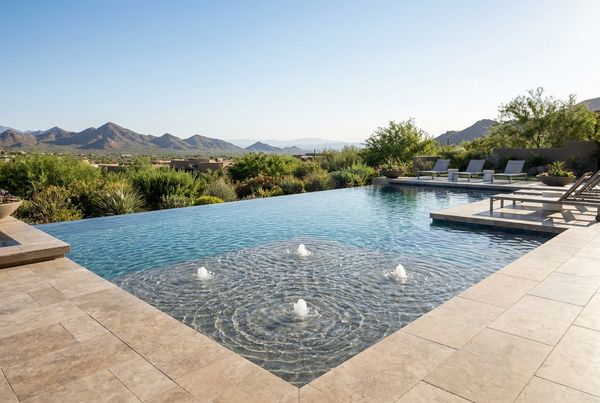
The tanning ledge (also called a Baja shelf or sun shelf) is the workhorse of a family pool: a flat platform, usually 6 to 12 inches deep, wide enough for loungers and a parent sitting with a toddler. It's shin-deep and cool, so it's where little ones actually spend the day and where you keep them at arm's reach. Add bubblers — low geysers that erupt straight out of the ledge — and you've built the single most-used feature in most family pools we design. They add motion, sound and endless play, and they look magical lit at night.
For water play without any standing water at all, a splash pad is a brilliant complement. It's a zero-depth surface with jets, arches and sprays that drain rather than collect, so there's no pooling water to pose a drowning risk — ideal for the youngest kids and a great feature to place alongside a small pool. Many families run a dry splash zone next to the shallow end so the tiniest swimmers have somewhere to play that carries the least risk. For the full menu of jets, deck sprays and shelf features, see our pool water features guide — most of them scale down beautifully for a kid-focused shelf.
Slides & fun water features
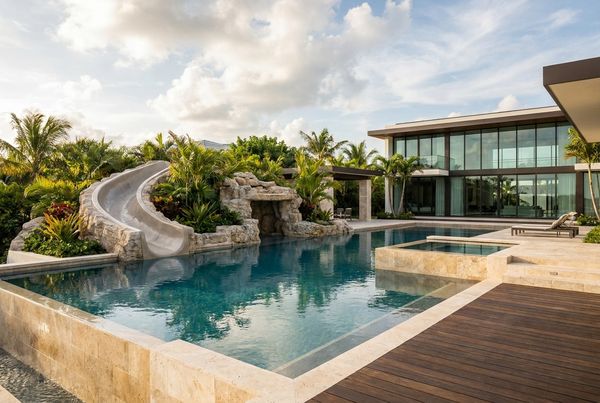
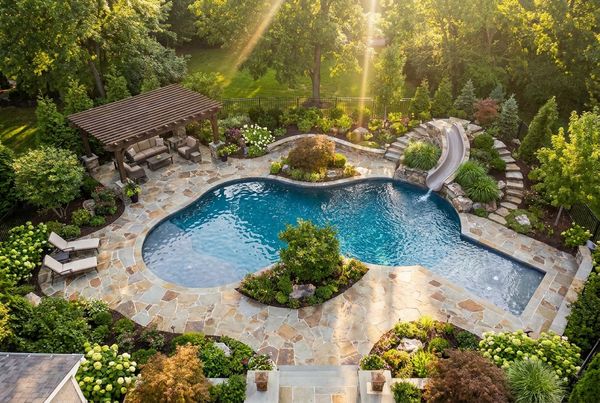
Once kids are confident swimmers, a slide becomes the headline feature — and the thing that keeps a pool exciting well past the toddler years. The key is matching the slide to the pool: manufacturers specify a minimum water depth for each model, and bigger flume slides need deeper water at the runout. Site it so the splash-down lands in a clear, deep-enough zone, add a non-slip surface on the steps, and set a simple house rule — one at a time, feet first, adult watching. Our pool slide ideas guide walks through straight, curved and tube models and the depth each one needs.
Beyond the slide, a family pool rewards a mix of fun water features for different ages. A waterfall or grotto doubles as somewhere to swim under and hide behind; deck jets and laminar streams arc across the water for kids to duck through; a sheer-descent on a raised wall gives sound and a curtain to run beneath. Layer them so a five-year-old and a twelve-year-old each find their own thing to do. And when the pool hosts birthdays, our pool party ideas guide covers the games and setups that make the most of it.
Fencing, alarms & pool depth
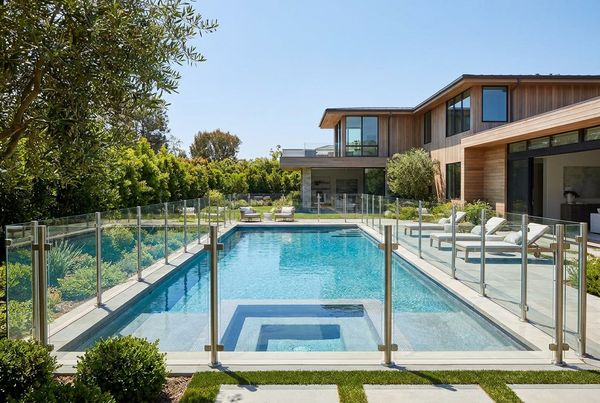
Here are the physical safety layers in detail — the features every family pool needs, whatever else you add. The foundation is a four-sided isolation fence: a barrier at least 48 inches tall (many codes and safety groups recommend taller) that separates the pool from the house, not just the yard from the street. This matters because most young-child drownings happen during a brief lapse when a child slips out to a pool they can otherwise reach directly. A fence with no footholds, vertical bars spaced too narrow to squeeze through, and a self-closing, self-latching gate that latches out of a child's reach is the gold standard. Our pool fence ideas guide shows glass, mesh and metal styles that stay code-compliant without looking like a cage.
Layer alarms on top: gate and door alarms that sound when a barrier opens, and a pool surface or immersion alarm for entry into the water. A power safety cover adds another barrier when the pool's idle. On depth, design for the ages using it — a shallow play zone of 6 to 18 inches for toddlers, a 2.5-to-3.5-foot stretch for early swimmers, and a clearly separated deep end. For a slide or diving, follow the manufacturer's minimum depth exactly. Here's how the core layers stack up.
| Safety layer | What it does | Typical 2026 U.S. cost* |
|---|---|---|
| Four-sided isolation fence | Primary barrier between house and water | $1,500–$7,000+ |
| Self-closing, self-latching gate | Auto-secures the fence line | $300–$1,000 |
| Gate / door alarms | Alerts when a barrier is opened | $30–$150 each |
| Pool surface / immersion alarm | Detects entry into the water | $100–$300 |
| Power safety cover | Physical barrier over the water | $1,500–$4,000 |
*Ballpark 2026 U.S. ranges; local code, materials and pool size move the number. Always confirm your local barrier requirements — none of these layers replaces adult supervision.
Non-slip surfaces & sun shade
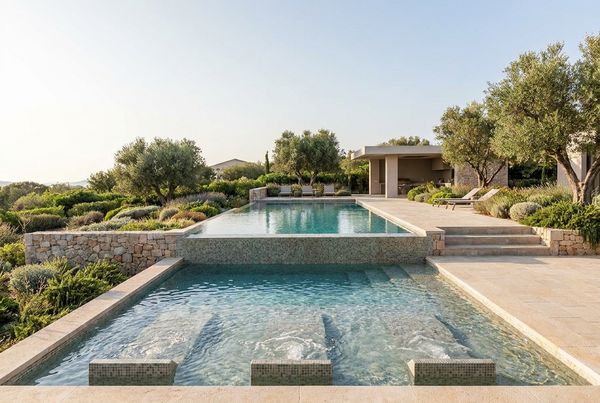
Two details quietly make a family pool safer and far more usable: traction and shade. Wet feet plus a slick deck is how most poolside falls happen, so specify a non-slip surface everywhere kids run and enter — textured concrete, brushed or shell-finish coping, and a grippy interior finish on the entry slope and steps. Pebble finishes are our go-to for the shallow zone precisely because the exposed-aggregate texture gives sure footing where kids stand and wade the most. For deck options that balance grip, comfort underfoot and looks, see our pool deck ideas guide.
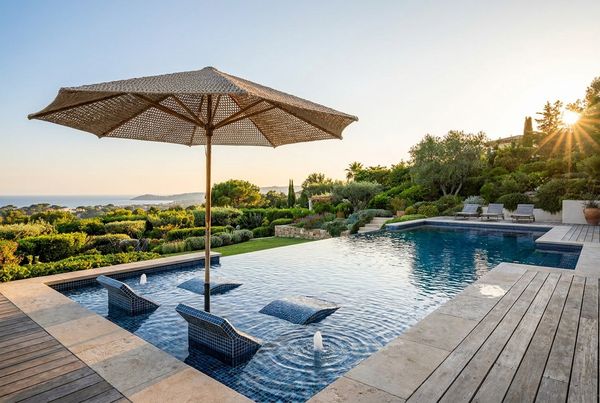
Sun shade is the other easy win. Kids in shin-deep water are exposed for hours, and a shaded shallow end simply gets used more and keeps everyone safer from the sun. An umbrella sleeve cored into the tanning ledge lets you plant a big umbrella right in the water; a pergola or shade sail over the shallow end does it permanently. Thoughtful pool landscaping — a shade tree placed to fall over the ledge by afternoon — works too. Our pool landscaping ideas guide covers planting that shades and softens the space without dropping debris into the water.
Designing a pool kids grow into
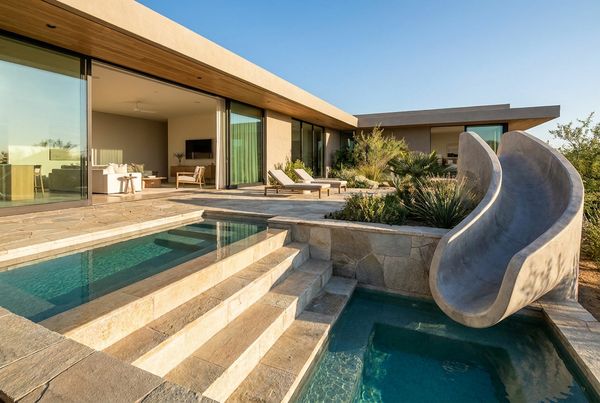
The mistake we see most often is designing for the kids you have this year instead of the kids you'll have in ten. Toddlers become confident swimmers, then cannonballing ten-year-olds, then teenagers who want to actually swim and dive. A pool built only for a two-year-old — all shallow, no depth, no thrill — gets outgrown fast. The fix is to design in layers of depth and use from the start, so the same pool serves every stage at once.
That means a shallow shelf for the wading years, a mid-depth zone for early swimmers, and a real 4-to-5-foot swimming depth with a slide or diving-safe area for the big kids and adults. Best of all, the features don't go to waste as kids age: a bubbler-filled tanning ledge is a toddler's playground now and your lounging-with-a-drink spot later; a beach entry is the safe entry today and the elegant resort-style edge forever. Design for twenty years of use, and the toddler features quietly become adult ones.
What a family pool actually costs
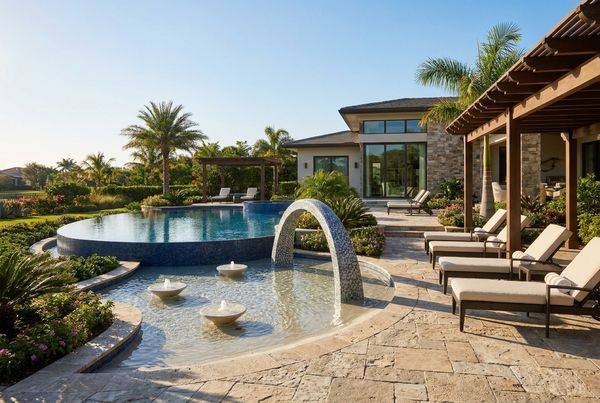
The good news for families: the features that make a pool kid-friendly are among the cheaper things you can add to a build. A tanning ledge, a set of bubblers, and a beach entry cost far less than a vanishing edge or a grotto, and they deliver the most daily use of anything in the yard. Where the money really goes on a family pool is the same place it goes on any inground pool — the shell, the excavation, the deck, and the equipment. Our inground pool cost guide breaks down where each dollar lands, and it's worth reading before you set a budget.
Two family-specific line items are easy to underestimate. The first is safety hardware — fencing, gate, alarms — which I covered in the table above; treat that as non-optional and budget it in from the start, not as an afterthought when the money's tight. The second is the ongoing cost of keeping the water safe and clean for kids who swim constantly. A shallow, feature-rich pool with lots of splashing needs steady chemistry, and the easiest way to stay on top of it is to run the numbers before you dose: our pool chemical calculator tells you exactly how much of each product to add, and the pool volume calculator gives you the gallon figure everything else depends on.
If a full inground build is out of reach, a small pool still delivers a real family experience — a compact pool with a generous shallow shelf beats a big pool with nowhere for little ones to stand. Our small pool ideas guide shows how to fit the features that matter into a modest footprint and a modest budget.
Common family-pool mistakes to avoid
After designing family pools for years, the same avoidable errors come up again and again. The biggest is treating safety as a fence you add at the end instead of a layered system you design from the start. Retrofitting a proper four-sided isolation fence, gate alarms, and a safety cover onto a finished pool is more expensive and always looks bolted-on. Plan the barriers with the pool, and read up on styles early in our pool fence ideas guide so safe doesn't have to mean ugly.
The second mistake is skimping on the shallow zone to buy a bigger deep end. For young families it's backwards — kids under six live in the shin-deep water, so a generous ledge or beach entry earns its space many times over, while an oversized deep end mostly goes unused. The third is forgetting maintenance reality: a busy family pool gets cloudy fast when sunscreen, dirt, and heavy swimmer loads outpace the chemistry. If your water keeps turning hazy, our cloudy pool water guide walks through the usual causes and fixes, and a solid pool test kit is the single best purchase for staying ahead of it.
One last one: designing only for today's ages. I'll come back to that below, because it's the difference between a pool your family loves for two years and one they love for twenty.
2026 family pool trends
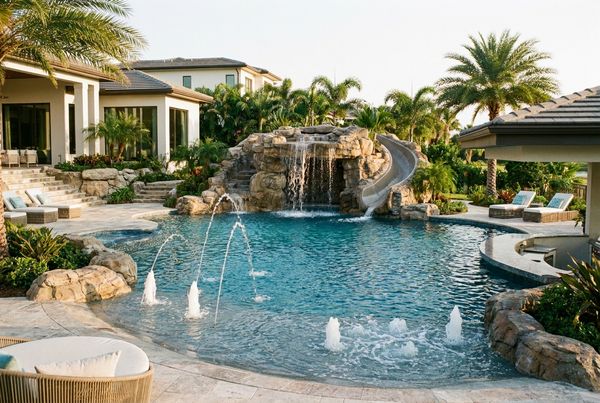
The family pool is having a good moment, and a few directions define 2026. Feature-rich shallow zones lead the way — bubblers, in-ledge loungers and generous tanning shelves have moved from luxury extra to near-standard, because buyers now expect the shallow end to be a destination, not just an entry. Splash pads and dry water-play areas are surging with younger families who want water fun with the least standing-water risk. And bold LED lighting on the shallow shelf keeps the busiest zone visible and magical into the evening.
Two more shape the look. Softened-geometric shapes — rectangles with rounded corners, gentle curves — read as friendlier and more playful than hard rectangles while still looking modern, and they suit a family pool perfectly. And smart automation is quietly a safety story: app-controlled alarms, gate sensors and remote monitoring add a layer of awareness on top of the physical barriers. Across all of it, the through-line hasn't changed and never will: safety first, fun built on top, and a pool designed for every age at once. For the wider design landscape, browse our pool water features and start your safety planning with our pool fence ideas — the two ends of a family pool done right.
Design Gallery
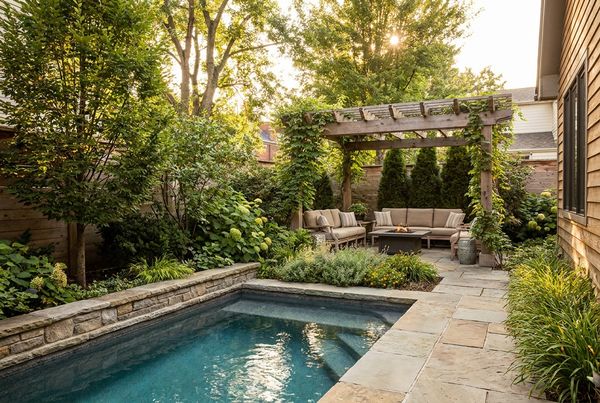
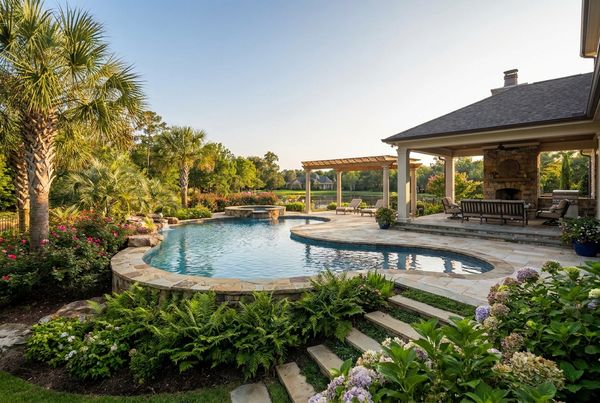
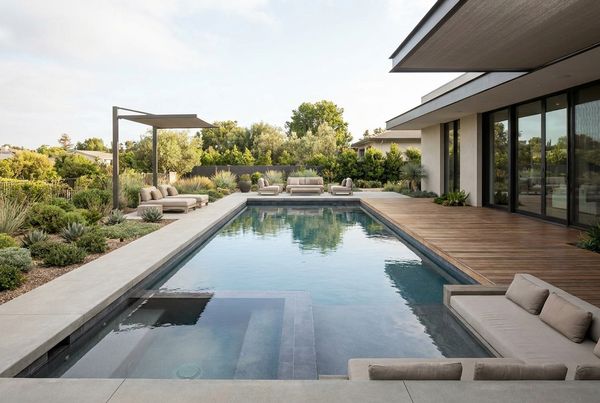
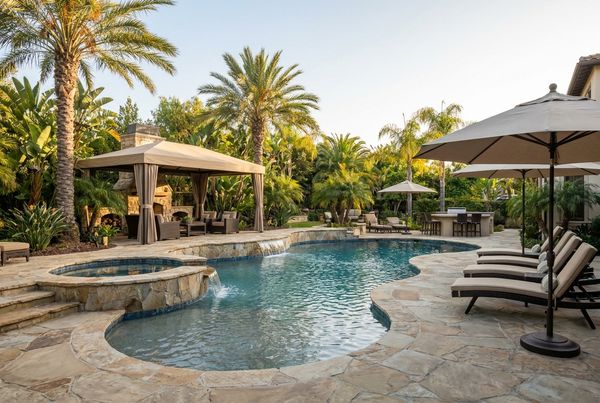
6 more ideas to save — tap any photo to view full screen.

Kelly E.
Pool Design Editor, PoolPad
Kelly has spent 10+ years around residential pools — planning projects, testing gear, and documenting backyard builds for PoolPad. Each design guide is checked against current construction methods and material pricing.
Frequently Asked Questions
What is the safest pool design for kids?
How shallow should a pool be for young kids?
Are pool slides safe for children?
What is a splash pad and is it safer than a pool?
Do I need a fence around a pool with young children?
How do I design a pool my kids won't outgrow?
How much does it cost to add kid-friendly features to a pool?
Why does my family pool keep turning cloudy?
How much chlorine does a busy kids' pool need?
Ready to build your dream backyard?
Compare local, vetted pool builders and get matched with pros who can bring these designs to life.
Find a Pool Builder Near You