



Key Takeaways
- Lean into xeriscape — native, drought-tough plants set in gravel and decomposed granite look luxurious, drop almost no litter, and sip water.
- Design in layers of stone: boulders for bones, DG for the ground plane, and sculptural plants like agave, ocotillo and cacti for drama.
- Plan for heat and shade from day one — shade sails, ramadas and a smart-irrigated planting palette make an arid yard genuinely livable.
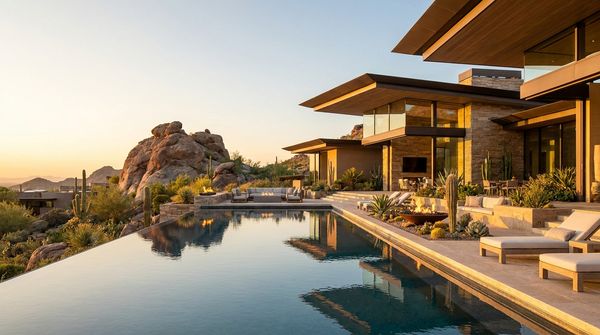
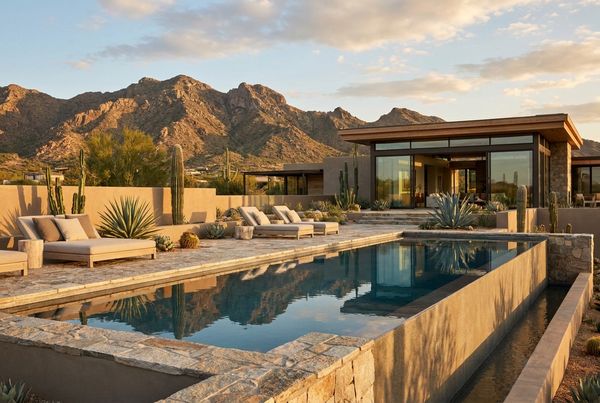
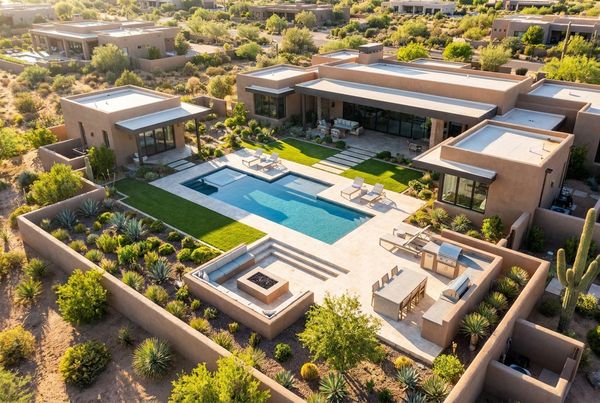
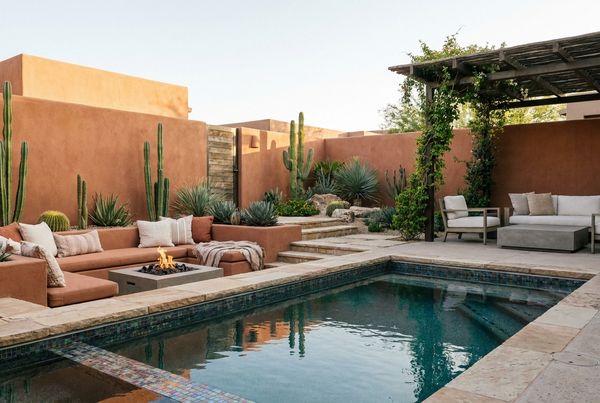
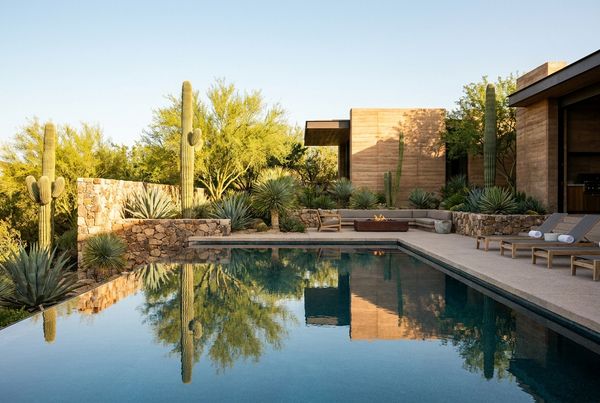
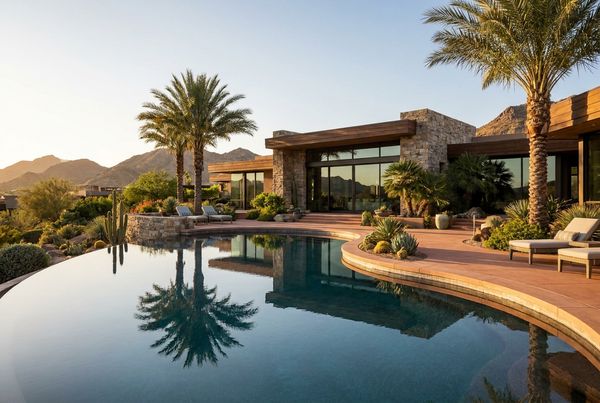
In the desert Southwest, the yard that fights the climate always loses — a thirsty lawn browns out, the water bill balloons, and the whole thing looks tired by August. The yards that win lean into where they are. Done right, desert pool landscaping is some of the most striking work in the business: sculptural agave and ocotillo against clean gravel, weathered boulders catching low light, and a pool that mirrors a hard blue sky. After years designing pools across Phoenix, Tucson, Palm Springs and Vegas, we can tell you the desert-modern look is also the easiest to keep beautiful. Here's how to build it.
Why xeriscape is the smart play in the desert
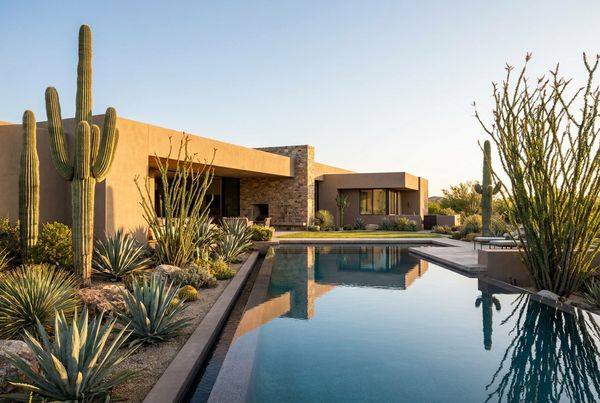
Xeriscape simply means landscaping built around low water use — the right plants, in the right place, on the right irrigation. In an arid climate that isn't a compromise; it's the best-looking option on the table. A palette of agave, cacti and grasses set in decomposed granite reads as intentional and high-end, and it stays crisp through the seasons instead of collapsing in the heat.
It also happens to be the friendliest possible surround for a pool. Desert plants are low-litter by nature — no carpet of falling leaves, no seed pods, no spent blossoms drifting into the skimmer. That means less time skimming and a lighter load on your filter and robotic cleaner. And with many Southwestern cities offering turf-removal rebates and tightening water rules, converting to xeriscape often pays part of its own way. The seven principles are worth remembering: smart design, soil prep, efficient irrigation, appropriate plants, limited turf, mulch (stone, here), and sensible upkeep. Get those right and the yard nearly runs itself.
The best low-water plants for a desert pool
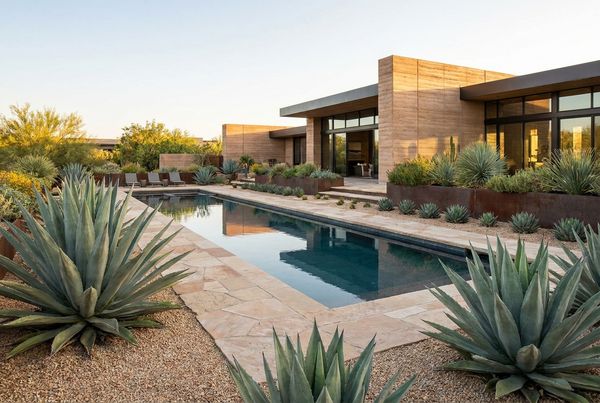
The desert palette is small, sculptural, and forgiving. A handful of species, repeated in generous drifts, does more than a scattered collection ever could. Our poolside shortlist:
- Agave — the workhorse. Blue agave, artichoke agave and octopus agave all give bold, architectural rosettes with no litter and near-zero water.
- Cacti — barrel cactus, golden barrel in groups, prickly pear, and columnar species for vertical punctuation.
- Ocotillo — nothing says Sonoran desert like its tall, whip-like canes that leaf out and flame red after rain.
- Red yucca & yucca — soft, grassy clumps that throw coral flower spikes for months and take splash-out in stride.
- Ornamental grasses — deer grass, muhly and bull grass add movement and catch light beautifully at dusk.
- Aloe & smaller succulents — for color and low, spreading texture right at bed edges.
A safety note we always give: keep spiny plants away from where people walk, swim-out, or brush past. Use spineless agave, soft grasses and aloe near the coping and traffic paths, and save the barrel cactus and ocotillo for the far beds where they're admired, not landed on. This is the same low-litter, right-plant logic we walk through in our broader pool landscaping ideas guide — it just leans harder into drought-tough species here.
Gravel, decomposed granite and clean ground planes
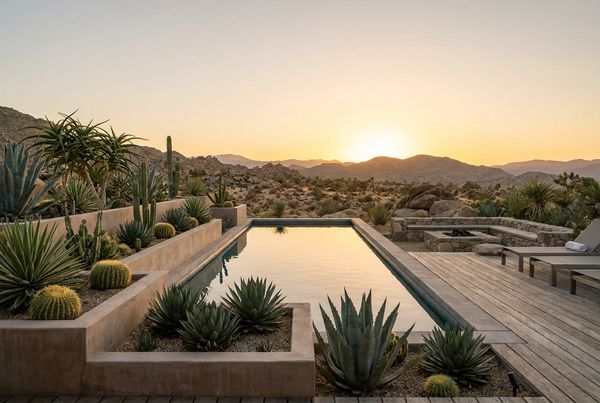
In a desert yard, the ground plane is the design. With less foliage covering the earth than a temperate garden, the stone you choose does most of the visual work — and it's the single easiest place to make the whole yard look expensive or cheap.
- Decomposed granite (DG) is the desert's default. It compacts into a smooth, natural, walkable surface for paths and open areas, and comes in tans, golds and warm reds you can key to your deck.
- Gravel and rock mulch in graded sizes handle bed fills and drainage, and layer nicely against boulders.
- Rip-rap and larger cobble dress swales and slopes where water runs during monsoon storms.
Coordinate the stone color with your deck and coping so the transition from pool to landscape reads seamless — warm travertine loves gold DG; grey porcelain wants a cooler charcoal gravel. Keep loose fines a few feet back from the water and use stabilized DG or paving right at the coping so grit doesn't wash into the pool. If you're still choosing the surround itself, our pool deck ideas pair naturally with a desert palette.
Boulders and grade: give the yard bones
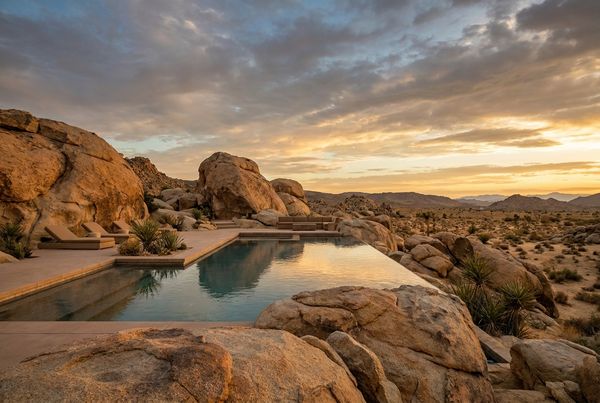
Flat lots are the desert norm, and flat reads as boring. Boulders are how you buy structure and age instantly. A few well-placed, weathered specimens — buried a third of the way into the grade so they look native, not dropped — give the yard the bones a lush garden gets from trees. Cluster them in odd numbers, vary the sizes, and let a mass of golden barrel or an agave spill against the base.
Grade is the other half of the trick. Even gentle mounding and berms create shadow, hide equipment, and give your planting a sense of place. Boulders also do real work: they retain small grade changes, edge beds, and give cascading groundcover something to tumble over. Where you need actual height or a level pad, a low retaining wall in matching stone reads as part of the landscape rather than an add-on. The goal is a yard that looks like the pool was set into an existing desert, not stamped onto a blank pad.
What we think
If we had one dollar to spend in a desert yard, it goes to boulders and shade — not more plants. Three great specimen boulders and a proper shade structure transform a flat lot more than a truckload of one-gallon succulents ever will. Splurge on a few large agave and a couple of statement boulders; skip the fussy annual color that fries by July. And do not cheap out on shade: an arid backyard you can only use at 7am isn't a backyard, it's a photo op. Fewer, bigger, tougher — that's the desert-modern formula.
Shade that actually works: sails and ramadas
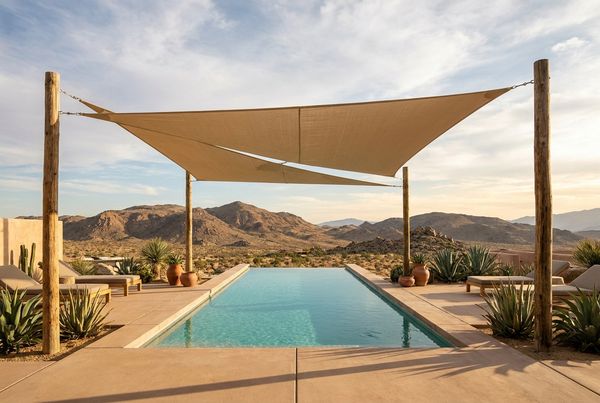
In the desert, shade is a design element, not an afterthought. Without it, the deck bakes and the yard goes unused for half the day. The three moves that work, in rough order of how modern they read:
- Shade sails — tensioned fabric triangles are the desert-modern favorite: cheap relative to their impact, architectural, and easy to angle for afternoon sun.
- Ramadas — the Southwest's classic open-sided shade structure, in timber or steel, gives a permanent shaded room by the water.
- Pergolas and cabanas — for a more finished outdoor living zone; our pergola ideas show styles that suit a desert palette.
Position shade over where people actually sit and lounge, orient it against the low afternoon sun, and use a light-colored deck so the paving underfoot isn't scorching. Overhead structure also doubles as privacy from two-story neighbors and a mount for fans, misters and lighting — worth planning as one system rather than bolting on later.
The 2026 desert-modern look
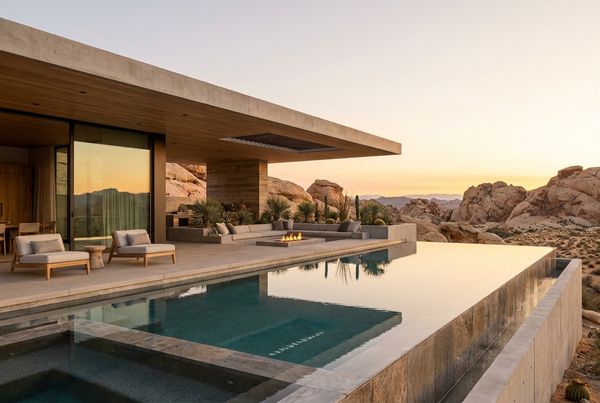
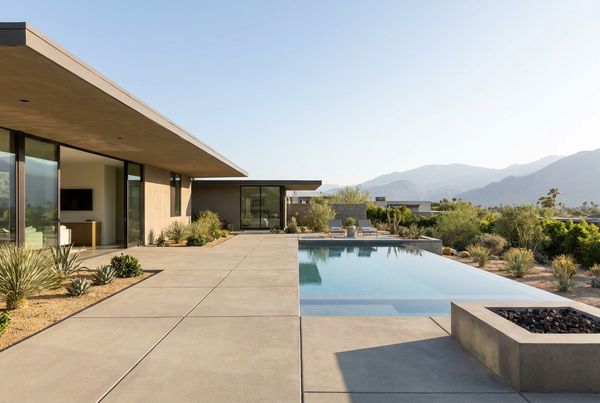
The dominant desert style heading through 2026 is desert-modern: architectural, monochrome, and deliberately restrained. It pairs the tough xeriscape palette with the pool trends we're seeing everywhere:
- Softened-geometric pool shapes — rectangles with gently radiused corners that feel modern without being severe.
- Dark interior finishes — deep grey and charcoal plaster or pebble finishes that mirror the sky and read as a reflecting pool by day.
- Tanning ledges — a shallow shelf for loungers and kids, perfect in a climate built for sunbathing.
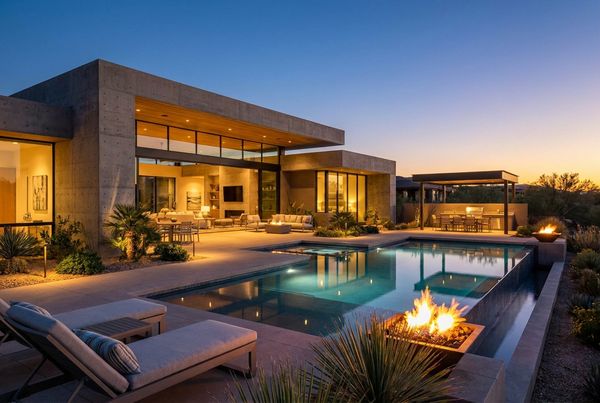
- Fire features — fire bowls and a fire pit glow beautifully against boulders once the desert night cools.
Here's how the desert-modern palette compares to two other regional looks so you can pick the language that fits your home and lot:
| Style | Signature plants | Ground plane | Water use |
|---|---|---|---|
| Desert-modern | Agave, barrel cactus, ocotillo, red yucca | DG & gravel, boulders | Very low |
| Oasis / mixed | Palms, citrus, bougainvillea, lantana | DG with turf pockets | Low–moderate |
| Mediterranean-desert | Olive, rosemary, lavender, agave | Gravel courtyard | Low |
Water use assumes established plants on efficient drip irrigation. Confirm species and rebates with a local nursery or water authority.
Whichever you choose, restraint is what sells the look. Fewer species, repeated boldly, against clean stone reads far more "designer" than variety. For the pool geometry that anchors the whole scheme, our modern pool designs guide is the place to start.
Water-wise irrigation that keeps it alive
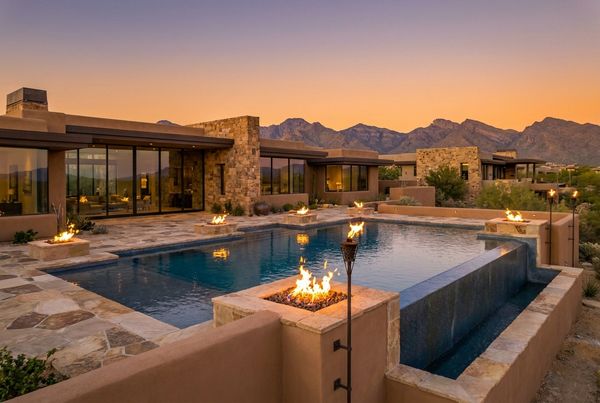
Low-water doesn't mean no-water — even tough desert plants need help establishing, and smart irrigation is what keeps a xeriscape looking intentional rather than stressed. The playbook is simple:
- Drip, not spray. Drip emitters put water at the root zone with almost no evaporation loss — critical in dry heat, and it keeps mineral-laden overspray out of your pool.
- Hydrozone. Group plants by water need so the thirsty pocket near the patio isn't dictating how often the tough far beds get watered.
- Smart controllers. Weather-based timers skip cycles after rain and dial back in cooler months — the same energy-efficiency mindset behind saltwater systems and modern pool automation.
- Water deep and infrequent to push roots down, and taper off once plants are established.
Route drainage and monsoon runoff away from the pool shell and equipment, and use stone mulch to hold soil moisture and stop erosion. Get the irrigation right up front and the yard rewards you with years of low-effort good looks.
Keeping the pool water balanced in desert heat
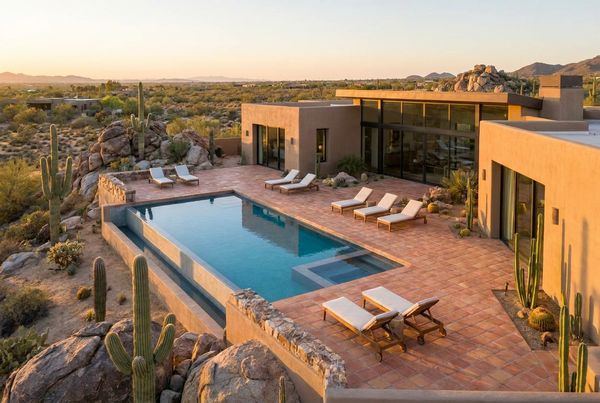
The landscape is the low-maintenance part of a desert pool; the water asks for more attention than it would in a mild climate. Relentless sun, dry air, and wind pull water off the surface fast, and every gallon that evaporates leaves its minerals behind. That means calcium and salts concentrate over the season, so a desert pool drifts toward hard, scaling water if you're not topping up and testing steadily. A cover is genuinely worth it here — it cuts evaporation, saves water, and slows that mineral creep.
The routine I lean on in a hot climate is simple but non-negotiable: test regularly with a good pool test kit, and dose to a target rather than a guess, since the numbers move faster in the heat. Because refills after evaporation change your chemistry, it helps to know your exact volume — run it once through our pool volume calculator and every future correction gets easier. When you do need to add chlorine or balance, our pool chemical calculator keeps you from over-shooting in water that's already mineral-rich.
Hard local tap water is the other desert reality. Topping up with hard water accelerates scale, especially on a dark interior finish, so watch calcium hardness closely and keep pH in range. Many owners here go saltwater for the softer feel and lighter chlorine handling — a natural fit with the energy-efficient, low-effort spirit of a xeriscape yard, as long as you stay on top of levels.
Budgeting a desert pool landscape
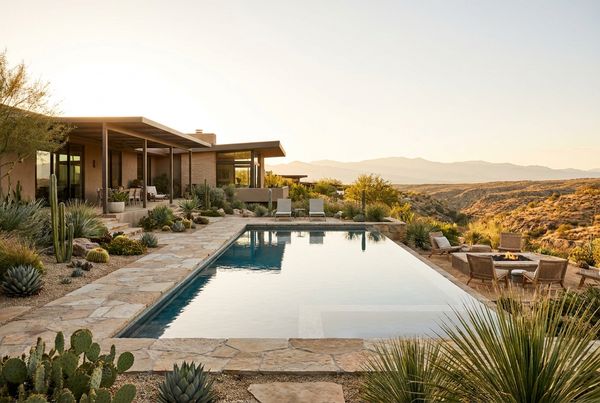
Desert landscaping has a reputation for being cheap because the plants are — and the plants really are the least of it. A xeriscape yard's cost lives in the hardscape and the structure: the deck, the stone ground plane, the boulders, and above all the shade. That's actually good news, because it's the opposite of a lawn-heavy yard that costs little up front and then bleeds money on water and mowing forever. Here you invest once in bones and shade, and the running cost stays near zero.
Where I tell people to put the money: a few large specimen boulders, a proper shade structure over the seating, and a smart drip system, in that order. Skip the temptation to fill beds with dozens of little one-gallon succulents — a handful of big, sculptural agave and a couple of statement boulders transform a flat lot far more, for less fuss. The pergola ideas and shade options are the line item most worth protecting; an arid yard you can only use before 9am isn't finished.
Two things ease the total. First, many Southwestern cities offer turf-removal rebates that offset converting lawn to xeriscape, so check with your water authority before you start. Second, the pool itself is usually the biggest number by far, so plan it and the landscape together rather than in sequence — our inground pool cost guide shows where the pool budget goes, and folding the hardscape and planting into one scope keeps the trades coordinated and the palette consistent.
Heat, privacy and living outdoors
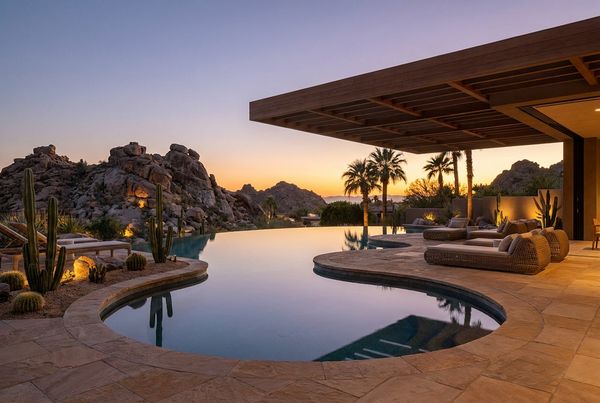
The whole point of a desert pool is to make the yard livable in a punishing climate — and the landscape is your main tool for that. Beyond shade, a few moves turn an exposed lot into a retreat you actually use:
- Privacy planting and screens. Clumping options and slatted screens give you seclusion without the water-hungry hedge; our pool privacy ideas cover desert-appropriate approaches.
- Evening design. The desert comes alive after sundown, so light for it — uplight a saguaro or agave, wash a boulder, and keep paths warm and low with pool lighting and landscape fixtures.
- Fire and gathering. Once the sun drops the temperature swings fast; a fire bowl or fire pit extends the evening and anchors the seating.
- Resort-style outdoor living. A shaded lounge, an outdoor kitchen and a cold-plunge for the peak of summer turn the yard into a full outdoor room.
That's the real promise of desert pool landscaping: a low-water, low-litter, high-drama yard that looks like it belongs exactly where it is. Lean into the climate instead of fighting it, spend on boulders and shade, keep the plant palette tough and sculptural, and you'll get a backyard that's stunning at noon and magical at dusk. When you're ready to plan the whole space, browse the rest of our pool design ideas and start matching a desert language to your pool.
Design Gallery
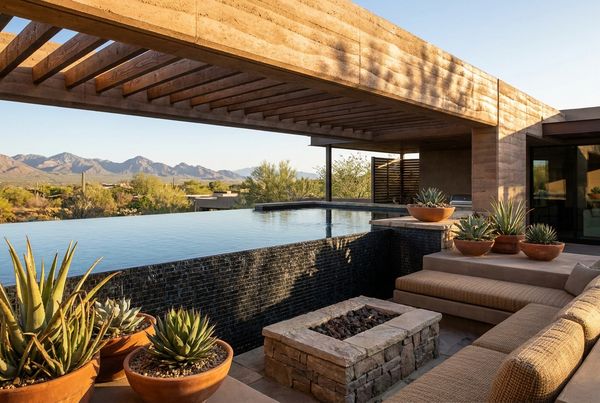
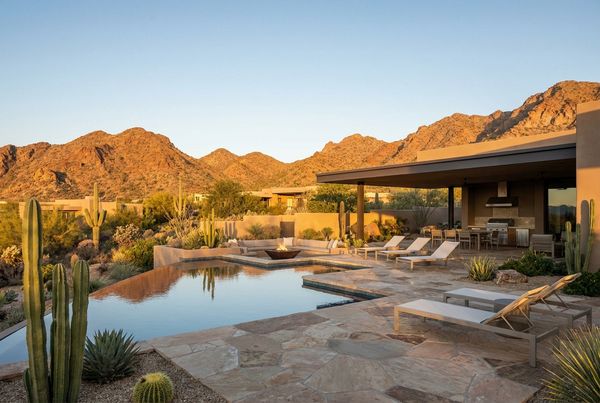
7 more ideas to save — tap any photo to view full screen.

Kelly E.
Pool Design Editor, PoolPad
Kelly has spent 10+ years around residential pools — planning projects, testing gear, and documenting backyard builds for PoolPad. Each design guide is checked against current construction methods and material pricing.
Frequently Asked Questions
What is the best landscaping for a desert pool?
What plants work best around a desert pool?
How do I keep a desert backyard cool around the pool?
Is decomposed granite or gravel better around a pool?
Do desert pools need less maintenance?
What's the desert-modern pool trend for 2026?
Does a desert pool lose a lot of water to evaporation?
Is a saltwater pool a good choice in the desert?
How do I keep desert dust and debris out of the pool?
How much water does desert pool landscaping actually save?
Ready to build your dream backyard?
Compare local, vetted pool builders and get matched with pros who can bring these designs to life.
Find a Pool Builder Near You