



Key Takeaways
- Map your sightlines first — you rarely need to wall the whole yard, just block the two or three angles neighbors actually see from.
- The best privacy is a combination of structure and greenery: a slat wall or fence gives you privacy on day one while plants fill in behind it.
- For overlooking two-story windows, go vertical and overhead — tall screening plants plus a pergola beat any fence height.
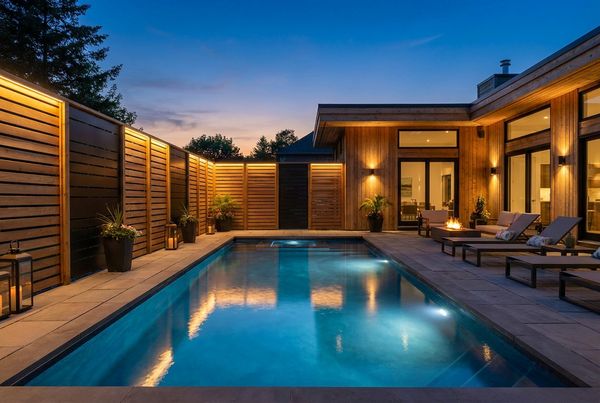
Privacy is the quiet luxury that separates a pool you love from a pool you're a little self-conscious using. The right screen turns an exposed slab into a retreat you actually want to swim in at 7 a.m. or 10 p.m. — no toweling up the second a neighbor steps outside. After years designing backyards, we've learned the trick is almost never one tall fence; it's blocking the two or three angles that matter with the right mix of plants and structure. Here's how to make your pool feel genuinely secluded without walling yourself into a box.
Start by mapping your sightlines
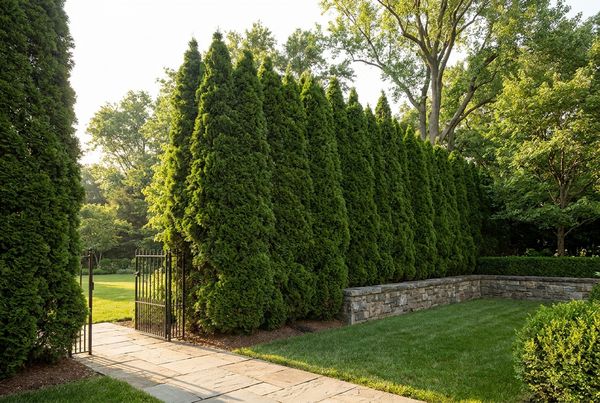
Before you buy a single plant or panel, do the cheapest and most valuable thing in this whole guide: stand in the pool and look around. Better yet, get in the water and note exactly where you feel exposed. Almost every backyard has just two or three problem angles — a neighbor's patio door, an upstairs window, a gap where two fences meet. You rarely need to enclose the entire yard, and trying to do so is how people end up feeling boxed in and spending three times what they needed to.
Map those sightlines on a rough plan, then target each one specifically. A single well-placed screen or specimen tree that blocks the one window overlooking your shallow end does more than 40 feet of hedge along a boundary nobody can see over anyway. This targeted approach also keeps the yard feeling open and bright — privacy should frame the sky, not cancel it. If you're working with a compact lot where every foot counts, our small pool ideas guide pairs naturally with tight, vertical screening.
Privacy plants: the living screen
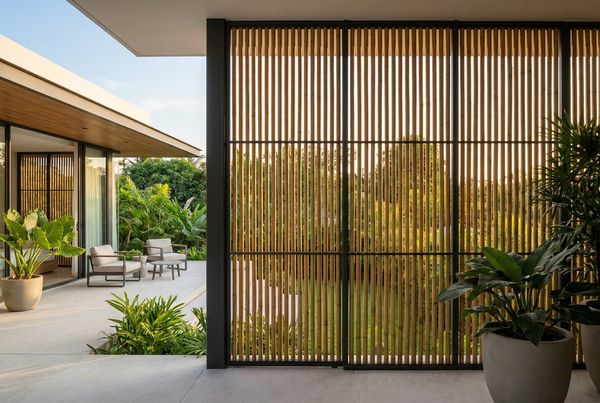
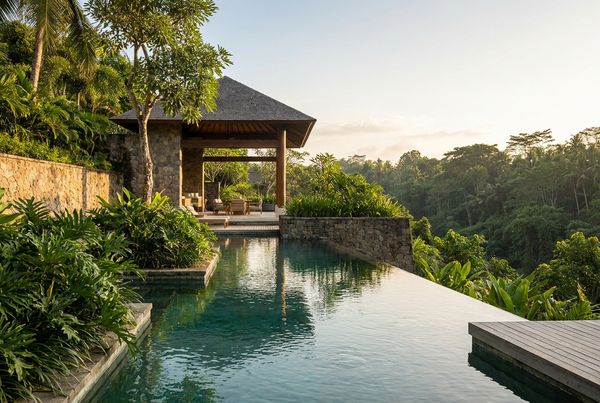
A living screen is the classic, and for good reason: nothing softens a boundary like greenery, and a good hedge reads far warmer than a wall. The key is choosing plants that grow tall, stay dense, tolerate poolside conditions, and — critically — don't rain litter into the water. Our go-to poolside screeners:
- Clumping bamboo — fast, tall, and dense, with a tropical rustle. Confirm it's a clumping (non-running) species; running bamboo is one of the genuinely regrettable plants you can put in a yard.
- Arborvitae ('Green Giant' or emerald) — the reliable evergreen privacy hedge across most of the country, fast-growing and forgiving.
- Podocarpus — a clean, clippable evergreen that takes a tight column or a soft hedge, ideal for modern and Mediterranean yards.
- Italian cypress — narrow, dramatic verticals for warm zones where you need height without width.
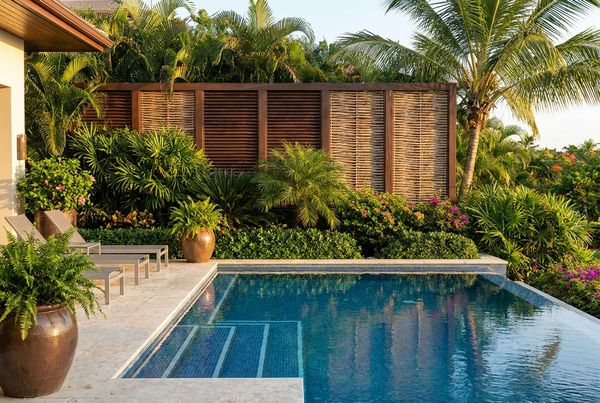
- Clumping palms — queen, areca, or pygmy date palms deliver instant resort privacy in zones 9–11.
Keep any screening plant a few feet off the coping so debris stays out of the skimmer, and lean toward evergreen so your privacy doesn't vanish in winter. For the full poolside plant playbook — including litter and root-safe distances — see our pool landscaping ideas.
Slat walls and modern screens
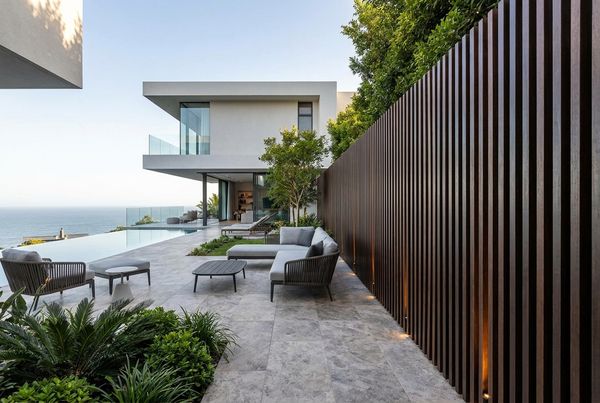
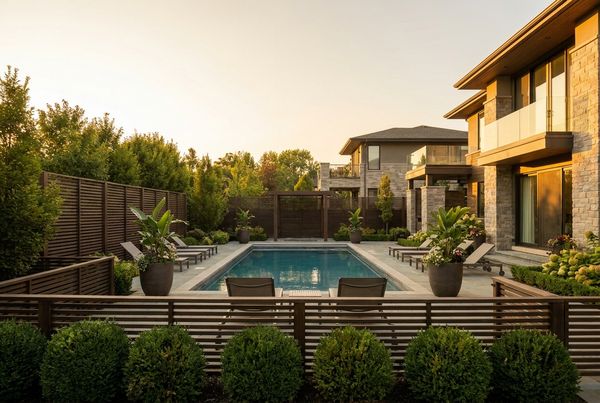
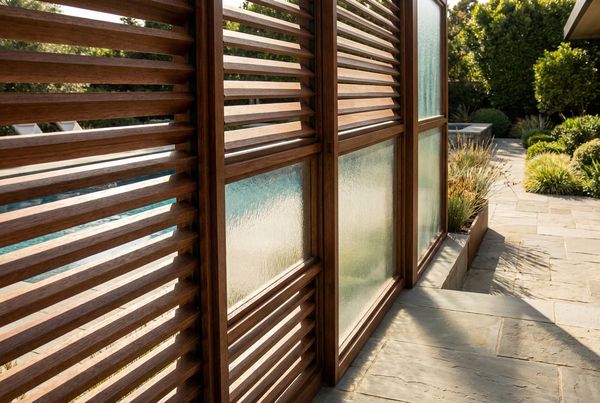
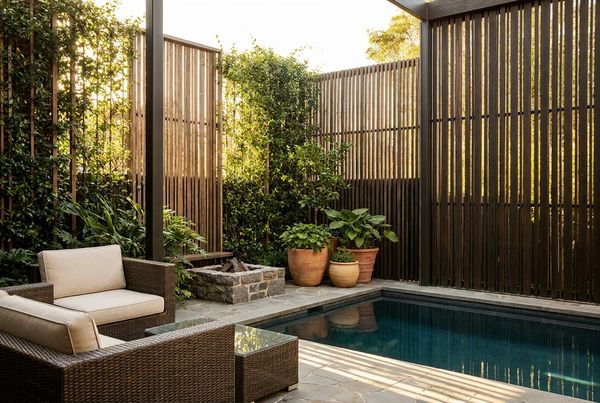
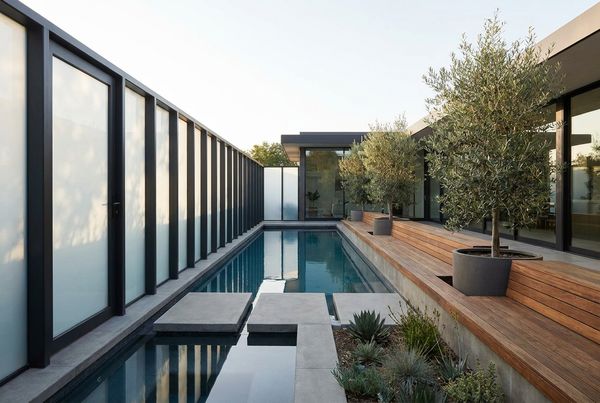
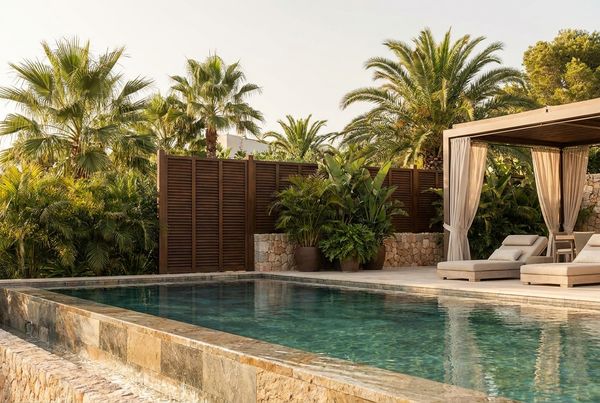
If plants are the slow, soft answer, a slat wall is the fast, architectural one. Horizontal-slat screens in warm wood, composite, or powder-coated aluminum have become the defining privacy look of modern pools — they block sightlines on day one, read as intentional design rather than a barrier, and the gaps between slats let light and air through so the yard never feels closed in.
You can use them as a full boundary wall, a freestanding "privacy fin" that screens one specific angle, or a backdrop behind a lounge or spa. Vertical slats emphasize height and screen a two-story window better; horizontal slats feel calmer and more contemporary. In 2026 we're seeing warm-toned wood and composite slats paired with dark metal frames and hidden LED strip lighting that washes the wall after dark — a detail that ties beautifully into your broader pool lighting ideas. A slat screen also makes the perfect host for a climbing vine or a row of planters at its base, which is where privacy really starts to sing.
What we think
Don't choose between a wall and a hedge — build the wall and plant behind it. The slat screen gives you privacy the day it's installed; the plants give you softness and life a season later. The single best money we see spent on privacy isn't more fence height, it's a pergola with drop curtains over the lounge: it kills the two-story sightline, adds shade, and instantly makes the space feel like a resort cabana. Splurge on the overhead structure, save on the boundary hedge, and let time do the rest.
Pergolas, curtains and overhead cover
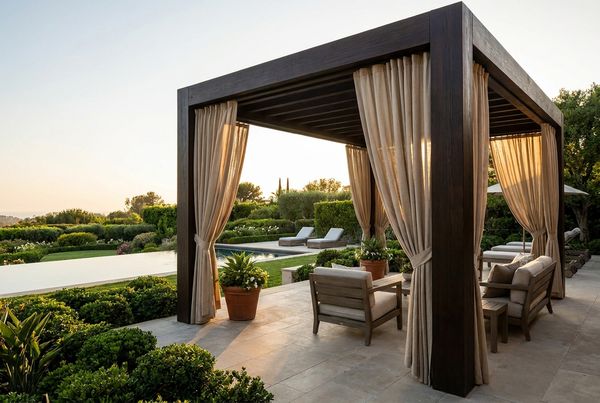
Here's the move most people miss: privacy isn't only horizontal. A fence blocks side-to-side sightlines, but it does nothing about a neighbor looking down from a raised deck or upstairs window. Overhead structure is what solves that — and it's why a pergola is one of the most powerful privacy tools you can add.
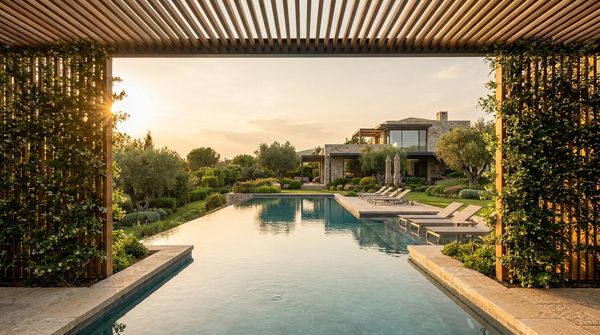
Fit a pergola over the lounge and shallow end and you've cut the downward sightline, added shade, and created a room-like zone that simply feels private. Add outdoor privacy curtains — weather-rated drapery on a track — and you get on-demand seclusion you can open for the view or close for a nap. Louvered or slatted roof pergolas let you dial the overhead angle exactly, and a planted vine over the top turns the whole thing into living shade. Our pergola ideas guide covers the styles and materials that suit a poolside, and pairing one with a pool cabana at the far end creates a genuinely resort-grade private zone.
Living walls and green walls
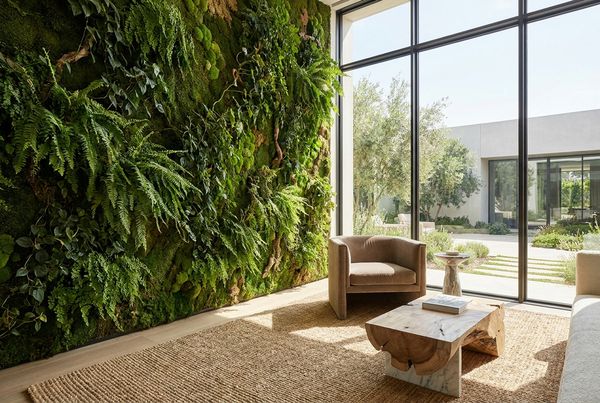
When floor space is tight — a courtyard pool, a narrow side yard, a small pool squeezed against a property line — a living wall earns its keep by screening vertically. Instead of a three-foot-deep hedge, a modular planted panel or a densely climbed trellis gives you a lush green barrier just inches deep.
Green walls read modern, luxurious, and unmistakably 2026, and they double as a stunning backdrop for a spa or lounge. They do ask for a bit more infrastructure: plan for built-in drip irrigation, drainage, and a sturdy waterproof mounting so runoff never touches the pool or the house wall. Choose plants matched to sun and splash — ferns, pothos, and small tropicals in shade; succulents and grasses in full sun. In warm, humid zones a living wall pairs perfectly with the lush layering in our tropical backyard ideas. Budget more here than for a plain fence, but the payoff is a privacy screen that feels like art.
Lattice, trellis and climbing vines
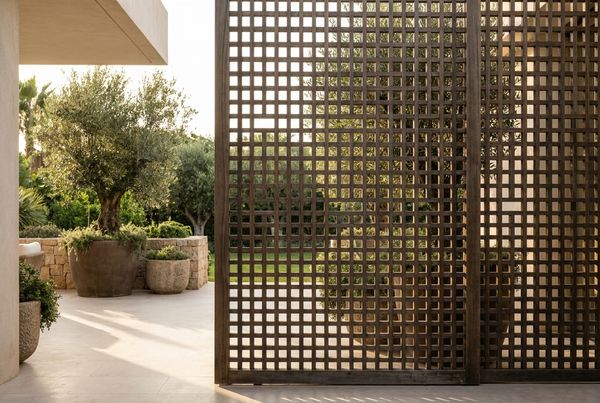
Lattice is the underrated, budget-friendly hero of pool privacy. On its own it filters views and softens a hard corner; grown over with a climber, a lattice or trellis panel becomes a full green screen for a fraction of the cost of a hedge or a living wall. It's the fastest cheap route to a "grown-in" look.
The trick is pairing the lattice with a vigorous, well-behaved climber:
- Star jasmine — evergreen, fragrant, fast, and tidy; a poolside favorite in warm zones.
- Bougainvillea — dramatic color and drought-tough for hot, dry climates (mind the thorns near the deck).
- Clematis or climbing roses — classic color for cooler, temperate yards.
- Creeping fig — a clingy evergreen that turns a plain wall into solid green (keep it off the house).
Mount lattice on a simple frame set a foot off a boundary fence and you've upgraded a plain fence to a screened, planted feature — an easy weekend win that ties into a broader backyard makeover.
Layer greenery with structure
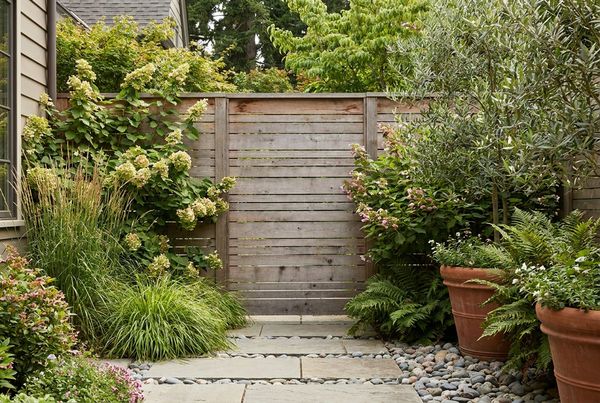
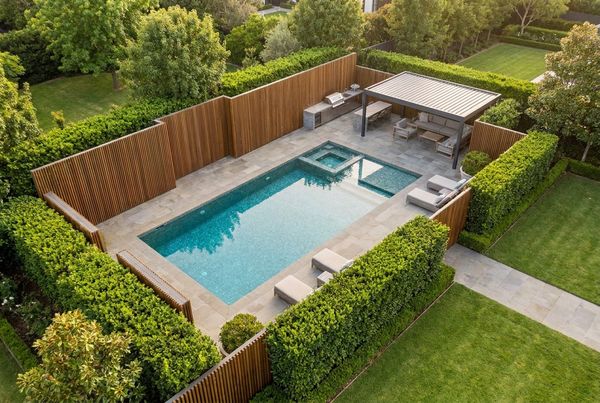
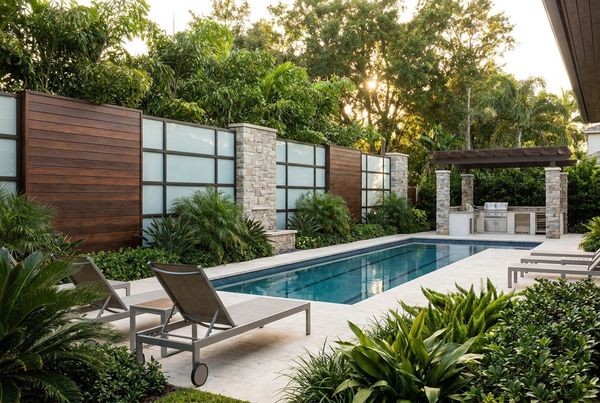
The single most reliable privacy formula we use is structure plus greenery, layered. A bare fence or wall says "boundary." The same wall with a tier of tall screening plants, mid-height shrubs, and grasses in front of it says "garden" — and it screens far more completely because the planting fills the gaps a rigid panel can't.
Layering also protects you against the weakness of each element on its own. Structure gives you privacy now but reads flat and hard; plants give you softness and life but take a season or two to fill in. Put them together and the fence covers you while the hedge matures, then the hedge takes over as the star. Build in three depths where you can — a slat wall or fence at the back, privacy plants in the middle, and a row of grasses or a low hedge at the front — and even a modest boundary reads as a lush, intentional edge. This is also how you keep a pool fence that's required for safety from looking purely functional.
Beating two-story sightlines
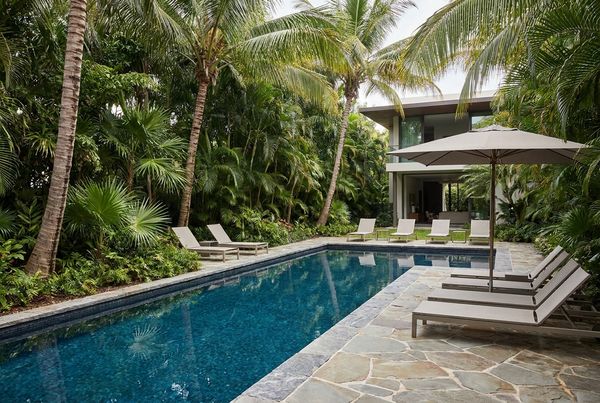
The hardest privacy problem — and the most common in newer, densely built neighborhoods — is the neighbor's second-story window looking straight down into your pool. No legal fence height will fix this, because the sightline comes from above. You have to go tall and go overhead.
- Tall columnar plants — Italian cypress, 'Sky Pencil' holly, tall clumping bamboo, or slender palms placed directly on the sightline between the window and the pool. A few well-aimed verticals beat a wall of trees.
- Overhead cover — a pergola, shade sail, or cabana over the lounge and shallow end blocks the downward angle entirely and gives you a shaded, private zone.
- A raised planter with a tall specimen — lifts a screening plant's effective height when there's no room for a large root ball.
The winning combination is almost always both: a tall vertical on the sightline and overhead structure over where you actually sit and swim. Aim the screening precisely — you only need to interrupt the line between that window and the water, not build a fortress.
Fast fixes vs. slow, permanent privacy
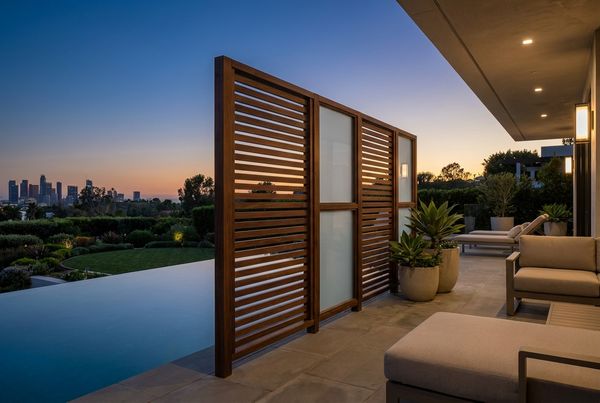
Privacy solutions split neatly into two camps, and the smartest designs use both — a fast fix for immediate relief and a slow one that becomes the permanent, beautiful answer. Use this to plan your budget and your timeline:
| Solution | Speed | Relative cost | Best for |
|---|---|---|---|
| Slat wall / screen panel | Instant | $$–$$$ | Modern look, one specific angle, day-one privacy |
| Pergola + curtains | Instant | $$$ | Two-story sightlines, shade, cabana feel |
| Large potted screeners | Instant | $–$$ | Renters, tight decks, movable flexibility |
| Lattice + climbing vine | 1 season | $ | Budget green screen, softening a fence |
| Living / green wall | Fast fill-in | $$$ | Narrow spaces, luxury vertical greenery |
| Privacy hedge (bamboo, arborvitae) | 1–3 seasons | $$ | Soft, natural, permanent boundary screen |
Costs are relative ballparks for planning only and vary widely by region, size, and materials. Always confirm local fence-height limits and pool-barrier codes before building any screen or wall.
Our honest recommendation: pair a built element you install this month with a living screen you plant the same day. You get privacy immediately from the wall, pergola, or panel, and a year later the plants have taken over as the soft, permanent star — the best of both timelines. Once your privacy plan is set, it's worth coordinating it with the rest of the yard; browse the full set of pool design ideas to make sure your screening, fencing, and planting all speak the same language.
Keeping privacy plants out of the pool
The one warning I give every client planting near water: privacy plants and pools have a complicated relationship. The whole point of a screen is dense, leafy growth — and dense, leafy growth sheds. Leaves, flowers, seed pods, and pollen all end up in the water if you plant too close, which means more skimming, a harder-working filter, and staining on the finish from tannins in fallen debris. The fix isn't to skip the plants; it's to place them thoughtfully.
Keep screening plants at least a few feet back from the coping, favor evergreen and low-litter species over messy flowering or fruiting ones, and steer well clear of anything with aggressive roots that can crack decking or invade plumbing. Running bamboo is the classic regret here — always confirm a clumping variety. Even with good choices, expect some seasonal cleanup: heavy pollen or leaf-drop periods will load your skimmer, and a screen right beside the water can leave organic debris that fuels algae if the pool sits unbalanced. Staying on top of the basics — a running pump, a clean skimmer basket, and balanced chemistry — keeps a lush, private pool from turning into a green one; our cloudy pool water guide covers what to do if debris ever gets ahead of you.
What pool privacy costs
Privacy budgets swing more wildly than almost any other pool project, because "private" can mean a $200 lattice-and-vine weekend or a $15,000 masonry wall. The honest way to plan is to separate the fast, built solutions from the slow, grown ones and price them differently. Built screens — slat walls, pergolas, panels — cost real money up front but deliver privacy the day they go in. Living screens cost far less in materials but charge you in time, since a hedge needs one to three seasons to do its job.
A few realistic ranges to anchor your thinking: a lattice panel with a climbing vine is the budget champion, often a couple hundred dollars a section. A quality horizontal slat wall runs meaningfully more per linear foot depending on material — powder-coated aluminum and composite cost more than pressure-treated wood but ask nothing of you later. A pergola with weather-rated drop curtains is the priciest single move but does the most work, especially against two-story sightlines. Live plants sit in the middle: cheaper the smaller you buy them, far more expensive if you want instant height from mature specimens. If privacy is one piece of a larger yard project, it's worth folding into the whole plan — our backyard makeover ideas guide helps you phase the spending so the screening lands alongside the deck, planting, and lighting instead of as a scramble at the end.
Design Gallery
6 more ideas to save — tap any photo to view full screen.

Kelly E.
Pool Design Editor, PoolPad
Kelly has spent 10+ years around residential pools — planning projects, testing gear, and documenting backyard builds for PoolPad. Each design guide is checked against current construction methods and material pricing.
Frequently Asked Questions
What is the best way to make a pool private?
What are the best privacy plants for a pool?
How do I block a neighbor's second-story view of my pool?
What is the fastest way to add pool privacy?
Does a living wall work for pool privacy?
How tall should a pool privacy screen be?
How much do privacy plants and screens near a pool add to maintenance?
Are running or clumping bamboo better for pool privacy?
How much does it cost to make a pool private?
Ready to build your dream backyard?
Compare local, vetted pool builders and get matched with pros who can bring these designs to life.
Find a Pool Builder Near You