



Key Takeaways
- A pool fence is safety equipment first — most codes require a minimum 48-inch barrier with a self-closing, self-latching gate that swings away from the pool.
- Frameless glass, black aluminum and horizontal slat are the three looks defining 2026 — each passes code while reading like design, not a cage.
- Codes vary by state, county and city — always confirm local requirements (and your insurer's) before you buy or build.
A pool fence is the one design decision that's also a safety decision — get it wrong and it's a liability; get it right and it disappears into the landscape while quietly doing its job. The good news for 2026 is that "code-compliant" and "beautiful" are no longer at odds. Frameless glass, black metal and horizontal slats all pass muster and look like they belong. After decades specifying barriers around pools, here's how we'd choose the right fence for your yard, your budget and — most importantly — the people you're keeping safe.
Why the fence matters more than any other pick
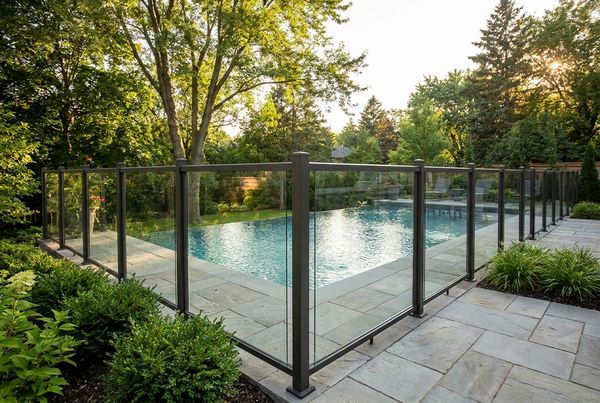
It's tempting to treat the fence as an afterthought — the last line item after the tile, the coping and the lighting are settled. Resist that. A pool barrier is the single element standing between a curious toddler and open water, and drowning is silent and fast. Whatever look you land on, it has to do its safety job flawlessly first and look good second.
The encouraging part: those two goals rarely conflict anymore. A well-chosen fence defines the pool zone, frames the water, and can even double as privacy screening. Think of it as architecture at the edge of the pool rather than a chain-link necessity. Everything that follows assumes the fence must pass code — we're just choosing how it does that, and how good it looks doing it.
Frameless & semi-frameless glass
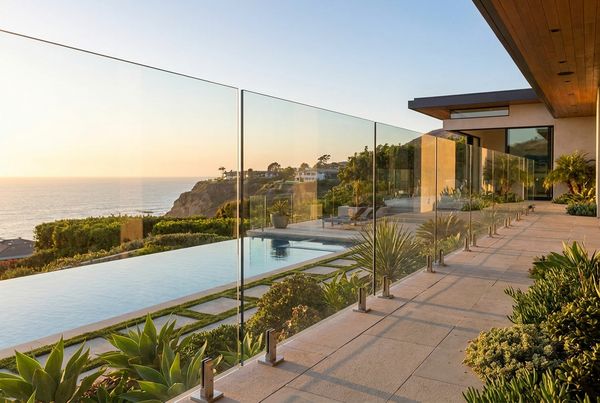
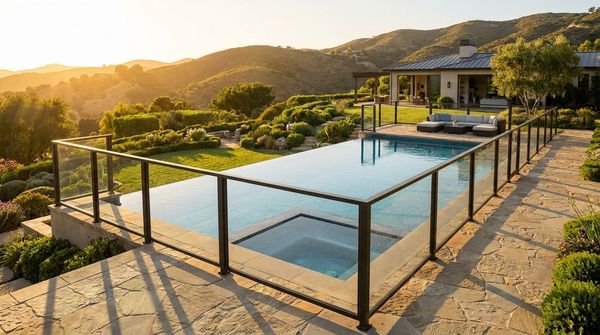
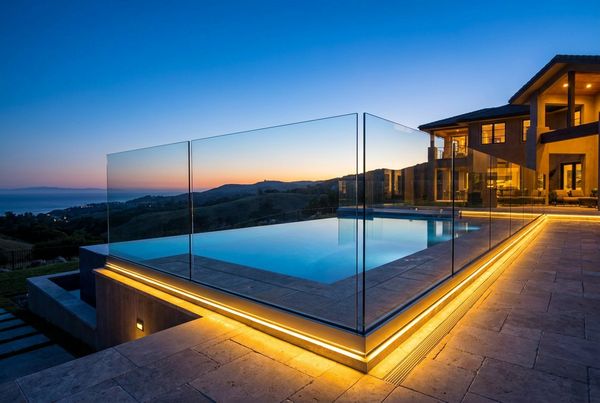
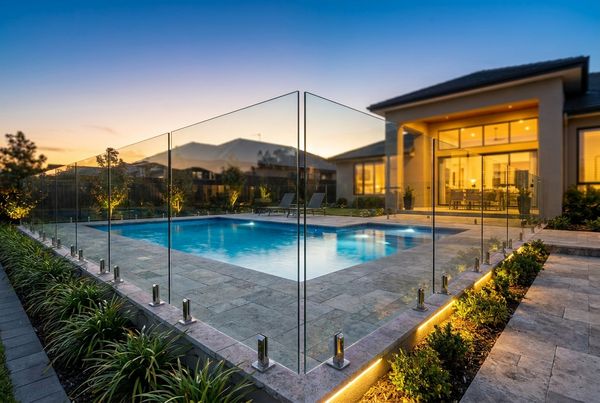
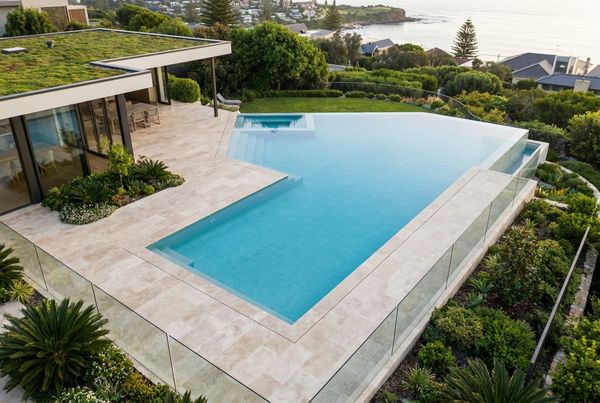
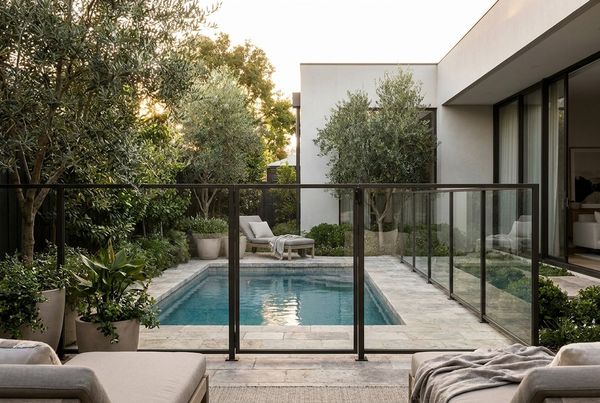
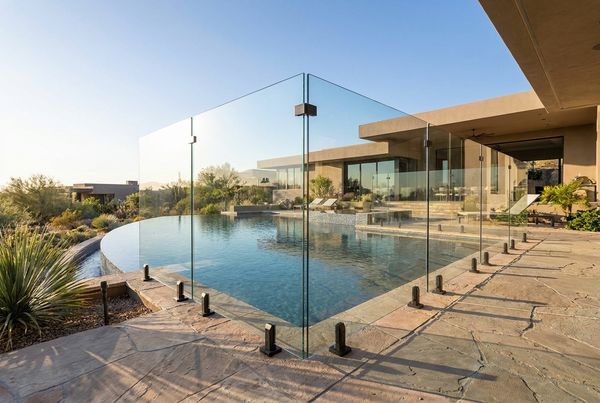
Frameless glass is the aspirational choice, and for good reason — it's the closest thing to no fence at all. Panels of thick tempered safety glass mount to the deck on discreet stainless spigots (frameless) or slot into a slim top-and-bottom channel (semi-frameless). From most angles the barrier reads as a faint shimmer, so your view of the water, the deck and the planting beyond stays completely open.
That transparency is the whole point: it keeps sightlines to the pool clear, which is a genuine safety benefit when you're watching kids from the kitchen window. The trade-offs are cost and upkeep — glass is by far the most expensive option per linear foot, and it shows water spots and fingerprints, so plan on occasional squeegeeing. Semi-frameless with a slim frame is a smart middle ground: nearly the same clean look for meaningfully less money. In 2026, frameless glass paired with a dark-bottom pool and warm LED lighting is about as resort-modern as a backyard gets.
Aluminum and black metal fencing
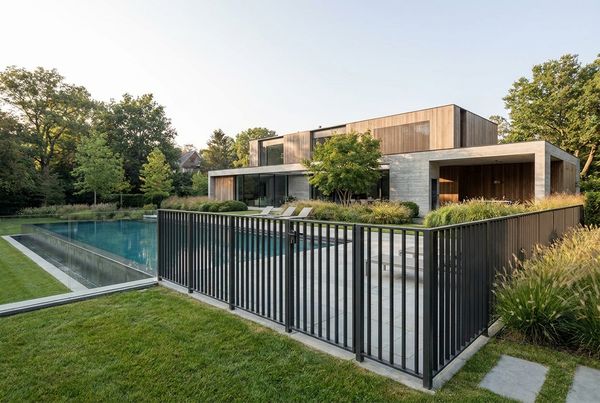
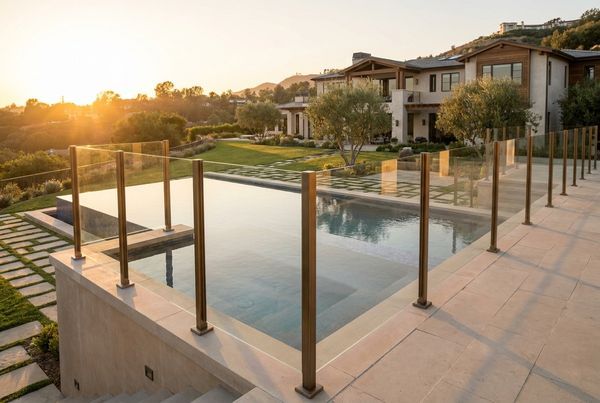
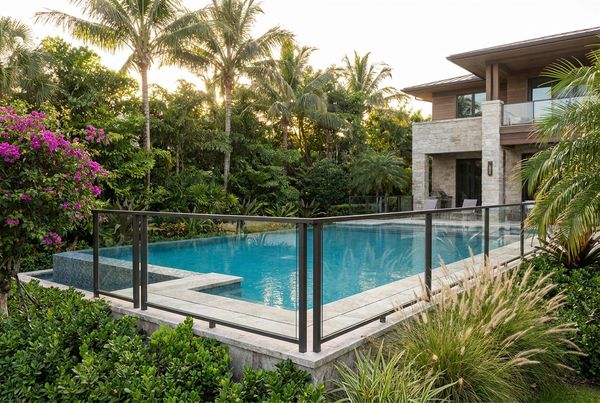
If glass is the splurge, powder-coated aluminum is the smart-money pick — and matte black is having a long moment. Aluminum won't rust like wrought iron, it's light, it installs quickly on almost any grade, and modern powder coatings hold their finish for decades. A slim vertical-picket profile in black practically vanishes against planting, letting the greenery and water do the talking while the fence quietly holds the line.
Black metal suits nearly every architecture — it reads modern against clean concrete and traditional against brick or stone. It's also the easiest option to get right on a sloped yard, since panels can be raked or stepped to follow the grade without gaps. Steel and true wrought iron are heavier, pricier and rust-prone, so unless you're matching a historic property, aluminum delivers 90% of the look for a fraction of the maintenance. This is the fence we recommend most often when clients want durability, code compliance and a clean look without the glass price tag.
Wood and horizontal-slat fencing
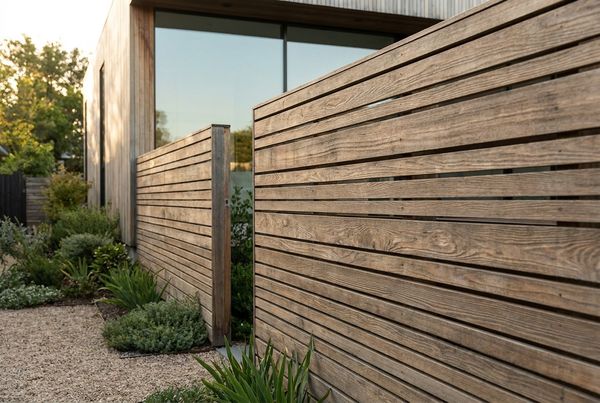
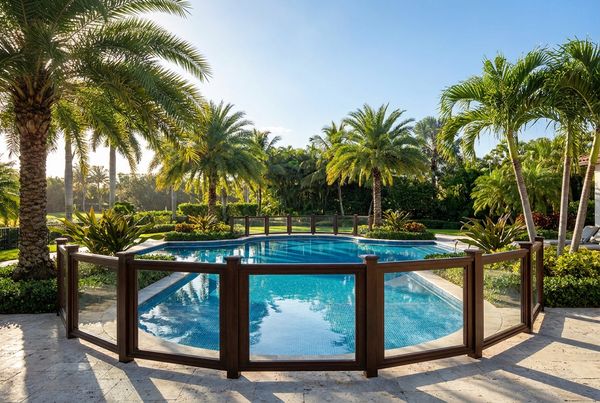
Metal and glass are transparent by design; wood does the opposite, and sometimes that's exactly what you want. A horizontal-slat fence in cedar, ipe, or a composite lookalike brings warmth, texture and instant privacy — it's the go-to when the pool backs onto neighbors or a street. The horizontal orientation reads distinctly modern and makes a yard feel wider, which is why it's one of the most-requested looks we build.
There's a safety caveat, though: horizontal rails can create a ladder. To stay compliant, slats either need gaps too narrow to climb, or the climbable face must sit on the outside with a smooth interior — check your local code carefully. Wood also demands upkeep (seal or stain every couple of years, or choose a composite to skip it), and it will silver over time if you let it. Done right, a slat fence pulls double duty as both barrier and privacy screen, and it pairs beautifully with layered poolside planting.
Removable mesh safety fencing
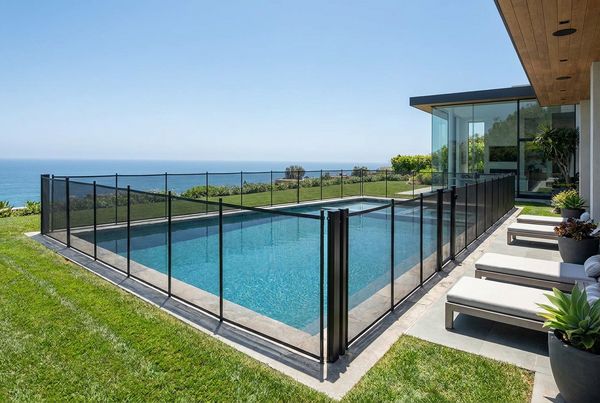
Removable mesh is the least glamorous option and, for households with young children, often the most sensible. Semi-transparent mesh panels tension between poles that drop into small deck sleeves, so the fence is climb-resistant (no footholds), see-through enough to watch the water, and — crucially — removable section by section when the kids grow up or you're hosting adults.
It's also among the most affordable barriers per linear foot, which makes it easy to justify as a layer of protection even if you plan a nicer permanent fence later. The mesh isn't a design statement, but it's honest, effective and beloved by parents and insurers alike. If little swimmers are your main concern, pair a mesh fence with the water-safety thinking in our kids pool ideas guide — a shallow tanning ledge, a self-latching gate and constant supervision matter every bit as much as the barrier itself.
Safety codes, gates and self-closing latches
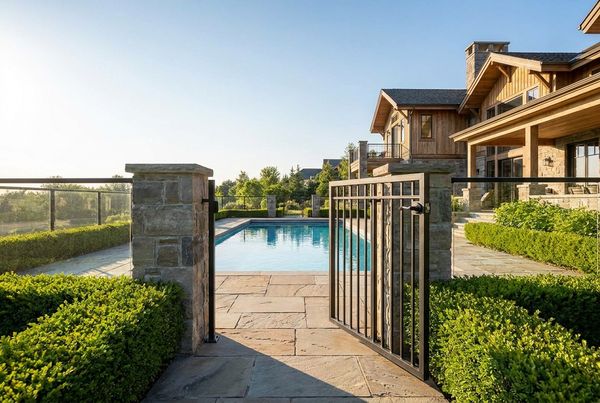
Here's the truth after years in the field: a fence almost never fails — the gate does. A perfect barrier with a gate that's propped open, sticks, or has a latch a child can reach offers no protection at all. Whatever material you pick, the gate has to be self-closing and self-latching, swing away from the pool, and keep its release mechanism out of a child's reach (typically at least 54 inches up, or shielded).
Common baseline requirements across much of the US look like this — but treat them as a starting point, not gospel:
| Requirement | Typical rule | Why it matters |
|---|---|---|
| Minimum height | 48 in (some areas 54-60) | Too low to climb over |
| Vertical gaps | < 4 in (no 4-in sphere passes) | A small child can't slip through |
| Bottom clearance | ≤ 2-4 in above surface | No crawling underneath |
| Gate | Self-closing, self-latching, opens outward | Never left ajar |
| Latch height | ≥ 54 in or shielded | Out of a child's reach |
| Climbability | No footholds / horizontal rails inside | Can't be scaled |
Requirements vary by state, county and city, and many areas add a door or gate alarm or a safety cover as a second layer. Always confirm your exact local code (and what your insurer requires) before buying or building.
Style vs. security: how to get both
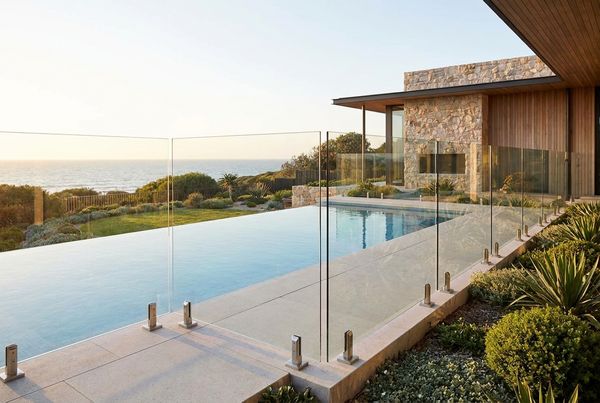
The old assumption was that a safe fence had to be an ugly one. That's simply no longer true. The move is to choose a material that meets code and recedes visually — transparent glass, slim black pickets, or slats that double as privacy — so the barrier reads as an intentional edge rather than an obligation. Match the fence to your home's architecture and it becomes part of the design language instead of fighting it.
What we think
If the budget is there, we'd splurge on semi-frameless glass on the primary sightline — the view from the house to the pool — and quietly run black aluminum along the side and back runs where nobody's looking. You get the disappearing-glass moment where it counts and durable value everywhere else. Whatever you do, don't cheap out on the gate hardware; a good self-closing hinge and magnetic latch is the least glamorous, most important money you'll spend. And if young kids are in the picture, add a removable mesh layer regardless of the permanent fence — belt and suspenders saves lives.
Cost per linear foot, compared
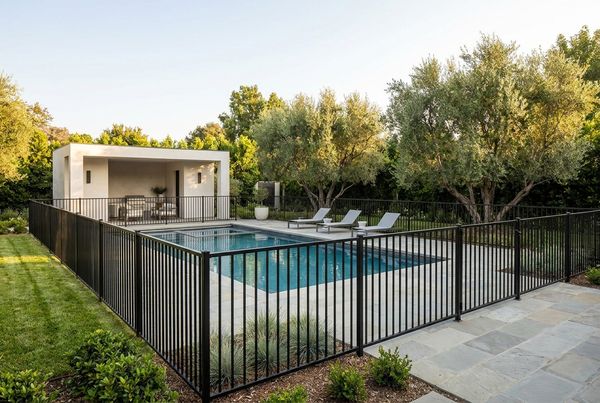
Budget usually narrows the field faster than taste does. The ranges below are realistic 2026 US ballparks, installed, and they swing with grade, gate count, glass thickness and region — treat them as directional, not quotes.
| Fence type | Installed cost / linear ft | Upkeep | Best for |
|---|---|---|---|
| Removable mesh | $15-$30 | Very low | Families, budget, flexibility |
| Aluminum / black metal | $25-$45 | Low | Durability and value |
| Wood / horizontal slat | $30-$60 | Moderate (seal/stain) | Privacy and warmth |
| Composite slat | $40-$80 | Low | Slat look, less upkeep |
| Semi-frameless glass | $100-$250 | Moderate (cleaning) | Clean look, lower glass cost |
| Frameless glass | $150-$400+ | Moderate (cleaning) | Views, resale, wow factor |
Add gates ($300-$1,500+ each depending on material), plus permits, grading and any alarms. Sloped or long runs raise per-foot costs.
A useful way to think about it: fencing is one of the smaller lines in your overall build. If you're mapping the full budget, our inground pool cost breakdown puts the fence in context against the shell, deck and features — and it's often worth reallocating a little to get the glass you actually want on the view side.
Fencing a sloped or awkward yard
Flat, rectangular lots make fencing easy. Real yards rarely cooperate — they slope, they curve, they wrap around a raised retaining wall or a spa, and every one of those transitions is a place a barrier can open up a gap. The material you pick matters more here than most people expect, because some handle grade changes gracefully and others fight you the whole way.
Aluminum is the easy winner on slopes. Panels can be raked (set at an angle to follow the grade) or stepped (kept level and dropped in stair-steps down the hill), and either way the bottom stays close enough to the ground that no child-sized gap opens underneath. Glass steps cleanly too but gets expensive fast on a long, sloping run because each panel height has to be worked out individually. Wood and slat fences step well but need careful attention to that bottom clearance — the code limit on the gap under the fence is measured at the highest point of the ground below it, so a fence stepping down a slope has to be detailed so no single spot exceeds it.
Curves and odd corners are their own challenge. Glass handles gentle curves with short straight panels that facet around the arc; tight curves want metal, which can be fabricated to almost any radius. Wherever the fence meets a house wall, a raised bed, or the pool equipment, close the gap completely — those junctions are exactly where a determined toddler finds a way through, so treat them with the same care as the gate.
Maintenance and what each material asks of you
The prettiest fence on install day isn't always the one you'll be happiest with in five years, because upkeep varies wildly by material. It's worth matching the maintenance to the amount of work you'll realistically do, not the amount you imagine you'll do.
Aluminum and composite are the low-effort champions — a powder-coated aluminum fence asks for little more than an occasional hose-down, and modern coatings hold their finish for decades. Removable mesh is nearly as easy: wipe the panels now and then and store the removed sections out of the sun. Real wood is the demanding one. Cedar and ipe both silver over time, and to keep the warm tone you'll be sealing or staining every couple of years; skip it and the fence weathers to grey, which some people love and others regret. If you want the slat look without the ritual, a composite lookalike gives you 90% of the warmth with none of the refinishing.
Frameless glass is low-maintenance structurally but high-maintenance visually — it shows every water spot, fingerprint, and splash of chlorinated water, so plan on regular squeegeeing to keep it looking like the reason you paid for it. Hardware is the quiet common thread: whatever the material, the hinges and self-latching mechanism on the gate take the most abuse and are the first thing to fail, so buy good hardware and check it seasonally. A gate that stops self-closing is a barrier that no longer works.
Combine fencing with planting and privacy
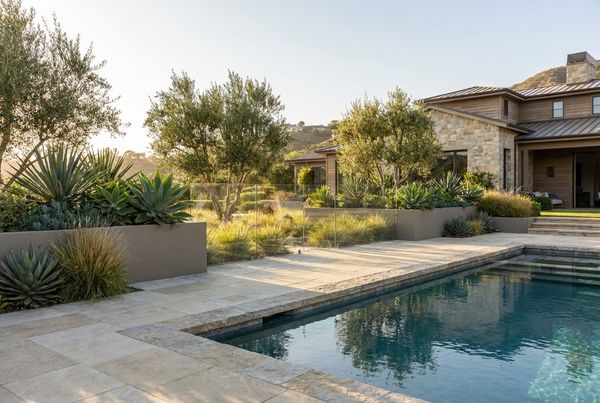
The best-looking pool fences are rarely working alone — they're softened, screened or backed by planting. A slim black metal fence nearly disappears behind a row of ornamental grasses; a glass panel gains warmth with a planter at its base; a slat fence and a clumping-bamboo hedge together give you a privacy wall no one can see through. Layering greenery against the barrier is the single fastest way to make it feel like landscape instead of hardware.
Just remember the fence still has to do its safety job: keep climbable planters, furniture and trellises well back from the fence line so they don't become a step-ladder for a determined toddler. For the planting palette that pairs best with each material — and screening that fills in fast — read our pool landscaping ideas and pool privacy ideas guides next, then see how it all comes together across our full pool design ideas collection.
Design Gallery
6 more ideas to save — tap any photo to view full screen.

Kelly E.
Pool Design Editor, PoolPad
Kelly has spent 10+ years around residential pools — planning projects, testing gear, and documenting backyard builds for PoolPad. Each design guide is checked against current construction methods and material pricing.
Frequently Asked Questions
How tall does a pool fence have to be?
What is the best type of pool fence?
Do you legally need a fence around a pool?
How much does a pool fence cost?
What is the safest pool fence for young children?
Can a glass pool fence meet safety code?
How much maintenance does a pool fence need?
Does a pool fence lower home insurance or affect liability?
Can I put a fence around just the pool instead of the whole yard?
What is the most budget-friendly pool fence?
Ready to build your dream backyard?
Compare local, vetted pool builders and get matched with pros who can bring these designs to life.
Find a Pool Builder Near You