



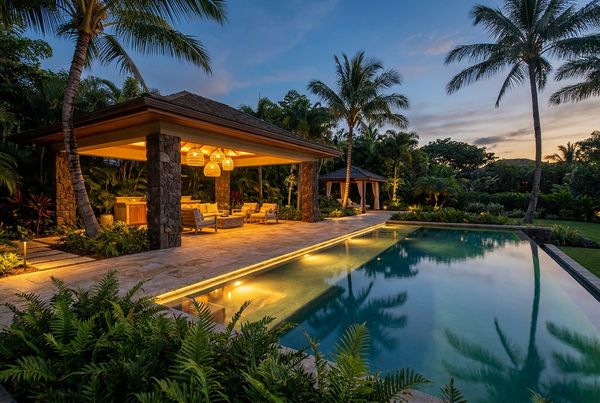
Key Takeaways
- A tropical backyard is built on layered, lush planting — palms, philodendron, bird of paradise and crotons stacked in tiers around a freeform pool.
- Water and shade sell the resort feeling: a rock waterfall, grotto or beach entry plus a tiki or cabana turn a pool into a destination.
- Warm 2700K lighting and low-litter plant choices keep the look magical at night and easy to maintain year-round.
The best tropical backyards don't announce themselves — they envelop you. You step out the door and the temperature seems to drop, water is moving somewhere out of sight, and a canopy of palms filters the light into something softer. That "am I on vacation?" feeling isn't luck; it's a handful of design decisions stacked on top of each other. After decades building resort-style pools and the jungles around them, we can tell you exactly which moves deliver the fantasy and which ones just cost money. Here's how to turn an ordinary yard into a private tropical resort.
What makes a backyard feel tropical
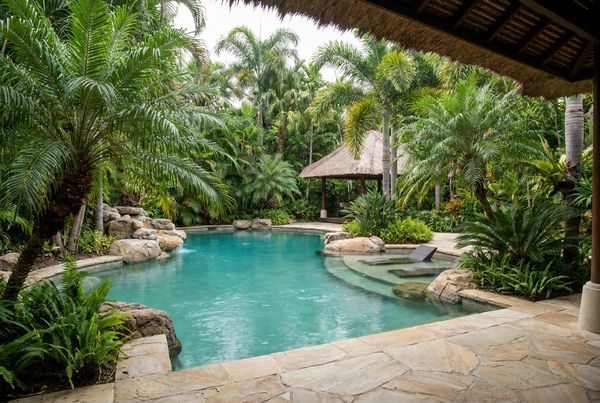
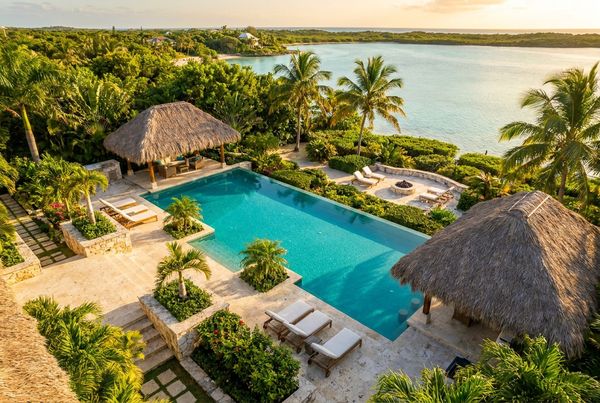
Strip a tropical backyard down to its essentials and you find four ingredients: lush layered greenery, curved organic water, the sound of moving water, and shade you can lounge under. Get those four working together and the style takes care of itself — miss one and the yard feels like it's trying.
The mistake we see most is treating "tropical" as a plant list. Plants matter enormously, but a jungle around a stark rectangle still reads suburban. The resort feeling comes from the shape of the water, the layers of planting, and the experience of walking through it — cool shade, dappled light, the trickle of a waterfall. Nail the bones first (pool shape, grade changes, shade structures), then dress them in green. If you want the broader planting playbook, our pool landscaping ideas guide covers the plant science; here we're focused on the specific tropical, resort-style version.
Layered, lush planting is the whole game
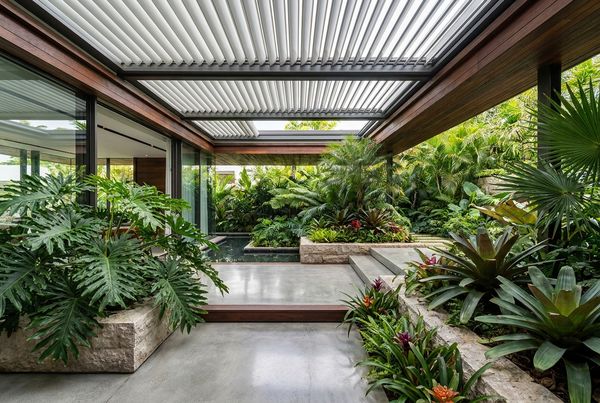
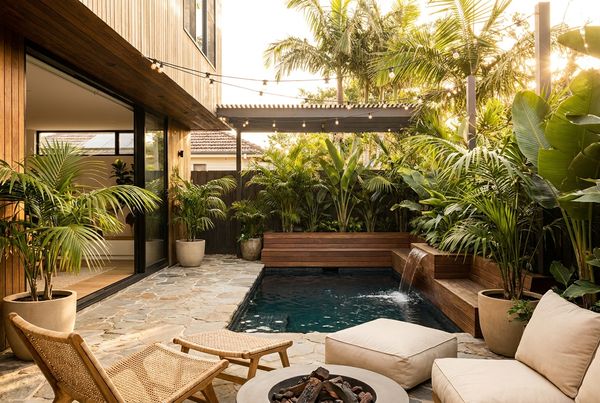
If a tropical backyard has one non-negotiable, it's density. Real jungles have no bare soil — every layer is filled, from canopy to floor. To recreate that, plant in three tiers:
- Canopy: palms (queen, pygmy date, areca) and taller specimens that arch overhead and cast dappled shade.
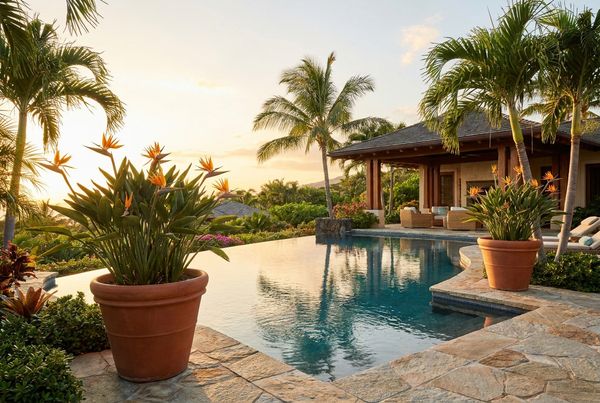
- Mid-layer: giant philodendron, bird of paradise, hibiscus, and elephant ear for big bold leaves and pops of color.
- Floor: ferns, crotons, bromeliads, and cannas knitting the ground together so no mulch shows.
The color comes mostly from foliage, not flowers — that's the secret to a jungle that looks lush every month rather than just in bloom. Crotons bring orange, red and yellow; bird of paradise adds architectural drama; variegated philodendron and bromeliads brighten the shade. Repeat a few hero plants in generous drifts rather than collecting one of everything, and the yard reads intentional instead of chaotic. Plant bigger than feels comfortable, too — tropicals grow fast in warm climates, and instant scale is what sells the fantasy on day one.
The lagoon or freeform pool
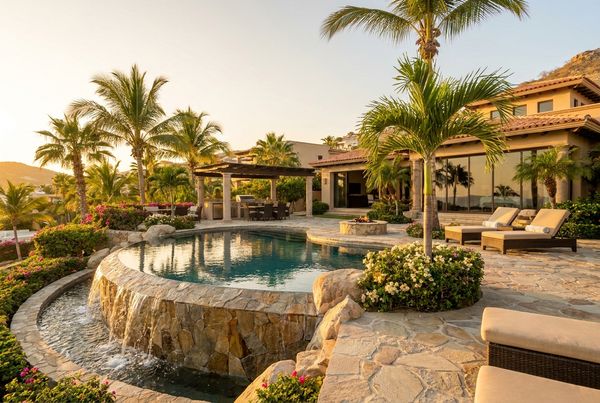
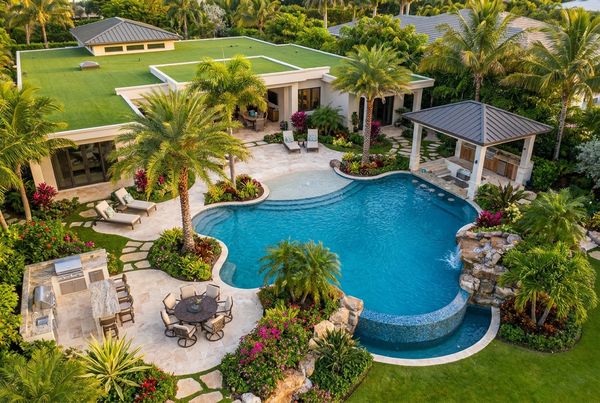
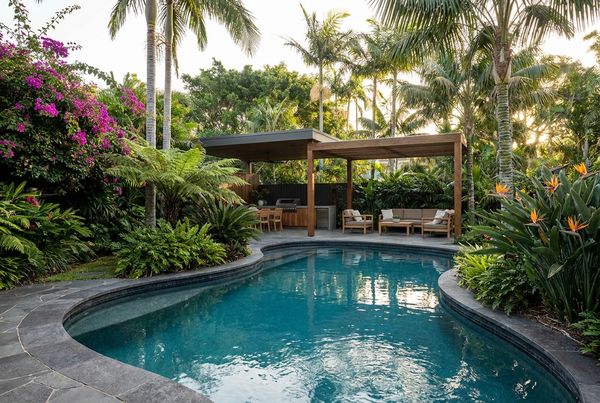
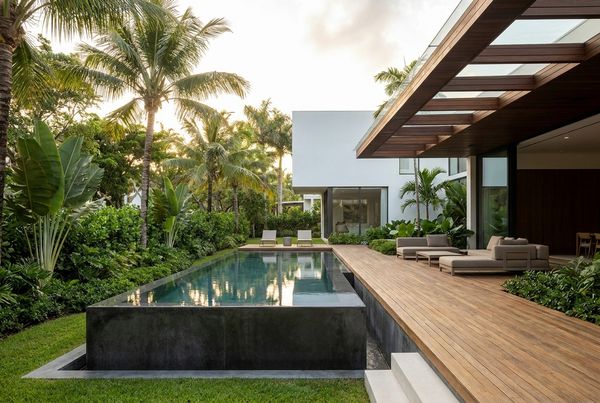
Nothing kills a tropical vibe faster than a hard rectangle. The pools that feel like a resort are almost always freeform, lagoon or kidney-shaped — soft curves that mimic a natural body of water. A curved shell hugs planting beds, wraps around a rock waterfall, and lets you tuck a beach entry into one end. Because these pools are usually poured in gunite, you get complete freedom over the shape; our gunite pools overview explains why that construction method dominates custom resort builds.
A few moves push a freeform pool from "backyard" to "lagoon":
- A dark interior finish — pebble or dark plaster in charcoal, deep green or blue-black makes the water look bottomless and reflective, exactly like a jungle pool.
- Boulder or rock coping on one side (the "wild" edge) with clean coping on the entry side.
- A raised bond beam or grotto at the back to give the water a source and a sense of drama.
Dark-bottom finishes are having a real moment for precisely this reason — they read natural and warm the water a little too. If the look appeals, our dark-bottom pool guide covers the trade-offs.
Rock waterfalls, grottos and moving water
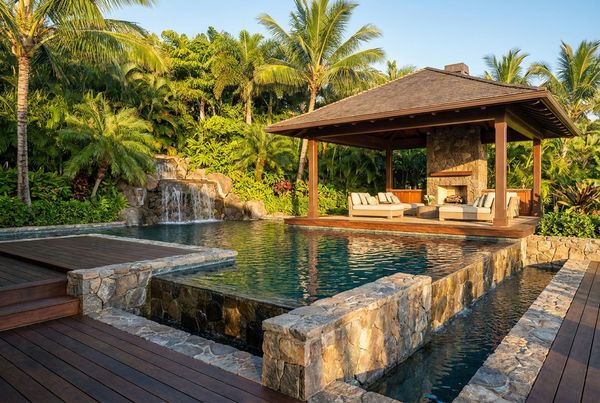
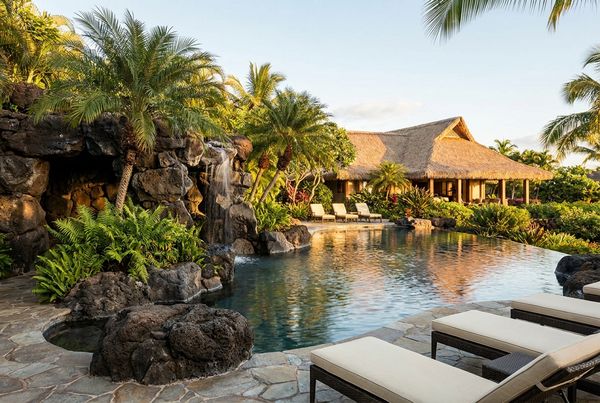
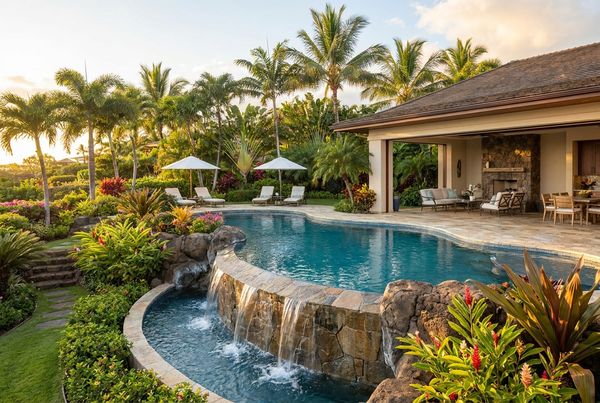
Moving water is the sound of a resort. Even a modest rock waterfall transforms a pool because it engages a second sense — you hear the vacation before you see it. Natural boulder waterfalls, whether built from real stone or high-quality artificial rock, are the tropical signature, and they double as a place for ferns and philodendron to spill over the edges.
The grand version is a grotto: a cave-like structure behind or beside the waterfall, often with a hidden bench, a spillover spa above, and cool blue light inside. It's the single most photographed feature in a tropical build, and it turns a swim into an experience. If you're weighing one, our pool grotto guide walks through the how and the cost, and the broader pool water features piece covers gentler options — sheet-descent falls, bubblers, and deck jets — if a full rock waterfall is more than your yard needs.
What we think
If the budget forces a choice, splurge on the waterfall and the planting, and skip the grotto. A grotto is spectacular but expensive and only occasionally used; a good rock waterfall plus dense, layered greenery delivers 80% of the resort feeling for a fraction of the cost. Put the saved money into mature, larger plants — instant canopy is worth more than any single hardscape gimmick. And whatever you build, wire it for warm lighting from day one; retrofitting is the expensive way to do it.
Tiki huts, cabanas and shade structures
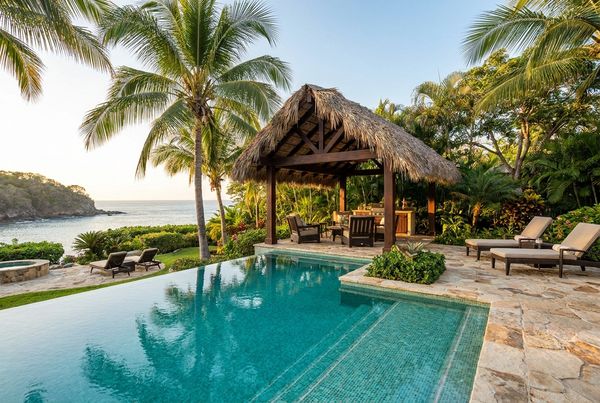
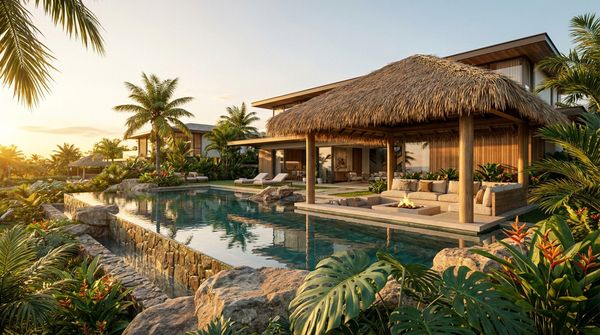
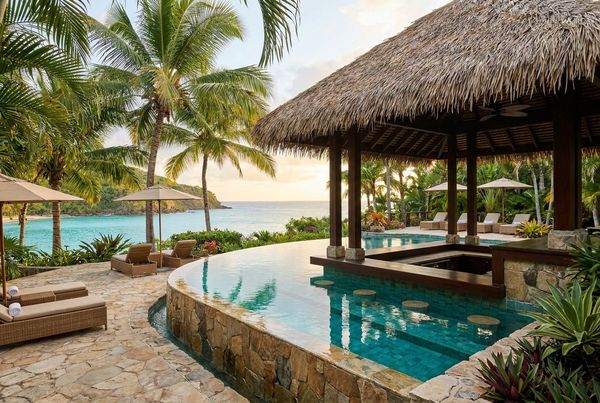
A tropical backyard needs a place to be — somewhere shaded to retreat when the sun is high. That's where a tiki hut, cabana, or thatched palapa earns its keep. It anchors the yard, provides shade, and (with a bar and a couple of stools) becomes the social heart of the whole space.
Options run from casual to resort-grade:
- Thatched tiki / palapa — the most literal tropical statement; a thatched roof over a bar or lounge.
- Cabana — a more finished structure with a roof, drapes, and lounge seating; see our pool cabana ideas for styles.
- Swim-up bar — a submerged counter with stools, the ultimate resort flourish, best paired with a shaded canopy so drinks and phones stay dry.
Whatever you build, orient it to catch the afternoon shade and frame the pool, and tie its materials to the rest of the yard — cedar, bamboo, thatch and natural stone all belong; vinyl doesn't.
Beach entry and the barefoot backyard
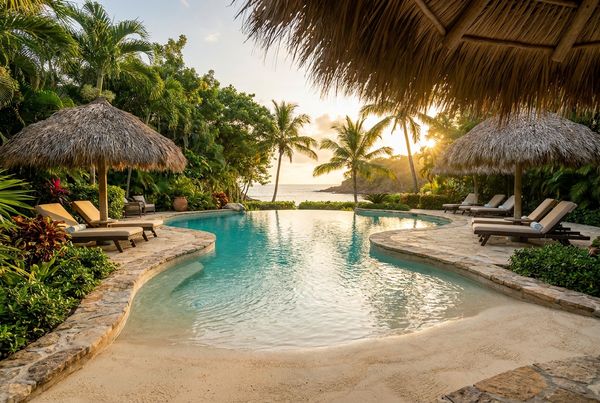
Nothing says "resort" like walking into the water instead of climbing down a ladder. A beach entry (also called a zero-entry or walk-in) slopes gently from the deck into the shallows, exactly like a shoreline. It's brilliant for kids and dogs, perfect for a shaded lounger in a few inches of water, and it photographs like a five-star hotel.
Beach entries pair naturally with tropical builds because the gentle slope suits a freeform shape and gives you a spot to set a couple of in-water chairs under a canopy. They do consume more footprint than a standard step, so they suit medium-to-large yards best — but even a small one changes the whole character of the pool. Our beach entry pool guide covers slope, surface texture and the finishes that keep the shallow shelf from getting slippery. A textured pebble finish is a favorite here for exactly that reason — grippy underfoot and natural-looking.
Warm lighting and the after-dark resort
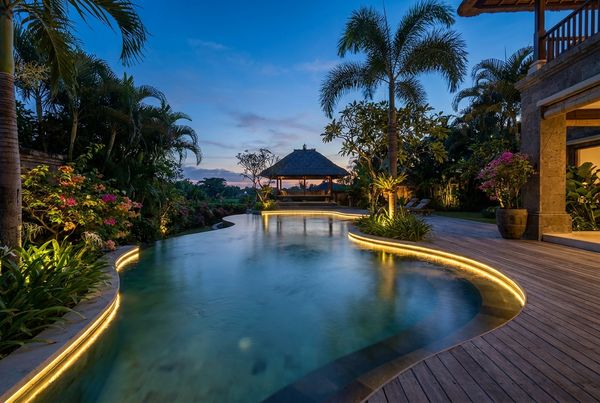
A tropical backyard is arguably better at night — and lighting is what unlocks it. Dollar for dollar, warm low-voltage lighting is the highest-impact upgrade in the whole plan, and the tropical version leans warm and moody rather than bright:
- Uplight the palms so their fronds throw dramatic silhouettes overhead — this single move does the most.
- Warm 2700K throughout — cool white reads clinical; warm light reads sunset and firelight.
- Glow the water with color-tunable LEDs, but keep them dialed to warm amber or deep teal rather than a nightclub blue.
- Hide every fixture behind foliage so you see the effect, not the source.
Add a fire feature — a fire bowl on the bond beam or a fire pit off the deck — and the resort feeling is complete; our pool lighting ideas and fire pit ideas guides go deeper on both. Smart automation lets you set a "resort" scene that dims the lights, starts the waterfall, and warms the spa from your phone.
Keeping a tropical yard low-litter and easy
Here's the honest catch: a dense tropical planting scheme can become a skimming chore if you're careless about species and placement. The good news is that a little discipline keeps the jungle from becoming a job.
| Move | Why it matters | Effort / payoff |
|---|---|---|
| Keep messiest plants back from the water | Fewer leaves and flowers land in the pool and skimmer | Low effort, high payoff |
| Stone mulch, not bark | Bark floats, blows in and clogs skimmers | Low effort, high payoff |
| Run a robotic cleaner | Handles fallen leaves so you don't skim daily | Upfront cost, huge payoff |
| Saltwater sanitation | Softer water, less chemical handling | Upfront cost, ongoing ease |
| Hydrozone the planting | Efficient drip irrigation, healthier plants | Design-stage effort |
A robotic cleaner is close to essential under a canopy — it quietly clears the leaf litter a jungle inevitably drops. A saltwater system makes the water gentler on skin and eyes for those long resort-style soaks, and it suits the barefoot, spend-all-day vibe a tropical yard invites. Keep bed edges crisp and mulch with stone near the coping, and the jungle stays lush without becoming a second job.
What a tropical resort backyard really costs
Let me be honest about money, because "resort backyard" covers a huge range. The pool itself is the anchor: a freeform gunite pool with a natural rock waterfall commonly runs from about $80,000 to well over $150,000 in 2026 once you add real rockwork, a beach entry, and a dark finish. Layer on a walk-in grotto, a spillover spa, or a swim-up bar and you climb toward the top of that range fast. The number moves most with rockwork and custom shaping, which is exactly why these builds are almost always gunite — concrete is the only shell that shapes to a true lagoon.
The good news is that the tropical feeling isn't locked behind the biggest budget. Dense, layered planting and warm lighting deliver most of the resort atmosphere for a fraction of what hardscape costs, so a modest freeform pool wrapped in mature palms and lit warmly can out-feel a far pricier build that skimped on greenery. If the water part of the project is the question mark, price the shell realistically first with our inground pool cost guide, then decide where the rest of the budget does the most work — my vote is always mature plants and lighting over a second hardscape feature.
Keeping the water clear under a canopy
A jungle canopy is the whole point of a tropical yard, and it's also the thing working hardest against your water clarity. Leaves, blossoms, and pollen drift into the pool constantly, and organic debris is algae food — so a tropical pool asks a little more of its filtration and chemistry than an open one. The single best investment is a good robotic cleaner running daily; under a canopy it quietly clears the litter that would otherwise sink, decay, and cloud the water. Skim the surface before debris waterlogs and drops, and keep your skimmer baskets clear.
Chemistry is the other half. All that organic load consumes sanitizer, so stay on top of your chlorine and circulation, especially in warm weather when algae moves fastest. A saltwater system suits these pools well — it trickles chlorine in steadily and leaves the water softer for the long, barefoot soaks a tropical yard invites. If the pool ever does tip green after a storm drops a load of leaves, don't panic; our green pool guide walks through clearing it. Balance a little diligence with the right equipment and the jungle stays lush without the water ever becoming a chore.
Tropical style in a cold climate
You don't need to live in Florida to build a tropical backyard — you just evoke the look with hardier stand-ins and lean harder on the structure. Real tropicals won't overwinter in most of the country, so the strategy is structure and water carry the theme; plants play a supporting role.
- Hardy palm-likes: windmill palm and needle palm survive surprisingly cold winters, and a hardy banana dies back but returns each spring.
- Bold-leaved perennials: cannas, elephant ear (dug and stored over winter), and big hostas mimic jungle foliage in temperate zones.
- Potted tropicals: grow crotons, hibiscus and true palms in large pots you wheel into a garage or sunroom for winter.
- Lean on hardscape: the rock waterfall, cedar tiki, dark-bottom pool and warm lighting deliver the resort feeling regardless of hardiness zone.
Because the built elements do the heavy lifting, a cold-climate tropical yard can look astonishingly convincing from spring through fall. When you're ready to see how the whole backyard ties together — pool shape, water features, shade and planting — browse the rest of our pool design ideas and start matching a tropical language to your space.
Design Gallery
6 more ideas to save — tap any photo to view full screen.

Kelly E.
Pool Design Editor, PoolPad
Kelly has spent 10+ years around residential pools — planning projects, testing gear, and documenting backyard builds for PoolPad. Each design guide is checked against current construction methods and material pricing.
Frequently Asked Questions
How do I make my backyard look tropical?
What plants give the best tropical look around a pool?
What shape pool works best for a tropical backyard?
How much does a tropical pool with a waterfall and grotto cost?
Can I have a tropical backyard in a cold climate?
How do I keep a tropical pool from being high-maintenance?
Does all the leaf litter from tropical plants make a pool hard to keep clean?
Is a saltwater system worth it for a tropical pool?
How do I keep a tropical pool warm enough to feel like the tropics?
What pool finish looks most tropical?
Ready to build your dream backyard?
Compare local, vetted pool builders and get matched with pros who can bring these designs to life.
Find a Pool Builder Near You