



Key Takeaways
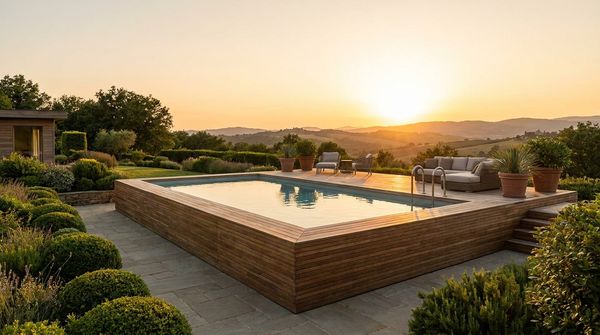
- The single biggest upgrade is a deck or surround that hides the wall and ties the pool into the yard — it's what separates a high-end above-ground pool from a kit dropped on the lawn.
- Semi-inground installs give you most of the inground look for a fraction of the cost, especially on a sloped lot.
- Expect a finished, deck-and-landscaped above-ground project to land around $6,000–$25,000 — well under a typical inground build.
An above-ground pool used to mean a blue-ringed kit plopped on the back lawn. Not anymore. With the right deck, surround, and planting, an above-ground pool can look genuinely high-end — and cost a fraction of an inground build. After years designing backyards around raised pools, here's exactly how to make one look like it belongs.
Why above-ground is having a moment
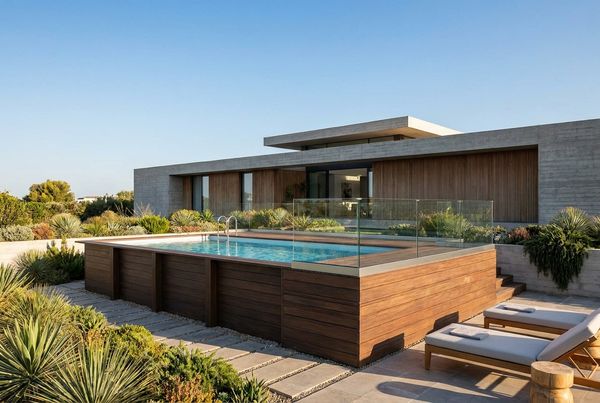
For a long time, above-ground pools were the compromise choice — cheap, temporary, and a little apologetic-looking. That reputation is out of date. Inground construction costs have climbed hard, permitting and excavation eat months, and a lot of homeowners simply don't want to bury a five- or six-figure hole in the yard. Above-ground has quietly become the smart backyard-water move for anyone who wants a pool this summer, not next year.
The manufacturers noticed. Today's above-ground pools come in dark resin and steel panels, larger oval and rectangular formats, and dark interior liners that make the water read deep and inviting. Pair one of those with a proper deck and some planting, and the difference between it and a small inground pool is mostly the price tag. If you're weighing a compact build overall, our small pool ideas guide covers the same "less footprint, more design" thinking.
Make it look high-end: the core moves
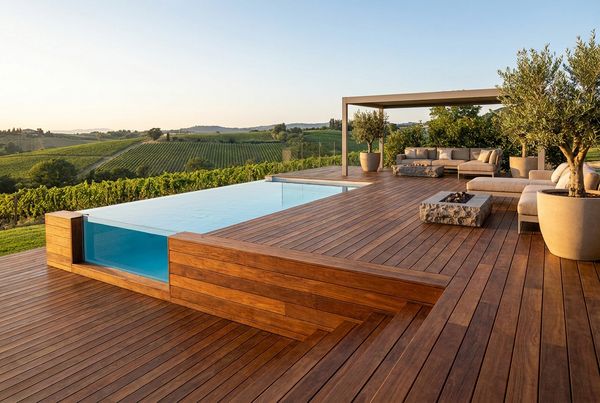
The reason cheap above-ground pools look cheap is almost always the same: the pool sits as a raised object on an empty lawn, with a visible metal wall, a wobbly ladder, and nothing tying it to the yard. Fix those three things and the whole impression changes. Here's the mental checklist we run every time.
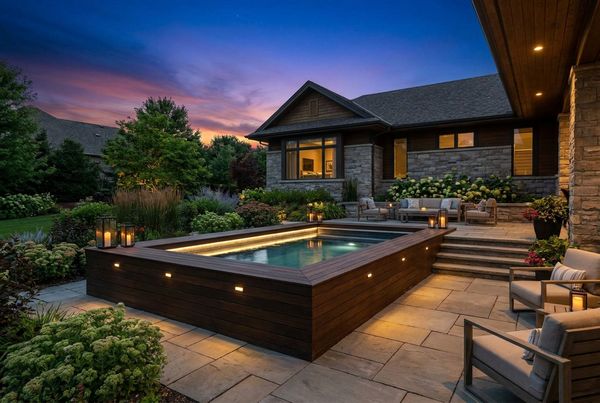
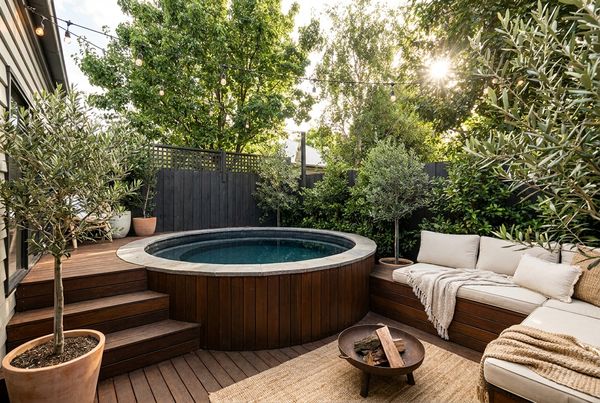
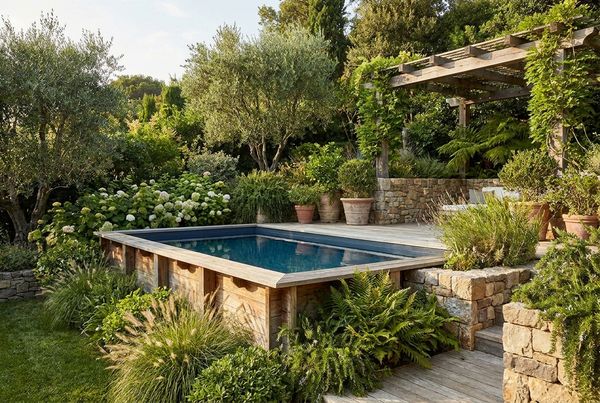
- Hide the wall. Whether with a deck, a skirt, or planting, the flat exterior wall is the biggest tell — cover or soften it.
- Give it a proper edge. A clean coping cap or a deck at the waterline replaces the "top rail" look with something that reads intentional.
- Ground it in the landscape. Beds, boulders, and grasses at the base make the pool grow out of the yard instead of floating on it.
- Go dark inside. A dark liner (gray, navy, charcoal) makes the water look deeper and more like a custom pool — the same trick used on premium inground builds like a dark bottom pool.
- Add light. A few well-placed fixtures turn the whole thing into a nighttime feature; see our pool lighting ideas for low-cost options.
Do even two or three of these and people stop clocking it as "an above-ground pool" and start seeing it as a designed water feature.
What we think
If we had one dollar to spend on making an above-ground pool look expensive, it goes to a deck that meets the water on at least one side. Nothing else transforms the look as fast. Our second dollar goes to a dark interior liner and simple landscaping at the base — cheap, high-impact, and the combination that fools the eye into reading "inground." Skip the flimsy stock ladder; it undoes all of it.
Decks & surrounds that transform the look
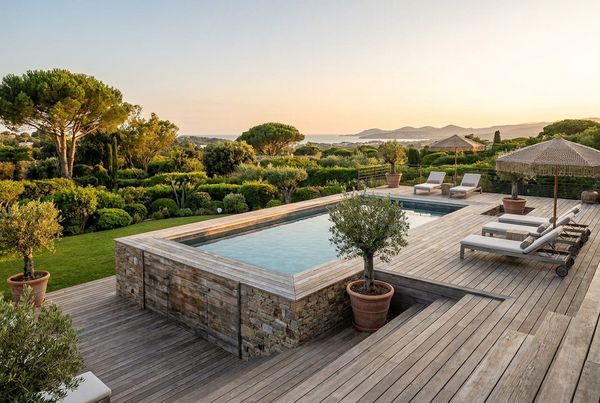
A deck is the difference-maker. Meeting the pool's wall at the waterline, it hides the structure entirely, makes getting in and out safe and graceful, and — crucially — adds usable square footage for lounging and dining. You have three broad approaches, in rising order of cost and effect:
- Partial deck / entry landing. A small platform on one side with steps up. Cheapest, still a huge improvement over a ladder.
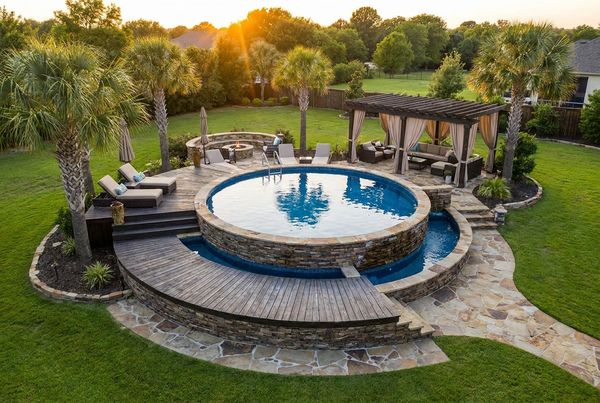
- Wraparound deck. A deck that hugs two or three sides. This is where an above-ground pool starts to look genuinely custom.
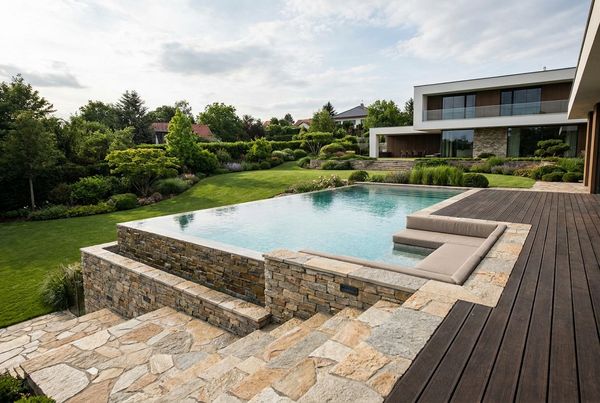
- Full-surround deck. The pool sits in a sea of decking with only the water visible — indistinguishable from inground in photos.
Materials follow the same playbook as any pool deck: pressure-treated pine is the budget default, cedar and composite look and wear better, and composite skips the annual sealing. Whatever you choose, build the deck freestanding on its own footings rather than bolting it to the pool — the pool needs to settle and flex on its own. For material trade-offs, heat, and cost, our full pool deck ideas guide applies directly here.
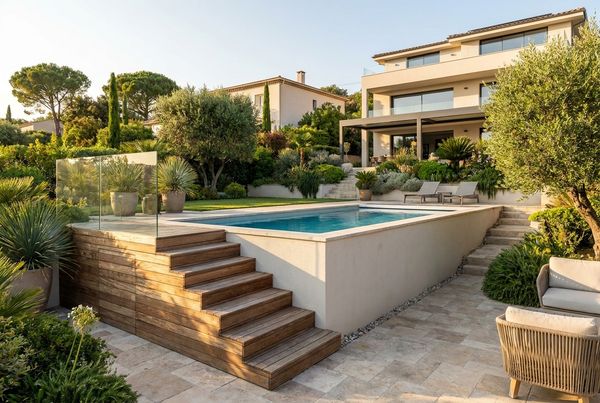
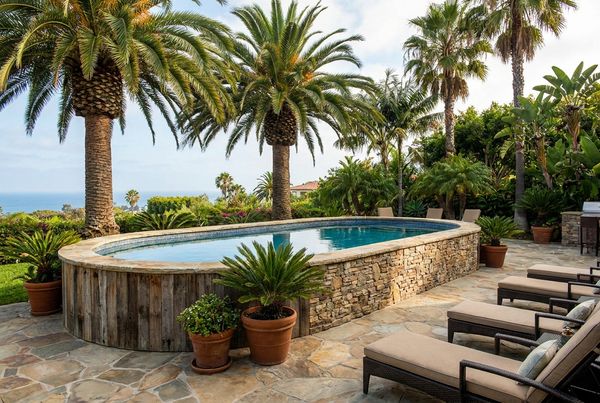
Not ready for a full deck? A stone or paver skirt, a low planter box built around the base, or even lattice panels can hide the wall for far less. The goal is the same: replace the bare metal cylinder with something that has texture and intent.
Landscaping to hide the wall
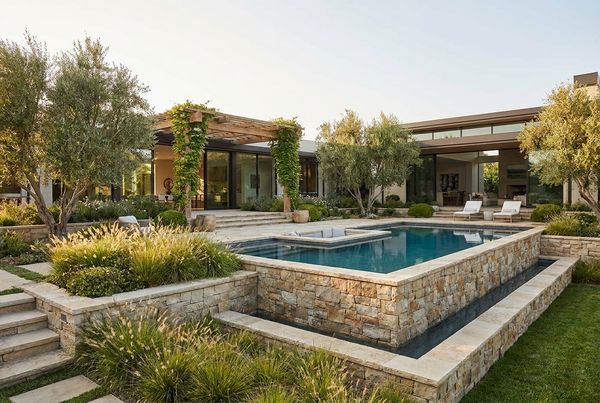
Planting is the most budget-friendly way to soften an above-ground pool, and it does something a deck can't: it makes the pool feel like it grew out of the garden. The trick is layering by height. Tall ornamental grasses and upright shrubs break up the flat wall, mid-height perennials fill the middle, and low ground cover finishes the base so you never see bare dirt or an exposed footing.
Favor plants that read lush but don't drop a mess into the water — avoid heavy fruit, cottonwood, and anything that sheds constantly. Ornamental grasses (miscanthus, feather reed grass), dwarf shrubs, and hardy perennials are workhorses here. Add a few boulders or a low berm on one side and the pool suddenly has a natural grade change working for it. For a full planting approach — including what thrives near splash and chlorine — see our pool landscaping ideas. If you're in a hot, arid region, the same wall-hiding logic works with agave, yucca, and gravel beds.
Privacy without a fortress
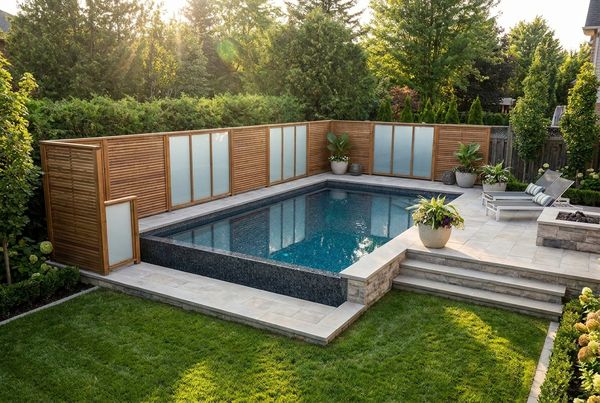
Above-ground pools raise you a few feet, which is lovely for the view out — and slightly exposing for the view in. The good news is that because you're elevated, targeted screening on one or two sides usually does the job; you rarely need to wall off the whole yard.
Slatted wood or metal privacy screens read modern and let air through. A living screen of tall grasses, bamboo (clumping, not running), or columnar evergreens gives softer, greener cover. Even a pergola or a run of outdoor curtains can carve out a private corner beside the deck. The move is to screen the specific sightlines that matter — the neighbor's second-story window, the street side — rather than build a fortress. Our pool privacy ideas cover screens, plantings, and structures in depth.
The semi-inground option
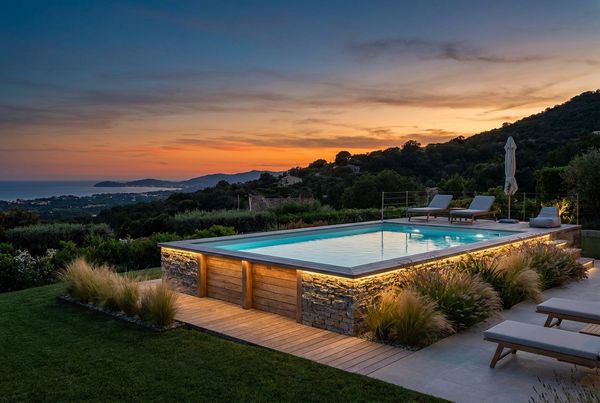
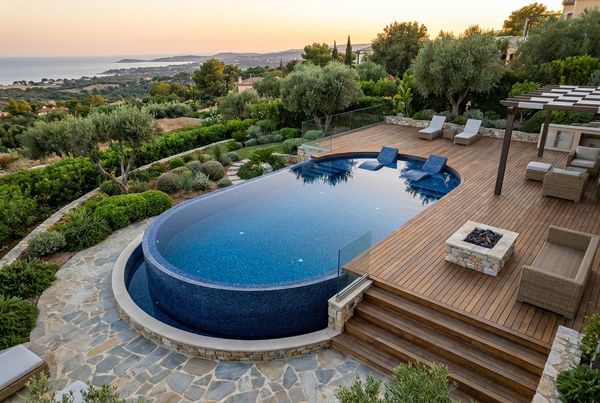
If you want the inground look but not the inground price, semi-inground is the sweet spot — and it's the fastest-growing way to install these pools. You bury the pool partway (typically 2 to 4 feet), so the exposed wall is short and easily hidden by a low deck, a retaining wall, or planting. Standing at the coping, most people can't tell it isn't a true inground pool.
Semi-inground shines on a sloped lot: set the pool so the downhill side sits at grade and the uphill side is bermed or walled, and the grade change does the hiding for you. It's the classic answer to a yard that would be expensive to fully excavate. You'll want a heavier-duty pool rated for partial burial and proper drainage around the shell, so this is worth a builder conversation. A retaining wall often does double duty here — holding the grade and framing the pool.
| Install type | Look | Best for | Relative cost |
|---|---|---|---|
| Above-ground, kit | Basic, raised wall visible | Fast, low-budget, renters | $ |
| Above-ground + deck | Custom, wall hidden | Most homeowners | $$ |
| Semi-inground | Near-inground | Sloped or graded lots | $$$ |
| Inground (for reference) | Fully built-in | Long-term, resale | $$$$+ |
Cost vs. inground: the honest math
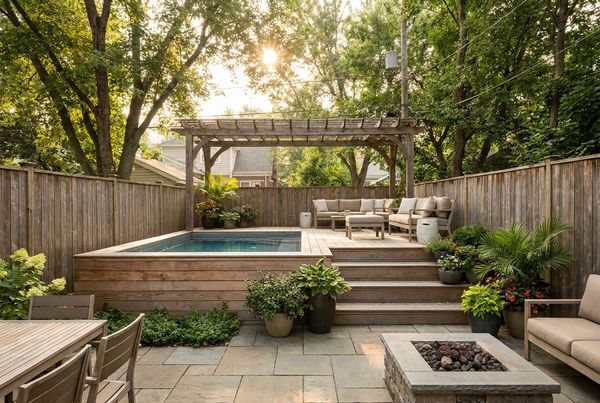
Here's the appeal in one line: an above-ground pool gets you swimming for a fraction of an inground project. A bare pool kit can start in the low thousands. Add a solid deck, landscaping, lighting, and a dark liner, and a genuinely nice finished project typically lands around $6,000 to $25,000 depending on deck size and materials. Semi-inground with a retaining wall pushes toward the top of that range.
By comparison, a typical inground pool in 2026 starts well above that once you include excavation, the shell, decking, and equipment. We break down the full picture in our inground pool cost guide — but the short version is that a decked, landscaped above-ground pool can deliver 80% of the experience for a fraction of the outlay. The trade-offs are real (liner replacement every 8 to 15 years, less resale value, size ceilings), but for many families the value math is lopsided in above-ground's favor.
Best shapes, sizes & budget wins
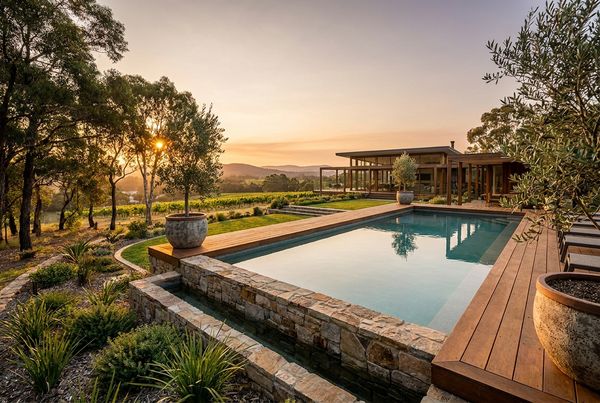
Shape is a cost-versus-looks decision. Round pools are the most affordable and structurally efficient — the water pressure works with the wall, so they need less bracing. Oval and rectangular pools look far more custom and suit lap-style swimming or bigger families, but they cost more and often need buttress supports. For most backyards, a 15 to 21 foot round or a 12x24 oval hits the sweet spot of usable water and a reasonable footprint.
Where to put your money for the biggest payoff:
- Splurge: the deck and the interior liner color. These define the whole impression.
- Worth it: landscaping at the base and a couple of lights. Cheap, huge effect.
- Skip: oversized filtration you don't need, gimmick accessories, and the flimsy stock ladder.
- Consider: a saltwater system for softer water and less chlorine handling — the same appeal as a full saltwater pool, and increasingly common on above-ground setups.
Keeping the water clean without the fuss
The thing people worry about most with any pool is the upkeep, and here the smaller size of an above-ground pool actually works in your favor. Less water means less chemical to move the numbers, faster response when something drifts, and a shorter list of gear. The one habit that makes it all easy is knowing your exact volume — dose blind and you'll either waste product or chase your tail. Run your dimensions through our pool volume calculator once, write the number on the equipment pad, and every future decision gets simpler.
From there it's the same rhythm as any pool: test, balance, circulate. I keep a decent test kit on hand and check a couple of times a week in season. When chlorine needs a bump, I size the dose with our pool chemical calculator rather than eyeballing it, and if the water ever turns hazy the fix is almost always circulation and a shock, not panic — our cloudy pool water guide walks through it. A saltwater system takes even more of the day-to-day off your plate, which is why so many above-ground owners convert.
The other quiet advantage: a robotic or good pressure cleaner handles the floor and walls while you're not looking, and the flat liner is easy for one to track. Pair that with a run-time you've actually calculated instead of guessed — our pump run-time calculator is the tool I reach for — and the pool mostly takes care of itself.
Mistakes that make an above-ground pool look cheap
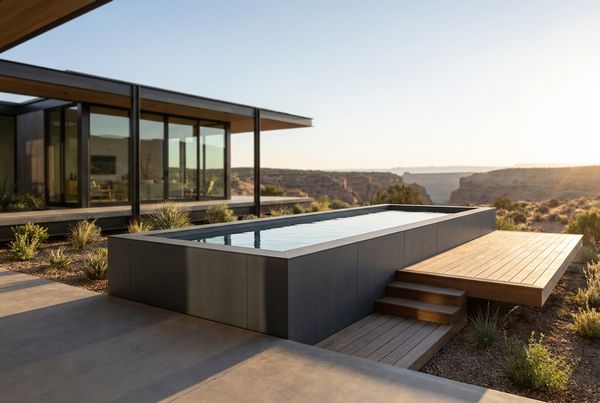
After enough of these projects, the missteps that undo an above-ground pool are predictable — and every one is avoidable. The biggest is leaving the pool as a bare cylinder on an empty lawn with a stock ladder hanging off the side. That single image is what reads as "temporary," and it's exactly what a deck, a skirt, or a band of planting is meant to erase. Don't spend on the pool and then stop before the surround; the surround is the part people actually see.
A few others I flag every time. Skipping the dark liner to save a little — a pale liner keeps the plastic-pool look no matter what you build around it, while a gray or charcoal interior instantly reads more custom. Under-planning the deck footing, so it's bolted to the pool instead of freestanding, which stresses the shell as it settles. Placing the pool without thinking about sun and sightlines, then wishing you'd rotated it. And buying more filtration and gadgetry than the water volume needs while neglecting the cheap, high-impact stuff — lighting, planting, a clean coping cap.
The fix for all of it is the same discipline I preach on every build: plan the finished picture first, spend on the visible layers, and don't cut the corners that show. Do that and no one clocks the price tag.
2026 trends & where to start
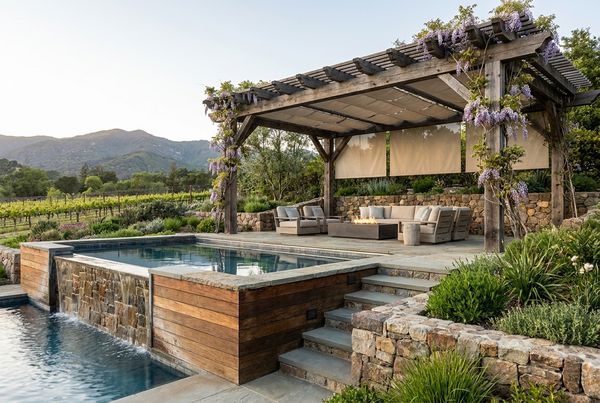
The above-ground category is following the rest of the backyard into resort-style territory. In 2026 we're seeing dark interior liners and dark exterior panels for that plunge-pool aesthetic, larger rectangular formats, integrated LED lighting, saltwater systems, and — the biggest shift — pools designed from day one to be decked, planted, and lit rather than bought as a standalone kit. The best-looking above-ground pools now get the same design attention as an inground one: a pergola for shade, a lounge for lingering, and a cohesive planting plan.
Start with the surround, not the pool. Sketch where a deck and a lounge area go, decide which sightlines need screening, and pick a liner color before you buy anything. Then build the pool into that plan. Done that way, an above-ground pool stops being a compromise and becomes exactly what most backyards actually want: water, this season, without burying the budget. When you're ready to price the deck and landscaping properly, a good local pro is worth the call — and this guide is worth bringing to the conversation.
Design Gallery
6 more ideas to save — tap any photo to view full screen.

Kelly E.
Pool Design Editor, PoolPad
Kelly has spent 10+ years around residential pools — planning projects, testing gear, and documenting backyard builds for PoolPad. Each design guide is checked against current construction methods and material pricing.
Frequently Asked Questions
How can I make my above-ground pool look expensive?
Can you put a deck around an above-ground pool?
What is a semi-inground pool?
How much does an above-ground pool cost compared to inground?
How do I hide the wall of an above-ground pool?
What is the best shape and size for an above-ground pool?
Is an above-ground pool harder to maintain than an inground one?
How long does an above-ground pool liner last?
Can I run an above-ground pool on salt water?
How do I figure out how much chlorine my above-ground pool needs?
Ready to build your dream backyard?
Compare local, vetted pool builders and get matched with pros who can bring these designs to life.
Find a Pool Builder Near You