



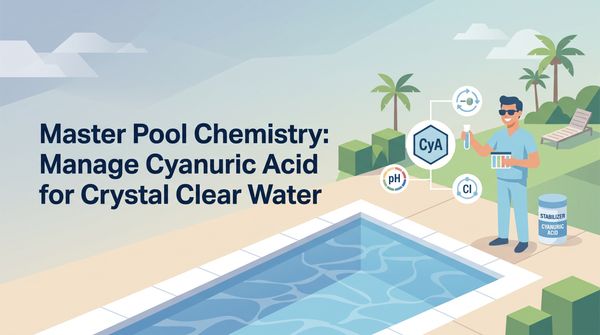
A warm afternoon, the pool glinting in the sun, and all you want to do is jump in. But behind that sparkling surface sits a careful balance of chemicals keeping the water safe. At the center is cyanuric acid (CYA), a modest compound with a big job: it stabilizes your chlorine so the sun doesn't burn it off. Useful stuff, but too much clouds the water, leaves your chlorine useless, and rolls out the welcome mat for algae.
My neighbor Tom preps carefully every season. One summer his clear pool turned murky and green even though he kept adding chlorine. The culprit was a buildup of cyanuric acid he'd never thought to test. That got me digging into what happens when CYA climbs out of control, and how to fix it without draining the whole pool.
This guide walks through your real options, from swapping out part of the water to products built to break down excess CYA.
Your Action Plan
- Test your CYA with a reliable kit so you know the real number.
- Stop adding stabilized chlorine and switch to liquid bleach or calcium hypochlorite.
- Partially drain the pool with a pump or the filter's waste setting.
- Refill with fresh water and retest until CYA sits between 30 and 50 ppm.
- If water is scarce or restricted, look into a reverse osmosis service instead of draining.
Lower Cyanuric Acid Fast
When cyanuric acid climbs too high, quick action brings your chemistry back in line. CYA shields chlorine from the sun, but too much works against you and your water gets out of whack fast.
Cut off the source, then dilute
First, stop feeding the problem. Pause your stabilized chlorine products, the tablets and granules labeled trichlor or dichlor, since those add CYA. Reach for unstabilized options instead: liquid bleach (often called liquid chlorine) or calcium hypochlorite, known as cal-hypo. Both sanitize without raising CYA.
Then drain and refill part of your pool. Pull some water out with a submersible pump or your filter's waste setting, top it back up with fresh water, and retest. Don't let the level drop so low that your pump runs dry. There are CYA reducers out there, but they rarely match the reliability and low cost of plain dilution.
Every stabilized chlorine tablet you drop in adds cyanuric acid that stays behind long after the chlorine is gone.
Stop Adding Stabilized Chlorine
I once spent weeks scratching my head over why my well-chlorinated pool kept fighting algae. The answer was sitting right in the skimmer: stabilized chlorine. Plenty of owners, me included, quietly push their CYA higher by leaning on stabilized tabs day after day.
The stabilized-chlorine trap
Every time you add stabilized chlorine, you add CYA too. Over a season that can turn a sparkling pool into a mess. I remember tossing in a few extra tablets, sure that more chlorine was the fix. What I was really doing was feeding the CYA. My sanitizer lost its punch, the water went cloudy, and the algae dug in.
To break the loop, switch to liquid bleach or cal-hypo, which don't raise CYA. That one change lets the water rebalance. If you've got an outdoor pool in a dry area with little rain, this step matters even more.
Dilute Pool Water Effectively
Dilution is a simple, powerful fix when CYA spikes. It takes some planning and elbow grease, but the reward is clear water and balanced chemistry.
Dilution, step by step
Start by checking where your pool stands with a good test kit, because knowing the number is half the battle. With a submersible pump or a garden hose, slowly lower the water level. Remove just enough to make room for fresh water without running the pump dry. A few inches usually does it. Refill and retest, then repeat until CYA settles between 30 and 50 ppm.
Sticking with dilution beats the steep cost of chemical reducers, which don't suit every pool anyway. Keep an eye on the weather, too. A good rainstorm can dilute stubborn CYA on its own, though it may nudge your other levels around.
Partially draining and refilling is the cheapest, most reliable way to bring high CYA back down.
Consider Reverse-Osmosis Solutions
When cyanuric acid stays stubbornly high, a reverse osmosis (RO) system might be your best bet. Pool water gets pushed through a semi-permeable membrane, which strips out contaminants, excess CYA included.
When reverse osmosis earns its cost
Think of it as a high-end filter that goes further than the usual methods. It handles not just CYA but calcium hardness and total dissolved solids too. Owners in areas with water restrictions often find it handy, since it keeps the water balanced without repeated draining.
It does come at a cost. RO systems aren't cheap, and they produce roughly two gallons of wastewater for every gallon they clean. Even so, that's far less water than dumping a full 10,000-gallon pool and starting over, which is why it counts as the water-saving choice. If you live somewhere short on water or where local rules make frequent changes impractical, RO can be a long-term ally.
Every summer, balancing pool chemistry becomes the main event, and your chlorine and CYA have to work in step. The trouble starts when you keep reaching for stabilized tabs. Dichlor and trichlor guard chlorine against ultraviolet rays, but they quietly push CYA up with every dose.
As chlorine burns off, cyanuric acid stays behind and slowly climbs past the ideal 30 to 50 ppm. It's not an instant disaster, but it hamstrings your chlorine's ability to keep the water clean. I've been there, cheerfully dropping in tabs, only to face cloudy water and stubborn algae later. The fix is the same simple swap: stop the stabilized chlorine and switch to liquid bleach or cal-hypo.
Identify Stabilized Chlorine Sources
Tracking down where your CYA comes from is a bit like spotting the culprits in a mystery. The usual suspects are trichlor and dichlor, which smuggle cyanuric acid into your water while they guard against UV rays. One harmless-looking chlorine tablet can bump CYA up by about 6 ppm in a 10,000-gallon pool.
Scatter a handful of granules in thinking you're keeping things balanced, and the stabilizer stays put as the chlorine burns off. That slow creep becomes a quiet problem, especially in pools left out year-round where evaporation leaves CYA behind. Switching to unstabilized chlorine keeps you from adding to the load. If you refill your pool every year or run an indoor setup, this is less urgent, but for everyone else it's a key step.
Dilute Water to Lower CYA
When cyanuric acid climbs high, a relaxing swim turns into a balancing act. The best fix is the old-school one: out with some old water, in with the new.
My friend Joe, who lives out in the sun-baked suburbs, dealt with this recently when his water started looking murky. A quick test showed his CYA off the charts, thanks to a steady diet of stabilized tabs. He partially drained his pool, using a submersible pump to draw out a few inches while making sure the pump always had enough water to pull from.
Once the level was down, Joe refilled with fresh water to dilute the CYA. A couple of tests later he was back in the safe zone between 30 and 50 ppm. He'd looked at CYA reducers but found them less reliable and pricier. A simple drain and refill set things right.
Consider Alternative CYA Solutions
When you're fighting high CYA, it pays to weigh every option, especially if the usual fixes are giving you trouble.
The first and easiest is changing your chlorine source. Many owners raise their CYA without realizing it by leaning on stabilized tabs. Switch to liquid bleach or cal-hypo and your chlorine keeps working without piling on more cyanuric acid.
Next is advanced filtration like reverse osmosis. It costs more, but it can be remarkably effective, especially where water use is restricted. RO purifies your pool water, pulling out CYA along with other dissolved solids, and it tackles calcium hardness too.
Finally, if a tech upgrade doesn't appeal, a CYA reducer lowers high levels chemically without the manual work of a drain. Just balance your pH and alkalinity first, because reducers don't work well when the water chemistry is off.
Standing poolside, you might notice the water isn't quite sparkling. High CYA could be the reason, dulling your chlorine and clouding things up. The fix here is dilution, which skips the complications of chemical treatments.
First, grab your test kit and check where CYA stands. If the number is sky-high, don't panic. Start a partial drain with a submersible pump or the waste setting on your filter, pulling out just a few inches so the pump always has water to draw from. Refill with fresh water, then repeat until CYA lands in the 30 to 50 ppm range.
Rainwater can help, but it's unpredictable and a little acidic, so it might throw off your balance. Steady, measured dilution gives more reliable results. If restrictions or preference rule out draining, an RO system is an option, though watch the cost and the water it uses.
Identify High-CYA Sources
Look into why cyanuric acid runs high and one suspect keeps turning up: stabilized chlorine. A lot of owners don't realize their chlorine choice is the quiet cause. Trichlor and dichlor are convenient for shielding chlorine from UV rays, but they raise CYA a little with every use. It's like a slow drip filling a bucket that eventually overflows.
Switching to unstabilized chlorine makes a real difference. Cal-hypo, lithium hypochlorite, or plain liquid bleach all sanitize without adding cyanuric acid. When I first tried them there was a bit of a learning curve, but clearer, better-balanced water showed up quickly.
Climate plays a part
Chemicals aren't the whole story. Outdoor pools that get little rain and lose water to constant evaporation watch CYA creep up over time. Regular testing becomes essential in drier climates, so you catch spikes before they surprise you.
Stop Using Stabilized Chlorine
Stabilized chlorine gets plenty of praise for its UV protection, but it cuts both ways. It shields chlorine from the sun, yet steady use quietly pushes CYA up and upsets your balance. A friend learned this the hard way when her pool became an algae farm despite a careful chlorine routine. She didn't know the trichlor tablets she kept adding were driving up CYA and leaving her sanitizer useless.
Switching to cal-hypo or plain liquid bleach turned things around, keeping the pool clean without the hidden CYA baggage. Think of your pool as a finely tuned ecosystem where each chemical has a role. Overload CYA and you tip the scales toward cloudy water and algae. Owners in sunny, low-rain climates face the biggest risk, so pay attention to what goes into your water.
Drain and Refill Water
On a sunny afternoon your pool might look less like a clear oasis and more like a murky swamp. High CYA could be weakening your chlorine and clouding the water. Draining and refilling part of the pool is a simple, powerful way to dilute it and bring your chemistry back.
First, check your CYA with reliable test strips or a liquid kit. If the reading is off the chart, a trip to your local pool store for a professional test might be worth it. Once you know the number, start the partial drain with a submersible pump, a hose siphon, or your filter's waste setting. Remove only a few inches at a time and keep enough water in the pool that the pump never runs dry. Add fresh water and repeat until CYA settles in the 30 to 50 ppm range.
Test and Balance Pool Chemistry
Balancing pool chemistry can feel like a dance, all timing and rhythm, especially when CYA climbs above the ideal. A longtime pool enthusiast down the street once told me over coffee how he learned the fine balance needed to keep his backyard pool from turning into a murky mess.
Reading your numbers right
To read your CYA accurately, use a reliable test kit or strips. These show not just CYA but how free chlorine, pH, and alkalinity work together. When CYA runs high, your chlorine weakens and algae move in. My neighbor keeps his free chlorine around 7.5% of his CYA level, and that ratio makes all the difference in holding the green stuff back.
Testing is only the start. Getting the water balanced heads off long-term problems like false alkalinity readings or low pH, which can damage your pool's surfaces. Testing and adjusting again and again isn't just upkeep, it's what keeps every swim safe and pleasant.
Keep your free chlorine near 7.5% of your CYA reading and your water can actually stay sanitized.
Manage Cyanuric Acid Levels
Keeping an eye on CYA is a careful dance with the sun. It shields chlorine from UV rays, but too much lulls the chlorine into a nap and leaves your pool open to bacteria and algae.
Once CYA drifts past the ideal 30 to 50 ppm, it needs correcting. The simplest way is dilution: partially draining and refilling. When my own backyard pool ran into this, a few Saturdays with a garden hose and some patience brought back the sparkle. The trick is not to drain too much at once, so the pump always has enough water to pull from while it takes in fresh.
In water-restricted areas, reverse osmosis is a modern option. It's pricey and uses a lot of water, but it strips out excess CYA and other unwanted minerals. For most owners, though, plain dilution gets the job done, as long as you stop using stabilized chlorine while you work on it.
Avoid Stabilized-Chlorine Products
Spend time around pool maintenance and you'll find plenty of owners pushing their CYA higher without meaning to, thanks to stabilized-chlorine products. Those innocent-looking tabs and granules sanitize while sneaking more CYA into your water. The sun chews through unstabilized chlorine fast, so stabilized versions come with a built-in shield of cyanuric acid to make chlorine last. Used too often, that shield backfires.
Toss a single pound of trichlor into a 10,000-gallon pool and it seems harmless, yet it raises CYA by 6 ppm. It's like adding sugar to your tea over and over until it goes from sweet to undrinkable. The acid sticks around even as water evaporates. Dropping stabilized chlorine for cal-hypo or liquid bleach is the essential first step toward rebalancing.
Implement Water Dilution Techniques
Dilution to bring down high CYA is simple, and it works like giving your pool a refresh. When my neighbor first hit high CYA, he was surprised it only took some draining and fresh water.
Start by checking your current CYA with a reliable kit. With that number, work out how much water to replace. Draining 20 to 30% of the pool usually makes a real difference. Use a submersible pump or your pool's waste setting to siphon off the right amount, but keep enough water in the pool that the pump doesn't run dry.
After the partial drain, refill with clean water and test again. You may need to repeat the cycle a couple of times to reach the sweet spot between 30 and 50 ppm. Over time, this drain-and-refill routine keeps your chlorine free to do its job.
Reverse osmosis systems offer a refined way to handle a CYA overload. Unlike the usual drain-and-refill, RO cleans your pool water with precision. One summer my neighbor got fed up with high CYA and invested in a system, and the results impressed me. His cyanuric acid dropped and the water clarity jumped.
These systems run pool water through a semi-permeable membrane, filtering out cyanuric acid, calcium hardness, and total dissolved solids. That's especially useful in areas facing shortages or strict conservation rules. RO can cost thousands to install, and you get about two gallons of wastewater for every gallon purified. Even so, it wastes far less water than repeated full drains, and many owners feel the convenience and results are worth it.
Identify High-CYA Causes
If your CYA has shot up, it helps to trace it back to the source. The most common offender is stabilized chlorine, popular because it disinfects and shields chlorine from UV at the same time. The catch is that it slowly raises CYA. As chlorine gets used up, the acid stays behind and builds to levels that can hobble your sanitizer.
Put plainly, every trichlor tablet both disinfects and leaves CYA behind. That residue sneaks up on you if you're not diluting regularly. Cal-hypo and liquid bleach won't add to the buildup.
It's not just the chlorine type, either. Pools that see little rain or rarely get drained face a higher risk. Indoor pools and ones with annual water changes usually dodge the issue. For year-round outdoor pools, regular testing and a switch to unstabilized chlorine keep CYA in check.
Implement Water-Dilution Methods
Dealing with high CYA often calls for a hands-on approach, especially if you want crystal-clear water. Dilution, the tried-and-true drain-and-refill, can save the day when you've got a pool party planned and your chemistry is off.
Start by checking your current CYA with test strips or a liquid kit. An accurate reading tells you how much water to replace, and if the number is alarming, a professional test at your local pool store is a smart move.
Next, begin the partial drain with a submersible pump or the waste setting on your filter, drawing off just enough that your skimmer and pump don't suck air. Refill with fresh water and keep testing until CYA lands in the 30 to 50 ppm range. It may take several rounds, but this method is kinder to the environment and cheaper than a full drain or pricey reducers.
Conclusion
Beating high CYA isn't complicated once you know the moves: stop feeding it with stabilized chlorine, dilute with fresh water, and keep testing until you land in that 30 to 50 ppm range. Stick with it and your pool rewards you with clear, swimmable water all season.
Want to get comfortable with the rest of pool care too? Our free Pool School course walks you through everything, from basic upkeep to tricky troubleshooting. You'll learn how to:
- Save thousands on pool repairs and chemicals
- Keep your water crystal clear year-round
- Prevent and solve common pool problems
- Master water chemistry with confidence
Join over 10,000 pool owners who have already transformed their pool care routine. Get started with our free Pool School course today!
What you need
Grab a reliable CYA test kit and a supply of unstabilized chlorine like liquid bleach or cal-hypo, then a submersible pump or hose for your partial drain.